Interview with Mayor Yoo Sung-hoon of Geumcheon District
Finding the Path to Geumcheon’s Leap Forward through Green, Balance, and People
Creation of Omi Ecological Park in Sihung Valley
District Budget Doubled in Seven Years as Mayor
Urgent Ne
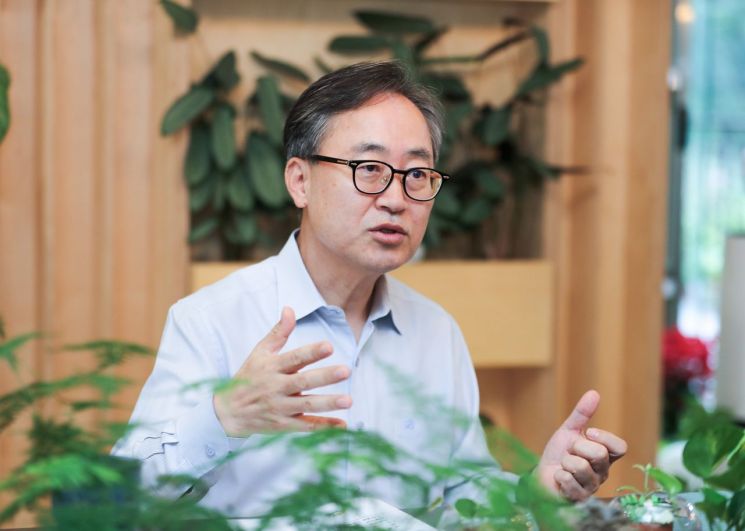 Yuseong Hoon, the mayor of Geumcheon District, said, "I will make Geumcheon District a balanced development city where people, nature, and industry harmonize." Provided by Geumcheon District.
Yoo Sung-hoon, the mayor of Geumcheon District in Seoul, says, "My goal is to revive the breath of Geumcheon, just as we have restored the waterway of Siheung Valley." Since taking office as mayor seven years ago, he has steadily pushed forward with projects such as the creation of Omi Ecological Park, collaborative development of the Air Force base site, the groundbreaking of a general hospital, and large-scale residential redevelopment projects.
The vision for the city he seeks to achieve is clear: "A balanced development city where people, nature, and industry harmonize." Above all, he prioritizes changes that residents can directly experience. Mayor Yoo stated, "Although Geumcheon was the last autonomous district to be established in Seoul, it is transforming into a self-sufficient and livable city based on well-developed industrial infrastructure, transportation, and natural environment."
To achieve these goals, funding (the budget) is essential. He said, "For local governments struggling with budget shortages, the speed of the district's growth depends on how much national and Seoul city funding can be secured." He added, "By fully utilizing administrative capabilities and personal networks, and responding systematically to public project competitions, we have nearly doubled the district's budget over the seven years of the 7th and 8th mayoral terms."
Mayor Yoo has effectively played the role of the "breadwinner" for the district. In fact, Geumcheon District's budget, which was 397.7 billion won at the launch of the 7th mayoral term in 2018, has nearly doubled to 764.9 billion won this year, marking an all-time high. Notably, the amount of national funding, which was 115.1 billion won in 2018, reached a record high of 275.3 billion won as of September this year.
Geumcheon District systematically analyzes and responds to public project competitions from various ministries, including the Ministry of Land, Infrastructure and Transport, the Ministry of Environment, and the Korea Forest Service. Each department studies the budget and public project schedules. He said, "It's not just about managing projects; it's about finding the right projects and taking action." The Hoamsanseong Historic and Cultural Trail Project (3.769 billion won) is a representative example. Of the 4.8 billion won budget for the Omi Ecological Park project, more than 1.6 billion won was covered by national funding. The district also secured 1 billion won and 630 million won in national funding for the Anyangcheon Fine Dust Blocking Forest Project and the Shinansan Line Groundwater Utilization Project, respectively.
When national funding is secured, Seoul city funding is matched. The typical structure is 70% national funding, 20% city funding, and 10% district funding. Mayor Yoo emphasized, "The competition for public project funding is fierce, but Geumcheon District has been persuasive with both the justification of being an underdeveloped area and our execution capabilities," adding, "Securing national funding directly translates into welfare for our residents."
Signing an agreement with Yoido Full Gospel Church for the free use of land and launching the "Southern Seoul Forest of Hope" project is another example of "making things happen" with limited resources. Scheduled for completion in 2028, the project will create a forested campground, forest bathing area, and barrier-free forest trails across an area the size of 34 soccer fields (about 250,000 square meters). The "Southern Seoul Forest of Hope" (tentative name) is a sustainable urban strategy led by Mayor Yoo that combines green space, culture, and tourism.
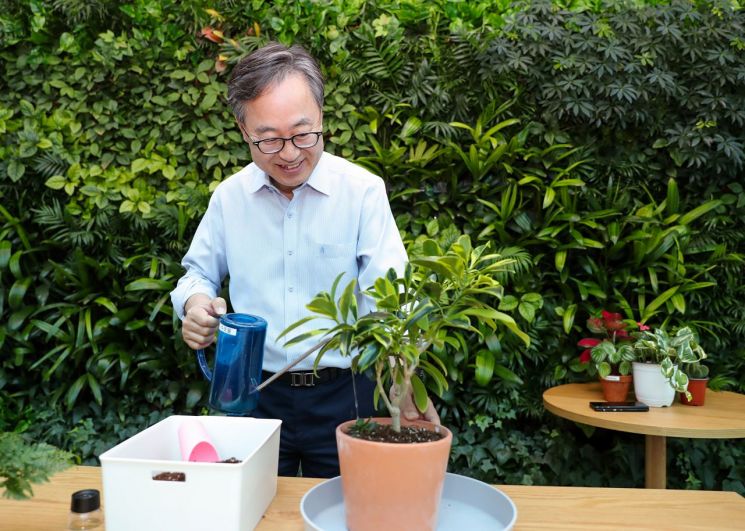 Yoo Sung-hoon, the mayor of Geumcheon District, is tending to flower pots at the Geumcheon Garden Support Center within Omi Ecological Park. Opened last year, Omi Ecological Park is a large-scale neighborhood park measuring 2.7 times the size of a soccer field and is considered a representative green infrastructure of Geumcheon District. Provided by Geumcheon District.
Air Force Base Site: Launching Win-Win Development with Compact Placement
Mayor Yoo said, "The relocation of the Air Force base is one of the most challenging issues in the region," but added, "Through compact placement and development of the remaining land, we will create the nation's first case of win-win development between the military and residents."
The site has been designated as a "Spatial Innovation Strategy Area" by the Ministry of Land, Infrastructure and Transport, allowing development without floor area ratio restrictions. Although the project has been delayed due to last year's illegal martial law incident and a change of government, a four-party consultative body involving the Ministry of National Defense, the Ministry of Land, Infrastructure and Transport, Seoul City, and Geumcheon District is currently in operation.
A large-scale residential complex, work facilities, public convenience facilities, and commercial spaces will be developed as a mixed-use complex. He stated, "The Air Force base site will serve as a forward base for new industries behind G-Valley, and we will create a K-Industry hub campus similar to the Amazon campus in Seattle, establishing a mixed-use city that combines advanced work, research and development, commerce, residential, and culture."
General Hospital Construction Likely to Begin in the First Half of Next Year
He said, "The construction of a general hospital, one of the most pressing issues in Geumcheon District, is likely to begin in the first half of next year, as the urban planning change procedures have been completed." The hospital, being promoted by Booyoung Group's Ujeong Medical Foundation with more than 500 beds, aims to be designated as a tertiary medical institution capable of ensuring golden time for emergency care. With only secondary medical emergency rooms currently available in the area, the hospital is expected to fill a significant gap in medical services.
The relaxation of floor area ratio regulations for quasi-industrial zones by Seoul City also serves as a catalyst for both hospital construction and residential complex development. Permitting for both the hospital and apartment sites is proceeding simultaneously.
Meanwhile, Mayor Yoo stated, "Due to balanced regional development policies, the national budget for all of Seoul has been drastically reduced, resulting in reverse discrimination against underdeveloped districts within the city." He also pointed out, "The large-scale renovation of southwestern Seoul by the city government remains merely declarative," urging for substantial budget allocations and the introduction of a balanced development index to strengthen support for underdeveloped areas.
Mayor Yoo said, "Making changes in everyday issues such as parking, cleaning, illegal dumping, and public safety, and implementing policies that residents can truly feel are the mark of genuinely successful policies." He added, "I will continue to faithfully fulfill my role as the 'neighborhood mayor'." On October 15, Geumcheon District will unveil the "30 Bucket List"-selected based on residents' opinions-in celebration of the 30th anniversary of the district's founding at the upcoming Residents' Day event.
*Yoo Sung-hoon, Mayor of Geumcheon District
Born in Geumcheon District, Seoul, in 1962. He began his path in the democratization movement while participating in student activism during his time at Chung-Ang University’s School of Business Administration. He worked as a Blue House administrator during the Kim Dae-jung and Roh Moo-hyun administrations, gaining extensive experience in national policy and administration. During the 18th presidential election, he served as the deputy head of general affairs for Moon Jae-in’s central election campaign. After serving as deputy spokesperson and deputy secretary-general of the Democratic Party of Korea, he was elected mayor of Geumcheon District for the 7th and 8th terms. He has led innovative resident safety initiatives, including the nation’s first AI smart safe alleyways, the enactment of a resident-participatory human rights basic ordinance, and the installation of neighborhood safety guardians.
© The Asia Business Daily(www.asiae.co.kr). All rights reserved.
![Clutching a Stolen Dior Bag, Saying "I Hate Being Poor but Real"... The Grotesque Con of a "Human Knockoff" [Slate]](https://cwcontent.asiae.co.kr/asiaresize/183/2026021902243444107_1771435474.jpg)

















