City Maximizes Convenience for Cemetery Visitors
and Minimizes Medical Service Gaps
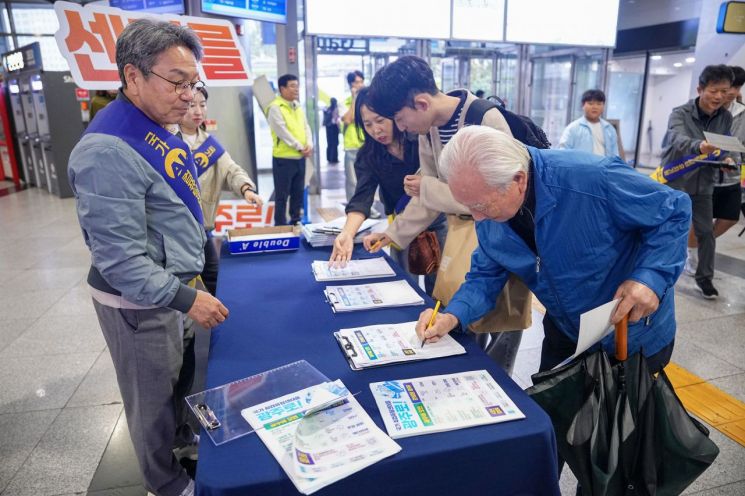 Gwangju Mayor Kang Gi-jung is campaigning to attract the National AI Computing Center while extending Chuseok holiday greetings to homebound travelers at the U-Square Intercity Bus Terminal in Seo-gu on the afternoon of the 3rd. Provided by Gwangju City
On October 10, the Gwangju City Government announced that both citizens and homebound travelers enjoyed a peaceful and safe Chuseok holiday this year without any major incidents. The city had established a "Citizen Life Stability Plan" ahead of the holiday and implemented a proactive emergency work system, focusing all efforts on ensuring public safety.
As of 12 p.m. on October 9, a total of approximately 2.34 million people arrived in Gwangju during the holiday period via Gwangju Songjeong Station, the Gwangju Comprehensive Bus Terminal, the airport, and private vehicles. Around 2.04 million people departed from Gwangju, resulting in a total population movement of about 4.38 million. This figure represents an increase of approximately 1.29 million compared to this year's Lunar New Year holiday.
In particular, the city operated an emergency work system to prepare for potential disasters. Despite seven fires, 56 traffic accidents, and 1,170 rescue and emergency dispatches during the holiday period, most incidents were minor except for one fatal case. This outcome is attributed to the swift on-site response by the 119 emergency teams and the seamless operation of the Citizen Life Safety Countermeasures Headquarters. However, a 30-minute service delay occurred on the Jisan Amusement Park monorail due to insufficient vehicle charging, causing inconvenience to some citizens.
At the municipal cemeteries (Mangwol Cemetery and Yeongnak Park), which received around 290,000 visitors, the influx of people was concentrated from the 5th to the 7th. Nevertheless, the city smoothly managed operations by adjusting and increasing city bus routes and deploying over 100 personnel, preventing major congestion. On the last day of the holiday, to coincide with the opening of the summit of Mudeungsan Mountain, the city increased the number of No. 1187 city bus trips by 29 and strengthened illegal parking controls in congested areas, greatly improving transportation convenience for citizens.
The city also focused on minimizing medical service gaps. Twenty-one emergency medical institutions and five emergency medical facilities maintained 24-hour service, while 1,656 "open medical institutions" and 1,056 "open pharmacies" operated throughout the holiday. Notably, the expansion of four public night and Dalbit Children's Hospitals compared to the Lunar New Year holiday provided significant reassurance to children and parents.
Meanwhile, Gwangju City also carried out efforts for regional development by conducting a "National AI Computing Center Attraction Campaign" for homebound travelers at major locations such as the Gwangju Comprehensive Bus Terminal, Gwangju Songjeong Station, and Mudeungsan Mountain during the Chuseok holiday.
© The Asia Business Daily(www.asiae.co.kr). All rights reserved.
![Clutching a Stolen Dior Bag, Saying "I Hate Being Poor but Real"... The Grotesque Con of a "Human Knockoff" [Slate]](https://cwcontent.asiae.co.kr/asiaresize/183/2026021902243444107_1771435474.jpg)















