Depicted in Actual Size: Camels, Bison, and More
Visible Only at a Specific Angle of Sunlight at Dawn
Can Be Identified with the Naked Eye for About 90 Minutes
Petroglyphs depicting mammals such as camels and gazelles in actual size have been discovered on rocks in the northern desert of Saudi Arabia, drawing significant attention from the academic community. On October 1, Yonhap News, citing AP and other foreign media, reported that a large number of petroglyphs depicting mammals such as camels, gazelles, and donkeys were found on sandstone cliffs in the Nafud Desert in the northern Saut region of Saudi Arabia. The discovery site is a high cliff, and the animals are depicted in actual size, about 1.8 meters in length, on flat rock surfaces. In addition, sharp, awl-shaped stone tools believed to have been used in the creation of the petroglyphs were unearthed in the area below.
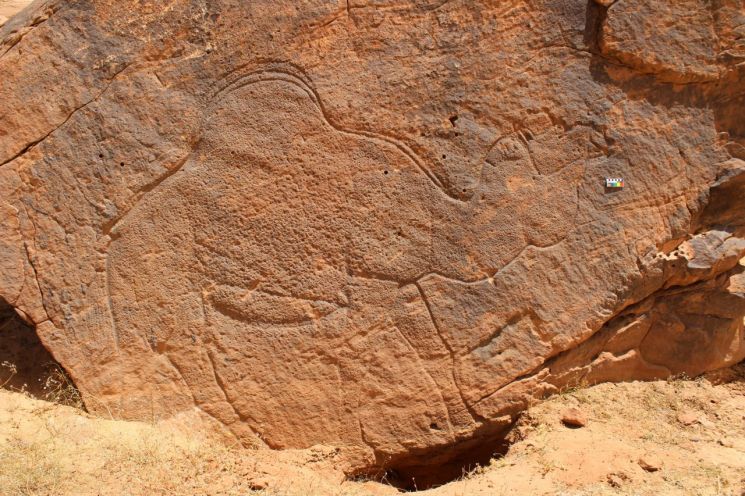 Petroglyphs depicting mammals such as camels and gazelles in actual size have been discovered on rocks in the northern desert of Saudi Arabia. Photo by AP Yonhap News
In particular, the research team dated artifacts such as ostrich eggs, oyster shells, and charcoal from hearths using radiocarbon isotopes, and analyzed the elapsed time since the sediment layers surrounding the buried artifacts were last exposed to sunlight. As a result, the artifacts were dated to between approximately 12,800 and 11,400 years ago. This overturns the previous hypothesis that the desert petroglyphs were created by human groups occupying the region about 7,000 years ago.
The New York Times described this discovery as "the oldest large-scale depictions of wild animals not only in the Middle East but also in the world." Dr. Maria Guagnin, a paleoanthropologist at the Max Planck Institute for Geoanthropology in Germany who led the excavation, explained, "These are very delicately drawn petroglyphs," and added, "It appears that the people who created these drawings possessed considerable skill." Another remarkable aspect is that these petroglyphs are visible only during a specific time period. They can be visually identified with the naked eye for about 90 minutes at a particular angle of light when the morning sun rises. Regarding this, Dr. Guagnin said, "We were very lucky at the time of discovery."
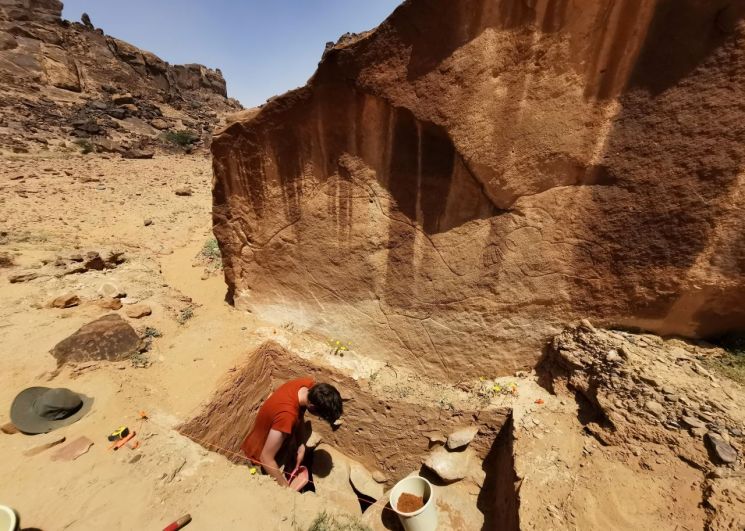 The most remarkable aspect of this discovery is that these petroglyphs are visible only during a specific time period. They can be identified with the naked eye for about 90 minutes at a particular angle of light when the morning sun rises. Photo by AP Yonhap News
Among the animals depicted in the drawings was an aurochs. The aurochs, the ancestor of domesticated cattle and bison, became extinct around the 17th century. It was an animal that found it difficult to survive in the arid desert environment. Therefore, scholars believe that humans living in this region may have migrated to other areas during the dry season, saw the aurochs, and later drew them from memory.
Furthermore, the research team believes that waterholes or temporary freshwater sources that appeared seasonally about 12,000 years ago influenced human settlement in the desert after the Ice Age. The discovery of the petroglyphs and stone tools shows that humans inhabited this region 2,000 years earlier than previously thought, according to AP.
© The Asia Business Daily(www.asiae.co.kr). All rights reserved.
![Clutching a Stolen Dior Bag, Saying "I Hate Being Poor but Real"... The Grotesque Con of a "Human Knockoff" [Slate]](https://cwcontent.asiae.co.kr/asiaresize/183/2026021902243444107_1771435474.jpg)

















