NEXT Proposes Transfer System and Additional Tax Credit Conditions
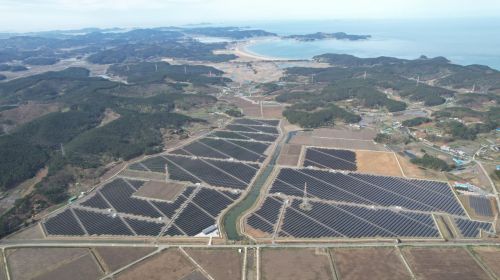 Overview of the 'Taean Haetdeulwon Solar Power Plant' completed in Taean County, Chungnam. GS Engineering & Construction
An analysis has found that if tax benefits related to renewable energy generation projects are restructured, the unit cost of solar power generation could be reduced by up to 23%, and that of onshore wind power by up to 25%.
On September 26, the climate and energy think tank NEXT released an issue paper titled "Quantitative Analysis of Enhancing the Effectiveness of Renewable Energy Tax Benefits through Transfer."
Currently, renewable energy generation facilities are eligible for tax credits under the Restriction of Special Taxation Act, but there have been criticisms regarding the lack of effectiveness.
The current system applies a low credit rate (1-10%, depending on company size) to investments in renewable energy generation facilities, which can deliver immediate greenhouse gas reduction effects, treating them the same as general equipment investments. However, renewable energy generation projects are unable to fully utilize even these limited tax benefits due to the unique characteristics of the business.
Renewable energy generation projects require significant upfront investment, while revenues are typically dependent on relatively small but stable income sources such as 20-year power purchase agreements (PPAs), system marginal price (SMP), or renewable energy certificates (RECs), making it difficult to recover the initial investment quickly.
Because there is insufficient taxable income in the early stages of the project, the minimum tax is applied, which restricts the available tax benefits. Since early-stage profits are insufficient, even the limited tax credits cannot be fully absorbed. Although the current law allows tax credits to be carried forward for up to 10 years, it remains difficult for renewable energy projects to fully utilize these benefits even with the carryforward.
For this reason, although a bill has been proposed to increase the tax credit rate for investments in renewable energy generation facilities, the effect is still limited due to insufficient taxable income, even if the credit rate is raised.
In response, NEXT proposed additional measures to enhance the effectiveness of tax credits, including the introduction of a transfer system and the establishment of additional credit conditions.
The transfer system would allow renewable energy generation businesses to transfer their tax benefits to RE100 companies that have signed a direct PPA with them. In this way, RE100 companies could indirectly receive tax credits for their renewable energy purchases, while the generation business could receive cash equivalent to the value of the transferred tax benefit from the RE100 company.
According to NEXT's quantitative analysis of the transfer effect, for solar power (based on 3MW), simply allowing transfers without increasing the credit rate could reduce the levelized cost of electricity (LCOE) by 13.2 KRW/kWh. If the credit rate is raised to 25%, the LCOE would decrease by an additional 23.5 KRW/kWh (17.8%) compared to the current level. The investment payback period would also be shortened by six months to one and a half years.
For onshore wind power (based on 20MW), introducing the transfer system alone would reduce the LCOE by 19.1 KRW/kWh, and applying a 25% credit rate would further lower it by 36.3 KRW/kWh (18.8%). The investment payback period would also be shortened by 0.7 to 2.1 years.
NEXT also proposed providing additional tax credits for projects that use domestically produced equipment or are structured as community-participation renewable energy projects. If the credit rate is raised and both the transfer system and additional credits are introduced, the LCOE for solar power could be reduced by up to 23% (30 KRW/kWh), and for onshore wind power by up to 25% (48 KRW/kWh).
The investment payback period could be shortened by up to two to three years compared to the current situation, allowing solar power projects to recover investments in 5.3 years and onshore wind projects in 7.5 years.
A NEXT official explained, "If these measures are implemented, generation businesses can reduce their initial investment burden through PPA transactions and transfer gains, while RE100 companies can more easily procure renewable energy and reduce their corporate tax burden."
© The Asia Business Daily(www.asiae.co.kr). All rights reserved.
![Clutching a Stolen Dior Bag, Saying "I Hate Being Poor but Real"... The Grotesque Con of a "Human Knockoff" [Slate]](https://cwcontent.asiae.co.kr/asiaresize/183/2026021902243444107_1771435474.jpg)















