Q2 U.S. GDP Growth at 3.8% Backs Strong Dollar
Trump Pressures Korea with "350 Billion Dollar Up Front" Investment Demand
Exchange Rate Breaks 1,400 Won Psychological Barrier, Further Gains Expected
The won-dollar exchange rate surpassed the 1,410 won mark during trading for the first time in four months. This was driven by the strengthening of the US dollar, supported by robust US economic indicators that reinforced a cautious stance on policy rate cuts, as well as heightened anxiety in the market regarding the government's investments in the United States. Market participants predicted that, as the won-dollar exchange rate broke through key psychological resistance levels, it would likely attempt further increases, such as surpassing the 1,420 won threshold in the near term.
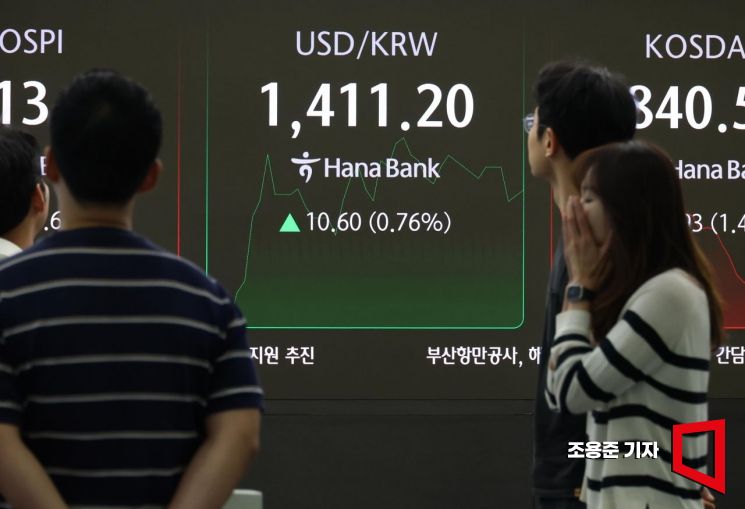 On the 26th, the won-dollar exchange rate and other information are displayed on the monitor in the dealing room of Hana Bank in Jung-gu, Seoul.
In the Seoul foreign exchange market, as of 9:22 a.m. on September 26, the won-dollar exchange rate stood at 1,411.2 won, up 10.6 won from the previous day's weekly closing price at 3:30 p.m.
The won-dollar exchange rate closed the previous day's weekly session at 1,400.6 won, surpassing the psychological resistance level of 1,400 won for the first time in over two months since August 1 (1,401.4 won). In overnight trading on the same day, it surged to as high as 1,411.0 won. On September 26, the rate opened at 1,409.0 won, up 8.4 won from the previous weekly closing price. This is the first time since May 15 (when the intraday high was 1,412.1 won) that the rate broke through the 1,410 won level during weekly trading.
The sharp rise in the exchange rate on this day was largely influenced by the strong dollar overnight. Robust US economic indicators weakened arguments for an urgent rate cut by the US Federal Reserve, thereby supporting the strong dollar. According to the US Department of Commerce, the final seasonally adjusted figure for the US gross domestic product (GDP) growth rate in the second quarter of this year increased by an annualized 3.8% compared to the previous quarter. This represents a significant rebound from the previous quarter's -0.6%. It is also 0.5 percentage points higher than both the market forecast and the preliminary estimate of 3.3% growth. This is the highest growth rate in seven quarters, since the third quarter of 2023 (4.7%). Weekly US employment data also contributed to the dollar's strength. According to the US Department of Labor, the number of new unemployment insurance claims for the week ending September 20 was 218,000 on a seasonally adjusted basis, lower than the market forecast of 235,000. As a result, the Dollar Index (DXY), which measures the value of the US dollar against six major currencies, rose 0.70% from the previous day to 98.485, continuing its upward trend.
Disputes surrounding the Korea-US tariff negotiations are also putting pressure on the foreign exchange market. In the trade agreement reached on July 30, the United States agreed to lower reciprocal tariffs and automobile tariffs imposed on Korea from 25% to 15%, while Korea agreed to implement investments in the United States totaling 350 billion dollars. However, the two sides have failed to narrow their differences regarding the composition and implementation of the US investment package, remaining at an impasse. In this context, overnight, US President Donald Trump reaffirmed that, under the Korea-US trade agreement, Korea would invest 350 billion dollars (about 490 trillion won) in the United States, stating, "That is up front," which further heightened market concerns.
Wi Jaehyun, an economist at NH Futures, said, "In addition to the uncertainty surrounding investments in the United States, which drove the rise in the exchange rate last week, this week we are also seeing a strong dollar due to solid US fundamentals, further increasing upward pressure on the exchange rate. In this situation, there are also reports from foreign media that the US side is considering slightly increasing the 350 billion dollar investment amount or providing the investment in cash rather than as loans, which has further heightened concerns." He added, "With uncertainty mounting, unless there is intervention by the authorities, upward pressure on the exchange rate is likely to prevail."
Min Kyungwon, an economist at Woori Bank, also stated, "With the increased pressure from a strong dollar at the end of the quarter, the market will test whether the rate can break above 1,420 won." He added, "Solid US economic indicators have completely dispelled arguments for an urgent rate cut by the Federal Reserve and concerns about undermining growth momentum, leading to increased upward pressure on the dollar." There is also analysis that heightened awareness of further exchange rate increases may prompt companies to secure dollars in advance for payments and lead to an increase in foreign currency deposits for speculative purposes by individuals, thereby increasing downward pressure on the won.
© The Asia Business Daily(www.asiae.co.kr). All rights reserved.
![Clutching a Stolen Dior Bag, Saying "I Hate Being Poor but Real"... The Grotesque Con of a "Human Knockoff" [Slate]](https://cwcontent.asiae.co.kr/asiaresize/183/2026021902243444107_1771435474.jpg)















