Aiming for Actual Inclusion in the MSCI Developed Markets Index by 2026
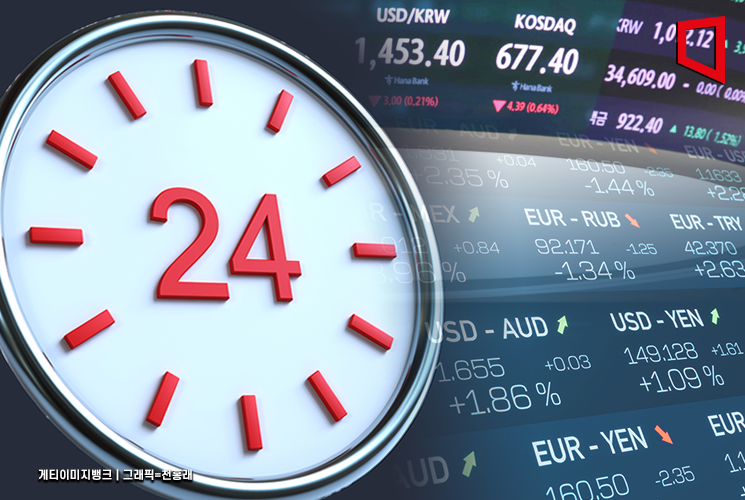
The government is pushing to extend the domestic foreign exchange market's operating hours to 24 hours by the first half of next year, aiming for South Korea's inclusion in the Morgan Stanley Capital International (MSCI) Developed Markets Index. This move follows last July's extension of trading hours to 2 a.m. and marks a shift toward a full 24-hour trading system. The plan is to have South Korea designated as a watchlist country-a candidate for inclusion in the MSCI Developed Markets Index-in June next year, and to achieve actual inclusion the following year.
On the 26th, the Ministry of Economy and Finance announced that it would expand the domestic foreign exchange market to a "24-hour operating system." The government made this announcement during the "Korea Economic IR Investment Summit," which took place after President Lee Jaemyung rang the opening bell at the New York Stock Exchange (NYSE) earlier in the day. The target for transitioning to a 24-hour system is the first half of next year, before MSCI's country classification in June.
The Ministry of Economy and Finance stated, "We will transition to a 24-hour trading system and introduce an offshore Korean won settlement network." The aim is to reduce trading gaps for overseas investors and to absorb Korean won transactions that have been flowing into the offshore Non-Deliverable Forward (NDF) market back into the domestic market.
Currently, the foreign exchange market only recognizes the onshore spot market for the won-dollar pair. Trading hours are limited to 9 a.m. to 2 a.m. the next day. Transactions are only possible through two government-approved brokers, and participation is restricted to financial institutions designated by the domestic financial authorities.
A system will also be established to allow foreigners to settle Korean won transactions offshore. A so-called "offshore Korean won settlement institution" system will be introduced, enabling foreign financial institutions to open Korean won accounts domestically and manage won directly. The Ministry of Economy and Finance explained, "This will make it possible for foreigners to freely transact, hold (deposit), and procure Korean won." The Bank of Korea will also establish a new 24-hour won settlement network, allowing foreign financial institutions to settle won transactions with each other even during nighttime hours.
This push to open up the foreign exchange market aligns with the current administration's policy of addressing the undervaluation of the Korean stock market and redirecting capital flows into more productive sectors such as the capital market. In the past, the government effectively banned won transactions between foreigners and prevented the formation of an offshore foreign exchange market due to trauma from past currency crises. However, the absence of an offshore won market and low market accessibility have been consistently pointed out in discussions about MSCI inclusion.
Since its initial inclusion in January 1992, South Korea has remained in the MSCI Emerging Markets Index. In 2008, South Korea was added to the watchlist as a candidate for the MSCI Developed Markets Index, raising expectations for an upgrade. However, after being removed from the watchlist in 2014, the country has remained in the emerging markets category for 11 consecutive years.
MSCI classifies major global stock markets every June into developed, emerging, frontier, and standalone markets. These classifications are used by global institutional investors to determine investment capital allocations, influencing national capital flows. The market expects that if South Korea is included in the MSCI Developed Markets Index, it could see capital inflows of about 30 billion dollars (approximately 42 trillion won).
In response, the government, the Bank of Korea, and major financial institutions plan to establish a task force for MSCI Developed Markets Index inclusion and announce a comprehensive roadmap within the year. The roadmap will include forward-looking reforms across foreign exchange transactions, investment systems, and market infrastructure to meet the requirements for MSCI Developed Markets Index inclusion. The government aims to be placed on the watchlist in June next year, achieve a decision on index inclusion in 2027, and secure actual inclusion in 2028.
© The Asia Business Daily(www.asiae.co.kr). All rights reserved.
![Clutching a Stolen Dior Bag, Saying "I Hate Being Poor but Real"... The Grotesque Con of a "Human Knockoff" [Slate]](https://cwcontent.asiae.co.kr/asiaresize/183/2026021902243444107_1771435474.jpg)
















