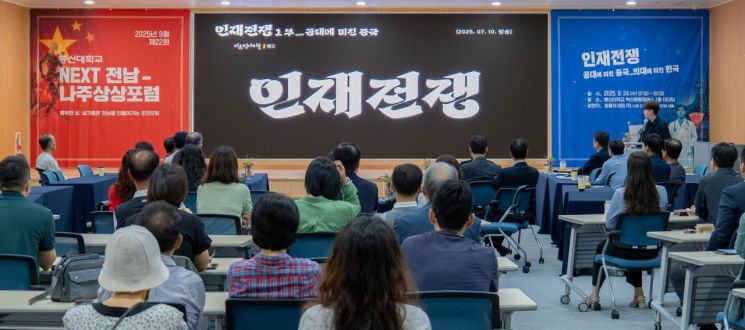
Dongshin University announced on September 26 that it recently hosted the 22nd NEXT Jeonnam-Naju Imagination Forum, inviting producer Jung Yongjae, who directed the KBS documentary "Docu Insight: The Talent War."
The forum, held on September 24 in the main auditorium on the second floor of Dongshin University's Innovation Convergence Campus, was attended by approximately 120 people, including Dongshin University faculty and staff, members of the Naju City Council, public institution and corporate representatives from the Innovation City, teachers, and Naju citizens.
In his special lecture titled "The Talent War: China Obsessed with Engineering, Korea Obsessed with Medical School," producer Jung compared the results arising from the sharply contrasting social preferences for medical and engineering schools in Korea and China, two countries known for their intense educational fervor.
Producer Jung explained that "DeepSeek," a Chinese AI developed at one-tenth the cost of ChatGPT and which made a significant impact recently, was not a product of chance. He pointed out that it resulted from systematic science and technology development policies by the Chinese government, strong social respect for scientists and engineers, and a social atmosphere that naturally accepts failure. These factors have led to top talent gravitating toward engineering and a surge in youth entrepreneurship.
However, he emphasized that DeepSeek is just one of many innovative companies, and that all of the so-called "Hangzhou Six Little Dragons," including DeepSeek, are examples of successful startups founded by young engineers in their 30s who grew up in China, highlighting the importance of systematic engineering development policies.
Currently, China's humanoid robot market is expected to be the largest in the world, valued at 300 billion yuan, and according to the Nature Index, China holds as many as eight out of the world's top ten research institutions.
In China, there is a pervasive social atmosphere that "success comes from attending engineering schools," leading many students to dream of entering engineering from elementary school. In contrast, in Korea, the phrase "medical school entrance exam at age seven" has become popular, and the preference for medical schools has intensified to the point where even students admitted to science and engineering departments at SKY universities (Seoul National University, Korea University, Yonsei University) are increasingly giving up their spots.
Producer Jung traced the deepening preference for medical schools in Korean society to the risk-averse tendencies of the parental generation, who experienced an unstable job market after the IMF crisis. He stated, "China imposes no limits on its investment in science and technology, while Korea tends to invest only in safe research, with a success rate as high as 99.5%." He emphasized, "Since technological innovation is achieved in fundamental fields, research and investment should be centered on taking on challenges."
He also suggested three directions for Korea to pursue: bold investment in science and engineering, improving the efficiency of budgets through revised evaluation criteria, and early identification and intensive nurturing of talent in scientific fields.
Producer Jung said, "Before the advent of INF, Korea had the technological prowess to commercialize self-driving cars ahead of any other country in the world," adding, "We still have the power to rekindle that sense of inspiration. I will do my part through the media so that students can dream of becoming engineers and engineers can take pride in their profession."
© The Asia Business Daily(www.asiae.co.kr). All rights reserved.
![Clutching a Stolen Dior Bag, Saying "I Hate Being Poor but Real"... The Grotesque Con of a "Human Knockoff" [Slate]](https://cwcontent.asiae.co.kr/asiaresize/183/2026021902243444107_1771435474.jpg)















