Hong Kong H Index ELS crisis, TMON and WEMAKEPRICE settlement delays, Lotte Card hacking incident
A series of incidents causing widespread consumer damage in the financial sector
Four bills to introduce a class action system proposed this year alone
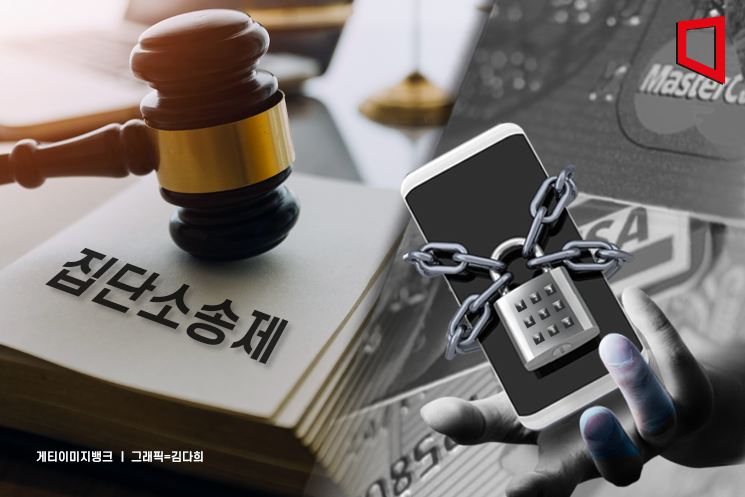
Following a series of major consumer damage incidents in the financial sector-including the Hong Kong H Index (Hang Seng China Enterprises Index, HSCEI) equity-linked securities (ELS) crisis, the Tmon and WeMakePrice settlement delays, and the Lotte Card hacking incident-lawmakers are accelerating efforts to introduce a class action system. The aim is to expand the currently limited class action system, which is only allowed in the securities sector, to the entire financial industry in order to strengthen consumer protection.
According to the National Assembly Bill Information System on September 26, Han Changmin, a member of the Social Democratic Party, proposed an amendment to the Securities-Related Class Action Act on September 23. The main point of the amendment is to change the name of the law, which was introduced in 2005, to the "Financial Consumer Class Action Act." If passed, the scope of class actions would be expanded to cover not only securities but also all lawsuits arising from financial transactions. Assemblyman Han explained, "As seen in the Hong Kong H Index ELS crisis, incomplete sales frequently occur, yet financial consumer protection remains insufficient. I proposed this bill to enable swift and fair remedies for financial consumer damages, ensure the rights of small-scale and multiple victims, and enhance the prevention of corporate misconduct."
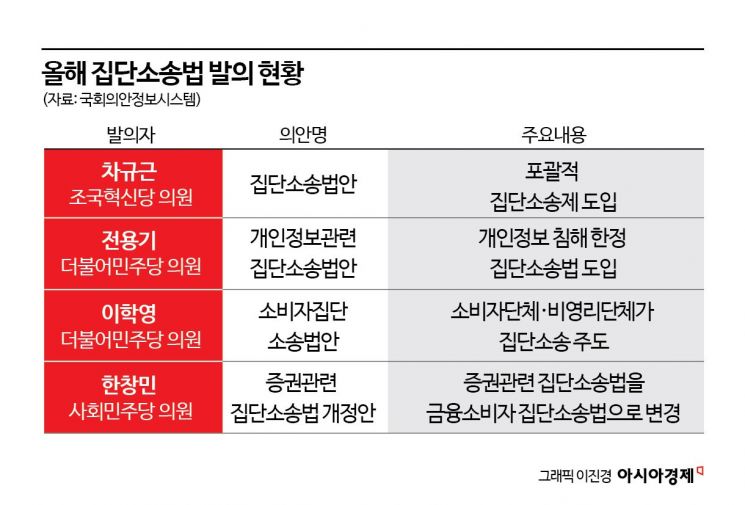
On September 19, Lee Hakyoung, Deputy Speaker of the National Assembly and member of the Democratic Party of Korea, introduced the "Consumer Class Action Act." The bill allows consumer organizations that meet the requirements under the Framework Act on Consumers, the Korea Consumer Agency, and nonprofit private organizations with sufficient financial capacity to act as plaintiffs and lead lawsuits. It also includes provisions granting these organizations the right to request information disclosure. Assemblyman Lee stated, "Despite frequent consumer damage incidents such as the 2014 credit card company data breach and last year's Tmon and WeMakePrice settlement delays, individual consumers remain silent because it is difficult to file lawsuits against large corporations. We need to enact the Consumer Class Action Act to respond to mass incidents where consumers become victims."
Last month, Jeon Yonggi, a member of the Democratic Party of Korea, sponsored the "Personal Information-Related Class Action Act." This bill allows a representative to file a claim for damages in cases where collective damage occurs due to the leakage or infringement of personal information. However, similar to the current Securities-Related Class Action Act, it requires court approval to proceed with a class action. To prevent excessive class actions from hindering corporate management, the bill limits its application to personal information infringement cases and requires a court approval process as a safeguard.
In May, Cha Kyugeun, a member of the Rebuilding Korea Party, also proposed a class action bill. At the time, Assemblyman Cha stated, "In the case of diesel vehicle emissions manipulation, sufficient compensation was provided to victims in the United States, where class actions are active, and in Germany, which introduced a class action law through special legislation. However, this was not the case in Korea. The class action system will serve as a legal foundation for innovative growth by raising the level of responsible management among corporations."
The class action system was promoted as a national policy task during the Park Geunhye administration but was scrapped due to concerns over excessive litigation. During the Moon Jaein administration, efforts to expand the class action system were included as a government initiative, but the bill was discarded after being tied to the Commercial Act amendment and facing strong opposition from the opposition party. Although the Lee Jaemyung administration did not include the introduction of the class action system as a national policy task, the recent KT unauthorized micro-payment incident and the Lotte Card hacking incident have prompted the government to review its necessity.
On September 24, the National Assembly held a forum to discuss the introduction of the "Three Consumer Rights Protection Laws," which include the class action system, punitive damages, and evidence disclosure. In her congratulatory remarks, Assemblywoman Baek Hyeryeon said, "The Lee Jaemyung administration recognizes the necessity of the Three Consumer Rights Protection Laws, including the class action system, and has held discussions with the Korean Bar Association during the process of establishing the national policy roadmap to discuss improvement measures. Protecting consumer rights is a task of our era that must be addressed, transcending political parties and ideological camps."
© The Asia Business Daily(www.asiae.co.kr). All rights reserved.
![Clutching a Stolen Dior Bag, Saying "I Hate Being Poor but Real"... The Grotesque Con of a "Human Knockoff" [Slate]](https://cwcontent.asiae.co.kr/asiaresize/183/2026021902243444107_1771435474.jpg)
















