Discussing the Value and Strategies of Domestic Platforms
Startup Alliance announced on the 25th that it held a seminar titled "AI Powerhouse, Why Is a Domestic Platform Necessary?" on the 24th at the Front1 seminar room in Mapo-gu, Seoul, in collaboration with the Digital Economy Forum.
This seminar was organized to discuss the role and value of domestic platforms in securing Korea's independent AI competitiveness.
Lee Gidae, Head of Startup Alliance Center, stated in his opening remarks, "Even in the age of AI, platforms are the point of contact between our daily lives and the outside world," emphasizing, "If we lose out on platforms, the entire ecosystem could become subordinate, so we must not lose platform competitiveness in the AI era."
The first presentation was delivered by Lee Seungyeop, a professor at Pukyong National University, on the topic "The Impact of the Online Platform Act on the Development of the AI Ecosystem." He said, "The direction of AI ecosystem development can be compared to the past ecosystems of smartphone operating systems or internet portals." He continued, "In particular, local characteristics such as the Korean language are important factors that allow domestic platform operators to compete with global platform companies. In this context, rather than focusing on regulation through the Online Platform Act, we need to strengthen AI competitiveness by maximizing our unique strengths."
Kwak Gyutae, a professor at Soonchunhyang University, gave a presentation on "The Impact of Domestic Platform Competitiveness on the Development of the AI Ecosystem." Presenting data directly collected by his research team, he noted, "Globally, only about seven countries have their own domestic platforms, and as of last year, Korea's domestic search platform market share was 43.92%, ranking fourth in the world." He also empirically confirmed, based on analyses of global databases such as those from the OECD, that "the market share of domestic platforms has a positive impact on strengthening AI technological capabilities, investment in AI startups, corporate AI utilization, and the expansion of the generative AI market size."
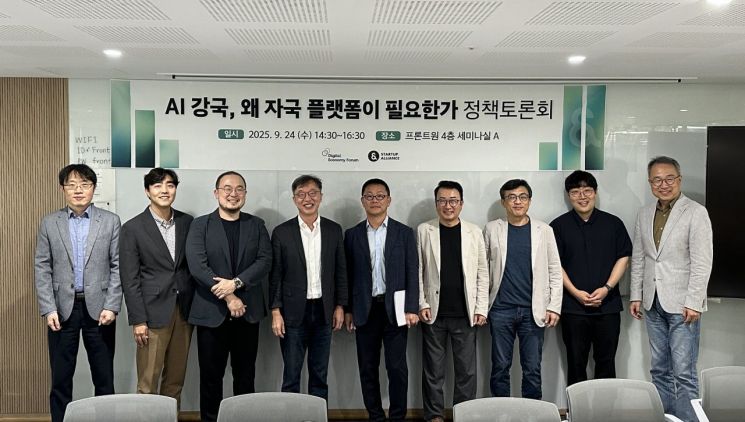 Participants at the seminar "AI Powerhouse, Why Is a Domestic Platform Necessary?" held on the 24th at the Front1 seminar room in Mapo-gu, Seoul, are taking a commemorative photo. Startup Alliance. Photo by Startup Alliance
The comprehensive discussion that followed was moderated by Lee Sangwoo, a professor at Yonsei University, with academic and industry experts engaging in an in-depth exploration of various issues.
Kim Junghwan, a professor at Korea University, stated, "In the AI era, competition is not just between companies but at the level of national ecosystems." He added, "We tend to focus on infrastructure to quickly show results, but in actual business stages, more discussion is needed in the data domain, which is most closely connected to the models."
Lee Changjun, a professor at Sungkyunkwan University, emphasized, "For AI competitiveness, the key is not simply market share, but whether an environment exists where data can flow smoothly." He suggested, "When adopting AI, as long as transparency and accountability are ensured, we should allow initial attempts and gradually establish regulatory frameworks."
Jung Yongguk, a professor at Dongguk University, commented, "Since the COVID-19 pandemic, there has been a global trend toward strengthening domestic centrism, with an increasing focus on finding competitiveness within domestic platforms." He added, "We also need to view domestic platforms as national strategic assets."
Ha Taehyun, a professor at Sejong University, stated, "The core of model development is securing high-quality, diverse data," and suggested, "We should consider making the platform itself more attractive so that it draws a wide variety of users regardless of nationality."
Choi Sungjin, CEO of Startup Growth Research Institute, remarked, "It is certainly worth challenging for Korea to enter the global top three in the AI field, but joining the top three is not an easy task." He concluded, "The key will be whether domestic platforms can grow and attract investment and talent."
© The Asia Business Daily(www.asiae.co.kr). All rights reserved.
![Clutching a Stolen Dior Bag, Saying "I Hate Being Poor but Real"... The Grotesque Con of a "Human Knockoff" [Slate]](https://cwcontent.asiae.co.kr/asiaresize/183/2026021902243444107_1771435474.jpg)















