AI Data-Based Bio Leading Technology Development Project Performance Exchange Held
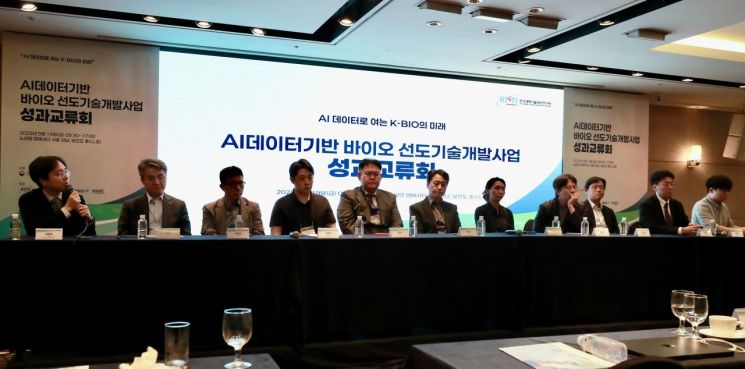 Participants are speaking at the comprehensive discussion session of the "AI Data-Based Bio Leading Technology Development Project Performance Exchange Meeting" held on the 19th. Photo by Paek Jongmin, Tech Specialist
There have been concerns raised that unless South Korea overcomes the challenges of securing accurate and extensive medical data, not only will the spread of achievements in AI-based bio research be hindered, but the subsequent second phase of the project may also be at risk.
According to the Ministry of Science and ICT on the 23rd, participants in the comprehensive discussion session of the 'AI Data-Based Bio Leading Technology Development Project Performance Exchange Meeting' held at the Novotel Ambassador Hotel in Gangnam-gu, Seoul on the 19th, highly evaluated the importance and achievements of the project so far, but emphasized that obstacles to realizing true results must be addressed.
The event was organized to share the outcomes of the national R&D project on bio and AI convergence, which the Ministry of Science and ICT has been promoting since 2023, and to discuss future tasks. The project aims to support data collection, standardization, and AI model development in four key areas directly related to public health-refractory cancers, metabolic diseases, dementia, and new drugs derived from natural products-by 2027.
An Sangho, Head of the Medical Division at Lunit, who participated in the discussion, stated bluntly, "It is most difficult to obtain data in South Korea." Lunit is a startup with the goal of "conquering cancer through artificial intelligence."
Kwak Suhyun, a professor at Seoul National University Hospital, said, "There are many misconceptions about the use of bio data. It is not dangerous," and added, "I am grateful to the commissioning agencies for giving us the opportunity to utilize the data, and I hope there will be more opportunities in the future."
Yeo Jungchul, a professor at KAIST, emphasized, "Flawed laws and regulations are actually holding back research," and said, "This should not end as a discussion among scientists; we need to publicly address where the system is failing."
Yoo Hanju, Director at Naver Cloud, suggested, "Automation can be achieved through AI, and that is the role of foundation models. The performance of general-purpose AI improves as data becomes more sophisticated. Ultimately, a hybrid approach is necessary."
There were also opinions that even if data is available, it must be used effectively. Ahn Junyong, a professor at Korea University, advised, "Medical school professors have only worked in their own specialties and are not familiar with AI. Now, they need to study on their own."
Participants in the discussion especially stressed that relevant institutions, including the National Bio Committee, which attended the event, should accurately understand the challenges faced in the field and reflect them in institutional improvements and additional project plans. They warned that if issues with data acquisition and unreasonable laws and regulations are not resolved, the purpose of the project will be undermined, making it difficult to proceed to the next phase.
Lee Junhak, Head of the Digital Bio Computing Research Division at the Korea Institute of Science and Technology Information (KISTI), emphasized, "The project, which began as the era of ChatGPT was opening, has completed its first phase. We must continue efforts to expand from specialized models to large language models (LLMs)."
At the event, research results to date were also shared. Professor Kim Sangwook of Yonsei University presented achievements in data utilization projects; Professor Kwak Suhyun introduced a clinical data-based platform; Professors Yeo Jungchul and Lee Dohyun each introduced projects on early diagnosis of dementia and AI-based new drug development. Models for predicting cancer recurrence, detecting rare disease mutations, and predicting drug responses have been developed, leading to improvements in research speed and accuracy, as well as increased joint research among institutions.
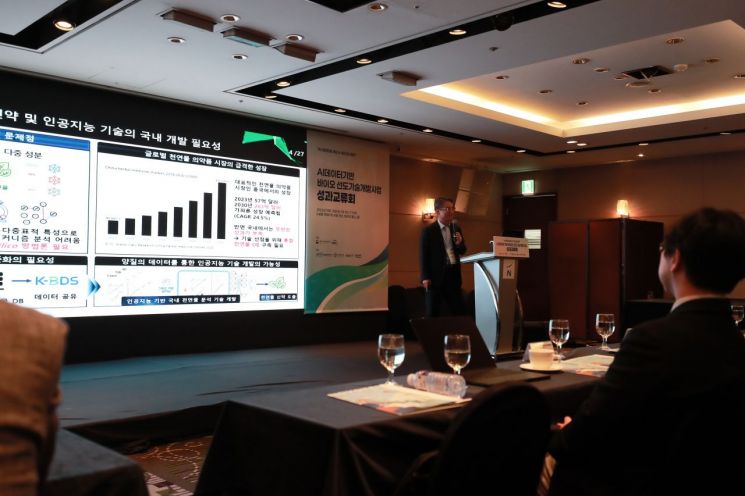 Lee Dohyun, a professor at KAIST, is presenting at the 'AI Data-Based Bio Leading Technology Development Project Performance Exchange Meeting' held on the 19th. Photo by Paek Jongmin, Tech Specialist
The AI Data-Based Bio Leading Technology Development Project is a national R&D initiative that aims to accelerate precision medicine, new drug development, and treatment of intractable diseases by combining vast genomic, clinical, and medical imaging data with artificial intelligence. The Ministry of Science and ICT officially launched the project as a new initiative in 2023.
The most significant value of the project lies in innovation in data utilization. As hospitals, research institutes, and companies share standardized datasets, research efficiency has increased, and models for predicting cancer recurrence, detecting rare disease mutations, and predicting drug responses have been developed. The time required for data preprocessing has been shortened, providing researchers with a foundation to achieve results more quickly.
The project has also greatly strengthened the industrial ecosystem. It has established itself as a platform where bio companies and AI companies can collaborate, functioning as a data hub that connects startups and large hospitals. Notably, it has also enhanced the potential for technology transfer and commercialization.
© The Asia Business Daily(www.asiae.co.kr). All rights reserved.
![Clutching a Stolen Dior Bag, Saying "I Hate Being Poor but Real"... The Grotesque Con of a "Human Knockoff" [Slate]](https://cwcontent.asiae.co.kr/asiaresize/183/2026021902243444107_1771435474.jpg)
















