Revision of Enforcement Decree of Financial Consumer Protection Act Adjusts Fine Imposition Standards
Potential Reduction of Fines Related to Banks' Equity-Linked Securities (ELS)
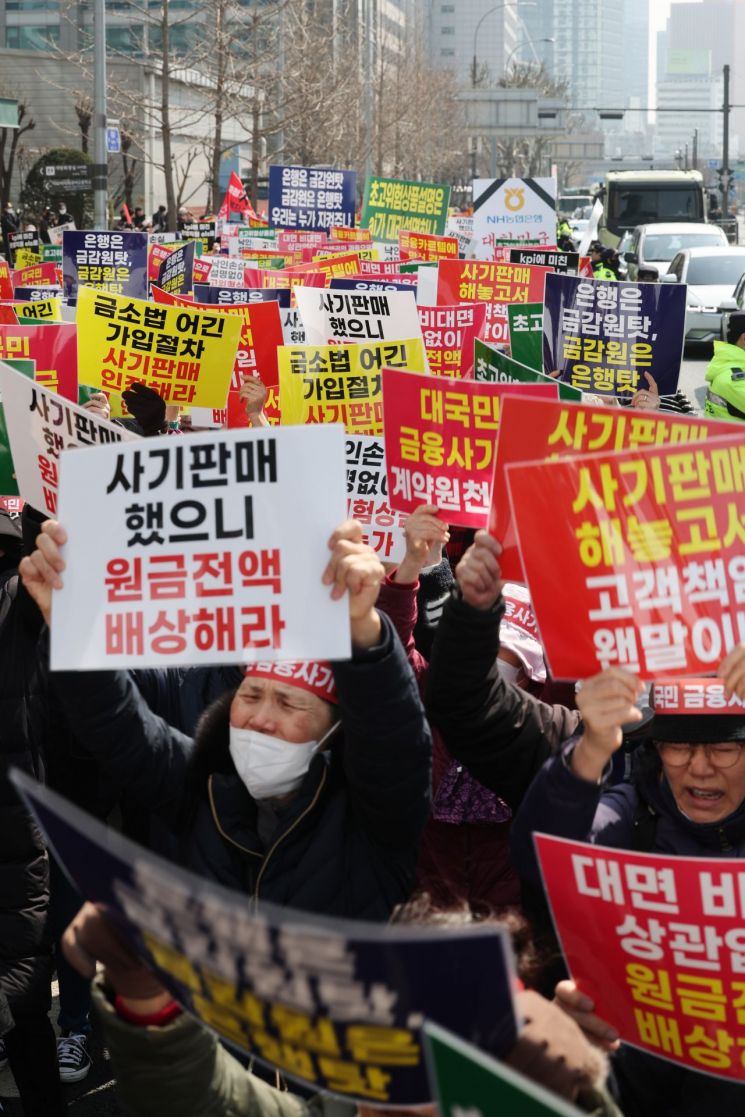 Representatives of the victims' group of Hong Kong H Index (Hang Seng China Enterprises Index) principal equity-linked securities (ELS) are urging full principal compensation at a rally held in front of a bank in Seoul on the afternoon of March 15 last year. Photo by Yonhap News
The government is revising the enforcement decree related to the Financial Consumer Protection Act to establish detailed standards for imposing fines. It is understood that the multi-trillion-won fines related to banks' Hong Kong equity-linked securities (ELS) may be reduced.
Government Revises Enforcement Decree of Financial Consumer Protection Act to Adjust Criteria for Fines on Financial Institutions
The Financial Services Commission announced that it will begin a legislative notice on September 22 for amendments to the "Enforcement Decree of the Financial Consumer Protection Act" and the "Supervisory Regulations on Financial Consumer Protection" to establish detailed standards for imposing fines under the Financial Consumer Protection Act.
The Financial Services Commission has introduced aggravating and mitigating factors to ensure that fines are proportional to the degree of illegality. First, as an aggravating factor, the commission considered the amount of unjust gains obtained by financial institutions through illegal acts. If the amount of unjust gains from the violation exceeds the base fine, the excess amount can be added to the fine.
To actively encourage financial institutions to voluntarily prevent consumer harm, the commission has established specific standards for reducing fines based on preventive efforts. If the results of the consumer protection evaluation are excellent (up to 30%), or if the internal control and consumer protection standards required by the Act are thoroughly established and implemented (up to 50%), the fines can be reduced accordingly.
If consumer harm actually occurs due to financial accidents, the commission has added post-incident recovery efforts as a mitigating factor to encourage financial institutions to actively address the situation. If a financial institution actively compensates financial consumers or makes thorough efforts to prevent recurrence after a financial accident, the fine can be reduced by up to 50% of the base fine (or the compensation amount).
With these new mitigating factors, there is a high possibility that the fines imposed on major domestic banks for the problematic sales of Hong Kong ELS in the past will be significantly reduced. So far, the outstanding balance of ELS sold by major commercial banks is about 15 trillion won. Under the current regulations, fines of 7 to 8 trillion won could be imposed, but with the introduction of mitigating factors, the amount of fines is likely to decrease significantly.
Prospects for Fine Reduction Related to Banks' Equity-Linked Securities (ELS)
The Financial Services Commission explained that, although fines under the Financial Consumer Protection Act can be imposed up to 50% of "income, etc.," the current enforcement decree only broadly defines the calculation method, making it difficult to apply the law specifically when imposing fines. Therefore, to actively reflect the legislative intent of the fine system-such as recovering economic gains from illegal acts and deterring violations-the principle of calculating "income, etc." by product type based on "transaction amount" has been clearly incorporated into the enforcement decree and supervisory regulations.
However, in some cases, it is difficult to uniformly apply the "transaction amount" as the basis for fines under the Act, depending on the nature of the violation. Reflecting this, the supervisory regulations now allow for alternative calculation methods when it would be unreasonable to use the "transaction amount" of the relevant financial product as the basis for "income, etc." For example, in the case of violations of the tying regulation, although the violation is related to the conclusion of a "loan-type product" contract, it has been pointed out that the fine should be based on the "transaction amount" of the other financial product that was forced upon the consumer.
The commission also plans to establish a system for calculating the base rate for fines so that various factors, including the nature and severity of the violation, are specifically reflected in determining the amount. Currently, the "base rate" used to calculate the base fine under inspection and sanction regulations is divided into only three levels (50-75-100%), making it difficult to impose fines that correspond to the specific illegality of each case. Under the new standards, higher base rates will be applied to serious violations where actual consumer harm occurs, while lower base rates will be available for minor violations, with a more detailed segmentation of the base rate system.
The amendment to the enforcement decree of the Financial Consumer Protection Act will undergo a legislative notice from September 22 to November 3, 2025. Afterward, it will go through the resolution of the Financial Services Commission, review by the Ministry of Government Legislation, and resolutions at the vice-ministerial and cabinet meetings before implementation. Meanwhile, the amendment to the supervisory regulations will be open for public comment from September 22 to October 10, 2025, and will be implemented after the resolution of the Financial Services Commission.
A representative of the Financial Services Commission stated, "With the revision of the enforcement decree and supervisory regulations of the Financial Consumer Protection Act, we expect to provide clear standards for calculating fines under the Act, making it possible to impose fines that correspond to the degree of illegality of the violator."
© The Asia Business Daily(www.asiae.co.kr). All rights reserved.
![Clutching a Stolen Dior Bag, Saying "I Hate Being Poor but Real"... The Grotesque Con of a "Human Knockoff" [Slate]](https://cwcontent.asiae.co.kr/asiaresize/183/2026021902243444107_1771435474.jpg)















