Jose Munoz Highlights at CEO Investor Day
"Tariffs Lower Operating Margin by 1 Percentage Point... Expanding U.S. Production"
On September 18 (local time), Jose Munoz, President of Hyundai Motor Company, expressed hope that the tariff rate on Korean-made vehicles would be reduced from the current 25% to 15%, emphasizing the need for a swift trade agreement between South Korea and the United States. Amid President Donald Trump's aggressive tariff policies, Munoz also revealed his determination to directly address tariff risks by increasing U.S. sales and continuously expanding local production.
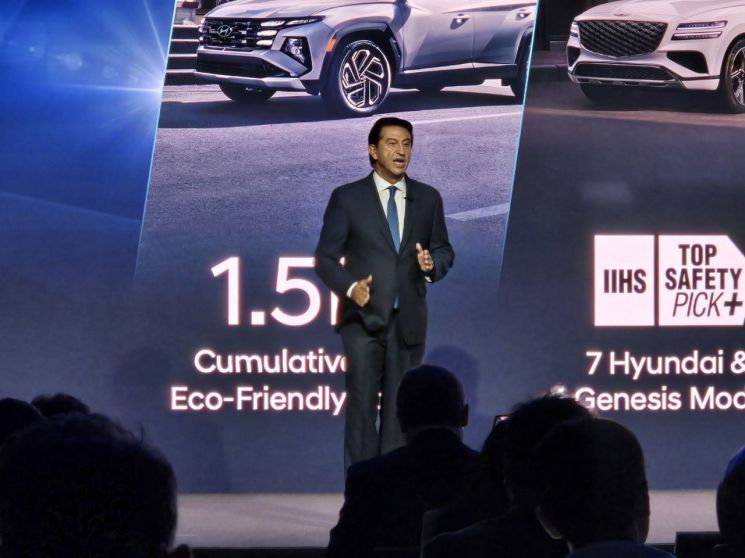
At the '2025 CEO Investor Day' held at The Shed in Manhattan, New York, targeting global investors and others, Munoz stated, "I hope the governments of both countries reach an agreement quickly," adding, "We want to set out our plans for this year and next year and present a strong roadmap for delivering robust results." This is the first time Hyundai Motor Company has held a CEO Investor Day event outside of Korea.
Since April, the United States has imposed a 25% itemized tariff on imported vehicles. In Japan's case, the rate was lowered to 15% through a bilateral agreement, but for Korea, despite agreeing at the end of July to a 15% reduction, the two countries have yet to resolve differences in follow-up negotiations, so the 25% rate still applies. Previously, under the Korea-U.S. Free Trade Agreement (FTA), tariffs on Korean car exports to the U.S. were 0%.
Regarding this year's downward adjustment of the operating margin target, Munoz explained, "The revised outlook provided today is based on a 25% tariff rate," and added, "If the tariff were reduced to 15%, we would have been able to meet the previously presented outlook."
Reflecting the impact of tariffs, Hyundai Motor Company adjusted its consolidated operating margin target for this year to 6.0-7.0%, down by 1.0 percentage point from the previous 7.0-8.0%. The consolidated sales growth target was raised to 5.0-6.0%, up from the 3.0-4.0% announced at the beginning of the year. The strategy is to offset as much of the profit decline as possible by expanding sales.
Munoz emphasized, "The focus of our business operations is always on our customers and shareholders," and added, "We will continue to grow despite tariffs by expanding sales, improving our product mix, and increasing net sales."
He also expressed the intention to increase the proportion of local production in the United States. Hyundai Motor Company currently produces about 40% of its vehicles sold in the U.S. locally, and plans to increase this figure to 80% by 2030.
Munoz stated, "Regardless of tariffs, Hyundai Motor Company has achieved localization in every successful market worldwide," adding, "Vehicles sold in the United States should be produced in the United States. Localization is absolutely necessary."
Regarding concerns that increased U.S. local production could lead to reduced production in Korea, he clarified, "This should be viewed from the perspective of U.S. market growth, not production relocation," and stressed, "It should not be seen as shifting Korean production to the United States."
On the issue of potential U.S. vehicle price increases due to tariff burdens, he explained, "We have not raised prices so far because we are focused on our customers," adding, "We are seizing opportunities to expand sales and improving auto financing. We will make decisions after comprehensively evaluating future market conditions, including new model launches and logistics costs."
© The Asia Business Daily(www.asiae.co.kr). All rights reserved.
![Clutching a Stolen Dior Bag, Saying "I Hate Being Poor but Real"... The Grotesque Con of a "Human Knockoff" [Slate]](https://cwcontent.asiae.co.kr/asiaresize/183/2026021902243444107_1771435474.jpg)















