Clash on the Final Day of Government Questioning at the National Assembly
Ruling Party: "National Default Risk Has Decreased Significantly"
On the final day of the government-wide questioning session at the National Assembly on the 18th, the ruling and opposition parties once again clashed over the fate of Supreme Court Chief Justice Cho Heedae. The People Power Party raised the level of its criticism against the administration, accusing it of “electoral dictatorship,” while the Democratic Party of Korea emphasized that the economy has improved since the inauguration of the Lee Jaemyung administration.
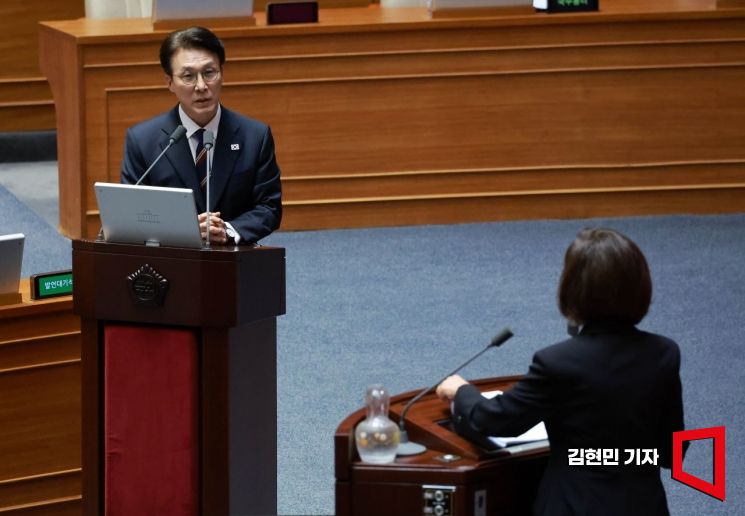 Prime Minister Kim Minseok is responding to a question from Na Kyungwon, a member of the People Power Party, during the government-wide questioning session on education, social, and cultural affairs held at the National Assembly on the 18th. Photo by Kim Hyunmin
Na Kyungwon, a member of the People Power Party, was the first to open fire in the main session hall of the National Assembly that afternoon. During her questioning of Prime Minister Kim Minseok, Na criticized, “The past 100 days of the Lee Jaemyung administration have been 100 days of destruction and dismantlement,” adding, “The control of the prosecution, the dismantling of the judiciary, the takeover of broadcasting, and fiscal collapse are not just 100 days of dismantlement, but I believe they mark the beginning of a long-term 100-year plan for left-wing rule.”
Na also argued, “The Democratic Party is hiding behind parliamentary immunity while bringing out a recording of unclear origin and talking about the resignation of Chief Justice Cho Heedae,” adding, “Forcing Chief Justice Cho out and creating a special court for insurrection, thereby infringing on judicial authority, shakes the basic order of liberal democracy.”
In response, Prime Minister Kim countered, “Isn’t it obvious that the judiciary is not exercising judicial power outside the bounds of the law? Are you denying that?”
When Na criticized the push for a special court for insurrection by referencing President Lee Jaemyung’s trial and asked, “Would you agree to create a special court for Lee Jaemyung with three conservative-leaning judges?” Prime Minister Kim replied, “The president’s trial has been suspended in accordance with the Constitution and the law. It is not appropriate to discuss a special court based on that.”
Na further criticized President Lee Jaemyung’s recent remark that “there is a hierarchy even within power,” saying, “If you look at the Chinese Communist Party model, it states that the elected National People’s Congress controls the Supreme People’s Court. That is why I am warning that this elected dictatorship is dangerous.” Prime Minister Kim responded by asking what was wrong with the president’s statement and countered, “If you call the current situation a dictatorship, how would you define the Yoon Sukyeol administration before these 100 days?”
During a subsequent question from a Democratic Party lawmaker, the argument was made that economic indicators have improved since the launch of the Lee Jaemyung administration. Park Hongbae of the Democratic Party referred to the ‘CDS (Credit Default Swap) premium’ and said, “During the 12·3 Martial Law last year and when the US announced its tariff policy, the CDS premium soared by more than 40 basis points, but it has now stabilized at around 17 basis points, its lowest level this year.” He added, “This means the risk of national default has fallen to less than half of what it was during the Yoon Sukyeol administration.”
He continued, “I recently met with overseas investors and asked about Korea’s amendments to the Commercial Act, the push for the Yellow Envelope Act, and other industrial safety measures. They responded that they are considering investing after seeing the Lee Jaemyung administration quickly achieve governance reforms that they thought Korea would not be able to accomplish.” He explained, “The amendment of the Labor Union Act is an indicator showing the maturity of Korean society by guaranteeing labor rights.”
Prime Minister Kim also responded, “There have been various evaluations regarding recent institutional reforms,” adding, “I recently visited the stock exchange, and most of the experts I spoke with evaluated positively the strengthening of general investors’ rights and the activation of the market from that perspective.”
When asked about the reasons for the recent rise in stock prices, Prime Minister Kim answered, “Ultimately, it is about expectations. The basic reason is the expectation that the current situation can improve, and that, as a result, the Korean economy can develop in a much more stable way.”
© The Asia Business Daily(www.asiae.co.kr). All rights reserved.
![Clutching a Stolen Dior Bag, Saying "I Hate Being Poor but Real"... The Grotesque Con of a "Human Knockoff" [Slate]](https://cwcontent.asiae.co.kr/asiaresize/183/2026021902243444107_1771435474.jpg)
















