Angry Students Set Government Vehicles Ablaze, Throw Stones
Protests Against Privilege Erupt Across Asia, Including Indonesia and Nepal
"Asia's Generation Z Is Furious With the Older Generation... Refusing to Accept Injustice as Destiny"
In Timor-Leste, one of the poorest countries in Southeast Asia, university students have launched large-scale protests in anger over the parliamentary budget for purchasing vehicles for lawmakers. Amid a wave of protests against the 'privileged class' sweeping across various Asian countries, this situation is also seen as being fueled by deep-rooted corruption, inequality, resulting economic hardship, and the deprivation of opportunities for young people. As the global economic downturn continues, issues of inequality and transparency are emerging as key factors reshaping the political landscape in Asia.
'New Toyota Vehicles for 65 Lawmakers'... Outraged Youth Flood the Streets
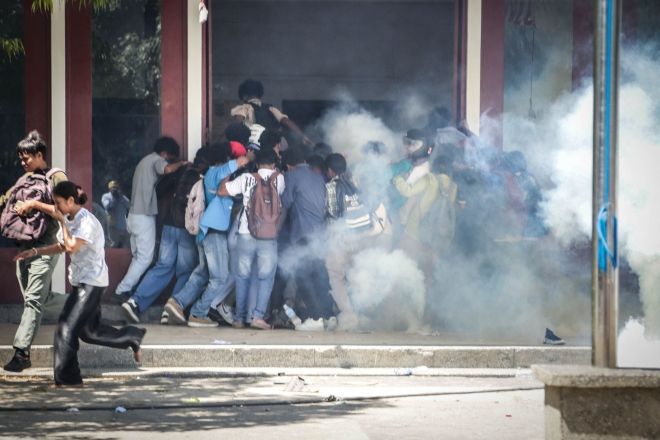 Students from several universities at the National University of Timor-Leste (UNTL) are fleeing from tear gas fired by the police during a protest against the parliament's plan to purchase 65 SUVs for lawmakers. Photo by AFP Yonhap News Agency
According to AFP on September 17 (local time), about 2,000 university students protested in Dili, the capital of Timor-Leste, over two days on September 15 and 16. The protests were sparked by news that the parliament was planning to allocate and approve a budget to provide new vehicles to 65 lawmakers. The enraged protesters engaged in radical actions near the National Assembly, including setting government vehicles on fire and throwing stones at police officers. Most of the demonstrators were students from universities in Dili, who gathered to oppose the plan to provide new Toyota vehicles to the 65 members of parliament.
As the protests intensified, political parties in Timor-Leste called on the parliament to reconsider the plan, and the government announced a firm stance against acts of violence. President Jose Ramos-Horta acknowledged the right to protest but stated, "Violence cannot be justified." However, the protesters have vowed to continue their gatherings until the vehicle purchase plan is officially scrapped.
"Refusing to Accept Inequality and Injustice as Fate"
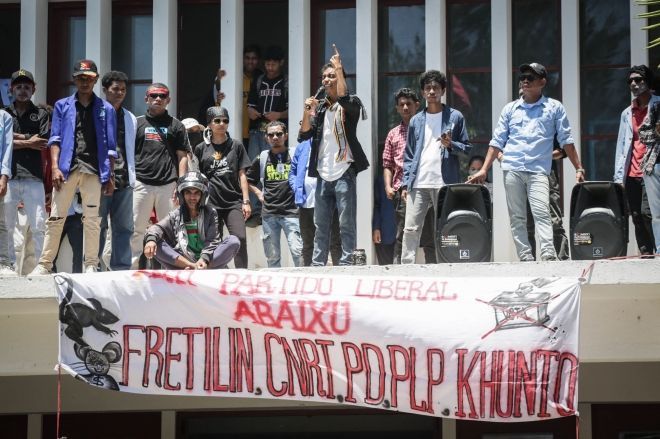 Students from various universities at the National University of Timor-Leste (UNTL) are protesting the parliament's plan to purchase 65 SUVs for members of the National Assembly. Photo by AFP Yonhap News
With a population of 1.41 million, Timor-Leste is considered the poorest country among Southeast Asian nations. About 40% of the population lives in poverty, and the country faces serious social issues such as inequality, malnutrition, and high unemployment. In this context, the use of public funds for what appears to be 'luxury in plain sight' has become a catalyst for growing anger among the youth.
Recently, large-scale protests against politicians and the privileged class have erupted in several Asian countries, including Indonesia and Nepal. In Indonesia, protests against parliamentary privileges spread nationwide at the end of last month, resulting in at least 10 deaths-including a motorcycle delivery worker who was killed by a police armored vehicle-and 20 people reported missing. In Nepal, massive anti-government protests on August 8 and 9 led to the replacement of the prime minister, with at least 72 people killed, including three police officers, and 2,113 injured. Previously, in 2022, Sri Lanka also saw large-scale anti-government protests as longstanding poverty and rising prices accumulated. Bloomberg News described the situation by saying, "Generation Z in Asia is angry at the older generation," and noted, "They are refusing to accept inequality and injustice as their destiny."
Experts believe that these protests go beyond mere 'emotional outbursts' and reveal structural problems. Worsening inequality, lack of transparency in public finances, and anxiety among young people about jobs and the future are combining to drive political activism in the streets. Some observers have even compared this to the 'Arab Spring' that swept North Africa and West Asia in the 2010s. Just as social networking services helped spread anti-dictatorship protests at that time, the youth in Asia are now emerging as the driving force for change. The Indian media outlet India Today referred to a quote by American novelist Mark Twain, "History does not repeat itself, but it often rhymes," and called this series of protests the 'Asian Spring.'
© The Asia Business Daily(www.asiae.co.kr). All rights reserved.
![Clutching a Stolen Dior Bag, Saying "I Hate Being Poor but Real"... The Grotesque Con of a "Human Knockoff" [Slate]](https://cwcontent.asiae.co.kr/asiaresize/183/2026021902243444107_1771435474.jpg)
















