2025 APEC Health and Economy Joint Statement Announced
Addressing Healthy Aging, Digital Health, and Mental Health
Asia-Pacific countries have agreed to actively cooperate in responding to aging societies and building sustainable healthcare systems.
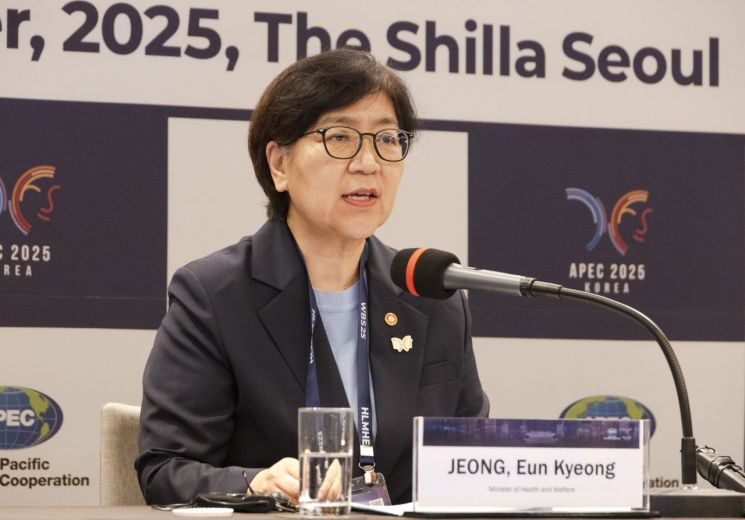 Jung Eunkyung, Minister of Health and Welfare, is giving a briefing after the 2025 APEC Health and Economy High-Level Meeting (HLMHE) held at the Shilla Hotel in Jung-gu, Seoul on the afternoon of the 16th. Ministry of Health and Welfare
Jung Eunkyung, Minister of Health and Welfare, told reporters after the "2025 Asia-Pacific Economic Cooperation (APEC) Health and Economy High-Level Meeting (HLMHE)" held at the Shilla Hotel in Jung-gu, Seoul on the 16th, "The 21 member economies have adopted a joint statement outlining the direction for future cooperation in the health sector."
Minister Jung emphasized the need to prepare for an aging society, stating, "The Asia-Pacific region is experiencing both low birth rates and rapid aging, which is resulting in a dual burden of shrinking labor forces and increased social security spending."
This HLMHE was a ministerial-level meeting hosted by Korea as the chair of the APEC summit. It was the first time the HLMHE meeting was held in Korea. The meeting addressed three main agendas under the theme "Innovation, Connection, Prosperity: Realizing a Healthy and Smart Aging Society": digital health, healthy aging, and youth mental health.
According to the Ministry of Health and Welfare, the joint statement focuses on the following: building a healthy, smart society that responds to aging; promoting healthy and active aging; establishing sustainable healthcare systems and promoting health for all; utilizing digital health and artificial intelligence (AI) for healthcare system transformation; strengthening community-based primary healthcare and care services; building resilient and efficient healthcare supply chains; enhancing comprehensive cancer management throughout the life cycle; strengthening mental health and well-being; reinforcing the resilience of healthcare systems against environmental threats; adopting multidisciplinary approaches to prevent future public health emergencies; and strengthening regional cooperation and outlook.
The member economies first agreed to strengthen policies so that older adults can actively participate as key members of society and the economy in response to aging. The agreement also included support for the APEC framework for responding to demographic changes, which Korea has been leading.
In addition, the statement emphasized the need to expand financial resources and improve governance to ensure that everyone can access essential health services. It called for the use of digital health technologies and expanded public-private partnerships to improve the efficiency and transparency of healthcare systems. While actively introducing AI and digital technologies, the statement also established the principle that institutional safeguards such as personal data protection are necessary.
Community-based care was also addressed as an important agenda. Member countries reportedly reached a consensus that, in response to aging, medical care, long-term care, and daily living support services should be integrated and that continuous care should be provided within local communities.
The joint statement also included the need to strengthen health supply chains. To prevent crises such as the COVID-19 pandemic, it emphasized the diversification of supply chains to ensure the stable supply of essential medicines, vaccines, and diagnostic devices.
The member economies also agreed to expand cooperation to strengthen the entire cycle of cancer prevention, early detection, treatment, and palliative care. In particular, they reaffirmed joint efforts to eliminate cervical cancer and emphasized the importance of improving women's health. The statement also called for expanding mental health services, as well as efforts for early intervention and stigma reduction.
Responding to environmental changes was also highlighted. Minister Jung explained, "We confirmed the need to expand cooperation, such as information sharing and knowledge exchange, to respond to environmental changes like abnormal weather, which affect not only infectious diseases but also chronic diseases." Furthermore, she called for building surveillance systems across multiple sectors to respond to future health crises and for research cooperation to strengthen regional and international crisis response capabilities.
Minister Jung said, "I hope that APEC countries will work together wisely to address health and healthcare issues," adding, "I look forward to further discussions on the contents of the joint statement." Eduardo Pedrosa, Executive Director of the APEC Secretariat, said, "We must work together to address the adopted agendas over the next 5 to 10 years. We need to build our strength and learn from each other's best practices."
© The Asia Business Daily(www.asiae.co.kr). All rights reserved.
![Clutching a Stolen Dior Bag, Saying "I Hate Being Poor but Real"... The Grotesque Con of a "Human Knockoff" [Slate]](https://cwcontent.asiae.co.kr/asiaresize/183/2026021902243444107_1771435474.jpg)















