Announcement of the "Daily Vitality Project for People with Disabilities"
Focus on Four Key Areas: Jobs, Housing, Mobility, and Human Rights
Doubling Public Jobs and Launching Specialized Vocational Schools
Improving Housing Environment and Intro
The Seoul Metropolitan Government will increase the number of public jobs for people with disabilities to approximately 12,000 by 2030. This initiative aims to support stable income security, while also establishing specialized vocational schools for people with disabilities and steadily expanding supported housing. The city will also improve the public transportation system to enhance mobility rights for people with disabilities.
On the morning of the 16th, Seoul Mayor Oh Sehoon announced the comprehensive support plan, the "Daily Vitality Project for People with Disabilities," at Seoul City Hall, stating, "We will break down barriers so that jobs enabling independent living, safe and comfortable homes, and free movement-things that should be taken for granted-do not become challenges for people with disabilities."
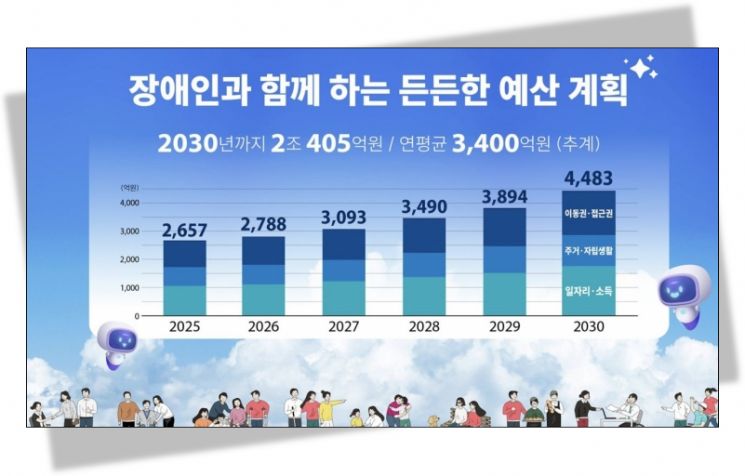
This support plan will invest a total budget of 2 trillion won to enable approximately 385,000 people with disabilities to enjoy "an ordinary day" across four key areas: jobs, housing, mobility rights, and human rights. The Seoul Metropolitan Government noted that 85% of registered people with disabilities in Seoul suffer from chronic illnesses and 74% rely on family care. In particular, while the employment rate for the population aged 15 and older is 63%, it is only 37% for people with disabilities, reflecting a low rate of social participation. According to a survey of people with severe disabilities, 45% of respondents identified "income and jobs" as the most needed support.
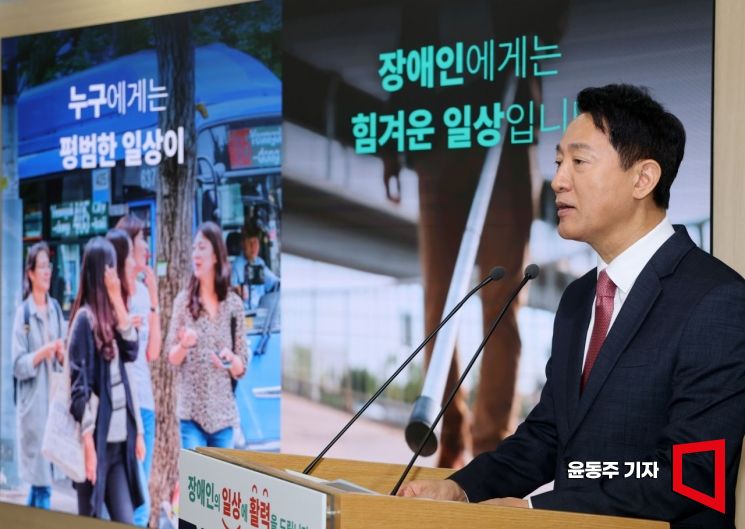 Seoul Mayor Oh Sehoon is announcing the '2530 Disabled Daily Vitality Project' at Seoul City Hall on the 16th. 2025.09.16 Photo by Yoon Dongjoo
Job Support for Stable Economic Activity... Customized Support Based on Independence
The city will first focus on providing "jobs" and supporting stable "income security." The number of public jobs for people with disabilities will be gradually increased from the current 5,000 per year to 7,000 by 2027 and 12,000 by 2030. These public jobs include "general office assistant" roles such as administrative support at public institutions and welfare centers, "social service" roles such as care assistant and senior massage services, and "employment-linked" roles such as barista and librarian.
Vocational training programs will also be strengthened to enable people with disabilities to achieve independent living through stable economic activity. By 2030, the city will establish specialized vocational schools for people with severe disabilities, such as developmental and brain lesions, and will introduce new "disability-specialized courses" (e.g., woodworking, barista, baking) at the existing Seoul Technical Education Centers. The core of these specialized vocational schools is to provide early vocational education in promising future industries such as information and communication technology (ICT) and offer job experiences tailored to corporate demand for people with disabilities aged 15 and older, thereby supporting their independence.
The "Seoul-Style Personal Budget System," which allows people with disabilities to enjoy a more comfortable life, will expand its coverage from the current 100 people to 2,600 by 2030, and increase the budget from 400,000 won to 500,000 won per person. This system enables recipients to select and use the budget for areas such as self-development, employment or entrepreneurship, and improving living conditions.
Additionally, the "Seoul-Style Disability Supplementary Allowance" for low-income people with severe disabilities will be doubled from the current 40,000 won per month to 80,000 won per month by 2030, benefiting about 30,000 people. For families aged 65 and older who care for children with the most severe disabilities, a new monthly payment of 300,000 won will be provided.
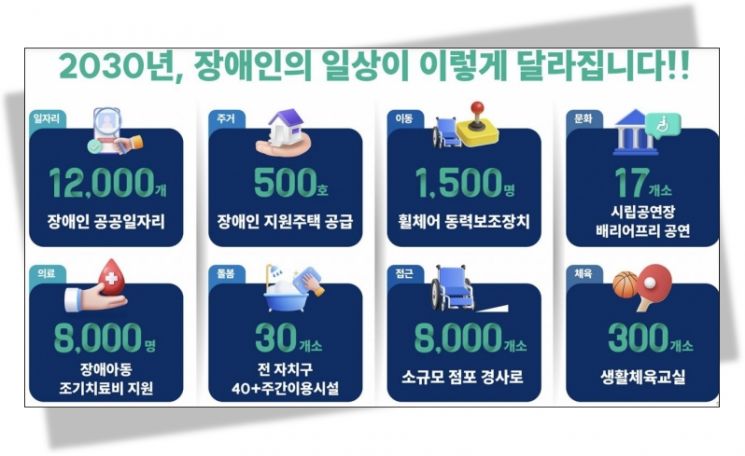 Details of the "Daily Vitality Project for People with Disabilities" announced by the Seoul Metropolitan Government on the 16th. Seoul Metropolitan Government
Comfortably Living at Home for a Long Time... Support for Home Renovation Costs Including Threshold Removal
Support measures for housing and daily living have also been announced. The number of "supported housing for people with disabilities," where residents can live comfortably for up to 20 years, will be increased from the current 336 units to 500 by 2030. These supported housing units, which provide not only living space but also social welfare services and community connections, are highly sought after, with an average competition rate of 2.8 to 1.
Home renovation support for low-income households with people with disabilities-such as threshold removal and ramp installation-will be increased from the current 1,700 households to 4,000 by 2030, with up to 3.5 million won provided per household. "Group homes," where small groups of three to four people with disabilities can live together in a home-like environment and receive care services, will be significantly expanded from about 150 to 250 locations. Additionally, 30 new "independent living experience homes" will be operated, allowing people with disabilities to try living alone for six months.
Medical expense support will also be provided. Reflecting the low health screening rate among people with severe disabilities, the city will be the first in the country to support "Seoul-Style Early Cancer Screening for People with Disabilities" (stomach and colorectal cancer). For 2,000 children with disabilities under the age of nine in households with income below 180% of the median, 1 million won per year will be provided for medical expenses to enable focused early intervention.
Support measures to ensure free movement and social participation for people with disabilities are also included. Using artificial intelligence (AI) and robotics technology, "climbing wheelchairs" to assist with stairs and advanced "walking assistive devices" will be distributed to 500 people. "Power assist devices," which can be attached to manual wheelchairs to enable easier movement, will be provided to 1,500 people.
Convenient and Accessible Mobility... Human Rights Violations Addressed with a Zero-Tolerance Policy
The convenience of public transportation will also be improved. For all routes where low-floor buses can be introduced, all village buses will be converted to 100% low-floor buses by 2030, and all city buses by 2032, to eliminate barriers for people with disabilities using public transportation. In addition, separate from the existing call taxi service for people with disabilities, universal design (UD) taxis that allow wheelchairs to board directly will be piloted this year, with 1,000 vehicles to be in operation by 2030. The city will also support the installation of ramps at the entrances of small, community-based stores such as pharmacies, convenience stores, and restaurants, and will complete the installation of audio signals for the visually impaired at all crosswalks by 2030.
A strict "zero-tolerance policy" will be applied to human rights violations in residential facilities for people with disabilities. For serious human rights violations, a "one-strike-out" policy will be enforced, resulting in immediate administrative closure of the facility. Additional strong measures will include wage reductions and restrictions on further subsidy support.
Furthermore, the working conditions of staff caring for people with the most severe disabilities will be gradually improved, and the city will promote the establishment of training centers for psychological support programs, capacity building for social welfare workers, and rest. Mayor Oh stated, "People with disabilities are not just beneficiaries of welfare, but active participants in building our society, which is the foundation of our philosophy of accompanying the disadvantaged," adding, "We will create a Seoul where an ordinary day for people with disabilities is not a special event but a normal part of life, making our city a happier place for everyone."
© The Asia Business Daily(www.asiae.co.kr). All rights reserved.
![Clutching a Stolen Dior Bag, Saying "I Hate Being Poor but Real"... The Grotesque Con of a "Human Knockoff" [Slate]](https://cwcontent.asiae.co.kr/asiaresize/183/2026021902243444107_1771435474.jpg)

















