Interview with Soonhee Lee, Mayor of Gangbuk District
Major Long-Awaited Goal Achieved: Relaxation of Bukhansan Height Restrictions
Projects Shaping Gangbuk District's Future Progressing Smoothly
"The relaxation of height restrictions in the Bukhansan area, the establishment of the first-ever basic residential area maintenance plan by a local government, selection for a 145.7 billion won rapid new growth hub project, the groundbreaking of Seoul's first Moa Town, and the introduction of the nation's first villa management office-these are the transformative projects that have changed the future of Gangbuk District over the past three years."
On September 15, Soonhee Lee, mayor of Gangbuk District in Seoul, stated in an interview with Asia Economy, "At the heart of every policy and project implemented over the past three years has been the 'lives of our residents,' and we have strived to provide administration that offers practical support to the community." She continued, "Gangbuk District is now truly on a 'trajectory of change,' and the most significant turning point was the relaxation of height restrictions in the Bukhansan area, which had hindered the district's development for over 30 years."
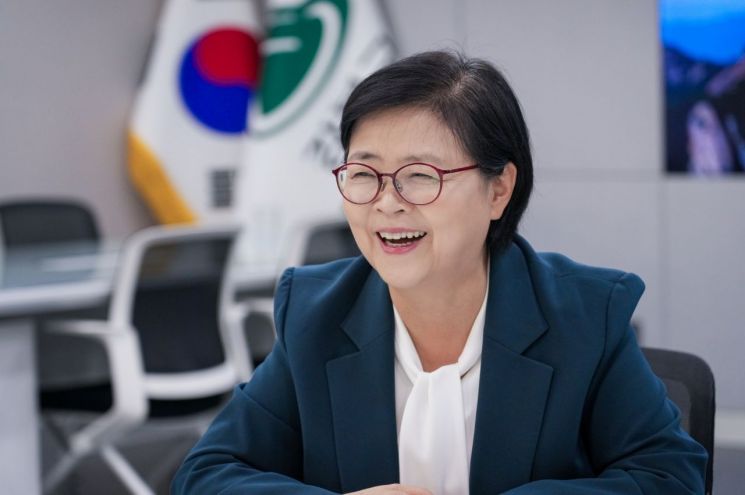 Lee Soonhee, mayor of Gangbuk District, is smiling brightly while talking about the achievements of the past three years in an interview with Asia Economy on the 15th. Provided by Gangbuk District.
Mayor Lee began submitting continuous proposals to the Seoul Metropolitan Government immediately after taking office as the 8th popularly elected mayor in July 2022. She presented objective evidence through landscape and environmental studies. She also joined forces with Dobong District. The two districts conducted joint signature campaigns, made frequent proposals, and negotiated with the Seoul Metropolitan Government.
Their efforts bore fruit in just over two years. In the Mia-dong 791-2882 area, where redevelopment had stalled due to insufficient profitability caused by limits allowing only apartment buildings up to an average of nine stories (28 meters), the new regulations now permit an average of 15 stories (45 meters) and up to 25 stories (75 meters). As a result, a large-scale complex of 2,500 units is currently being planned. The relaxation of restrictions reduced the area designated as height-limited in Gangbuk District from 3,557,000 square meters to 2,352,498 square meters-a 34% decrease-raising expectations for revitalized redevelopment.
Mayor Lee explained, "Narrow residential alleys, where even fire trucks could barely enter, saw declining quality of life due to a lack of infrastructure. However, the overly rigid height restrictions prevented improvements to the residential environment, and residents suffered financial disadvantages as a result." She added, "Now, by applying regulations more flexibly, we have simultaneously opened the door to residential environment improvements and urban development."
It was only possible for Gangbuk District to establish a 'basic residential area maintenance plan'-typically the responsibility of metropolitan governments-thanks to the relaxation of the Bukhansan height restrictions. This plan provides a long-term blueprint for improving the residential environment and lays the foundation for systematic urban renewal. Mayor Lee stated, "Currently, 120 redevelopment projects are underway in Gangbuk District. We must now move toward changes that restructure the entire city's structure and identity, designing plans that go beyond individual projects to create city-wide synergy effects."
The basic residential area maintenance plan, which the district has worked on for the past year and a half and is scheduled to announce this month, includes comprehensive directions for improving aging residential areas in Gangbuk District, guidelines for infrastructure such as roads, transportation, and living SOC (Social Overhead Capital), and considerations for future urban management plans.
Another major achievement of the 8th popularly elected administration was securing support from the Seoul Metropolitan Government to simultaneously address the underground relocation of the Ohyeon Waste Transfer Station-which had generated complaints about odor and noise for nearly 30 years-and the creation of the Bukseoul Sports and Culture Center (tentative name), a facility for sports and cultural activities. Gangbuk District proposed three projects to the city: the 145.7 billion won underground relocation of the Ohyeon Waste Transfer Station, the establishment of the Bukseoul Sports and Culture Center, and the creation of Bukhansan Citizens' Gardens No. 1 and 2. Two months ago, these projects were selected for the Seoul Metropolitan Government's '2025 Rapid New Growth Hub Project.'
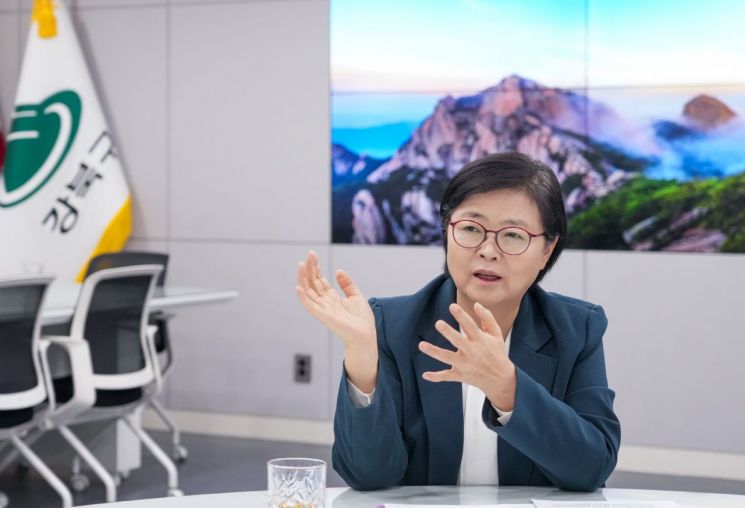 In an interview, District Mayor Soonhee Lee said, "'Hearing that Gangbuk-gu has improved' is a greater motivation and reward than any quantified achievement." Provided by Gangbuk-gu.
Mayor Lee stated, "These projects would have been impossible for Gangbuk District to accomplish alone, given our limited finances, so collaboration with the Seoul Metropolitan Government was essential. Policy support from both the city and the central government is necessary for long-standing local projects to come to fruition and for balanced development between southern and northern Seoul." She added, "As mayor, I will continue to responsibly pursue what can be done, working hand in hand with residents to persistently advocate for Gangbuk District's needs to the Seoul Metropolitan Government and the central government."
The 'Beondong Moa Town' project in Gangbuk District, which began construction last December and will provide 1,242 housing units, is another key initiative for Mayor Lee. As the first Moa Town under Seoul's urban renewal model, this project was highly symbolic. Thanks to mediation by Gangbuk District, compensation measures for tenants were established, enabling rapid relocation and construction.
The 'Villa Management Office,' which Mayor Lee introduced for the first time in the country, is another representative policy that has improved residents' lives. By establishing management offices in villa (multi-family) neighborhoods-similar to those in apartment complexes-issues such as alleyway garbage and parking have been addressed. This policy has attracted inquiries from other local governments nationwide seeking to benchmark the initiative.
She said, "I feel most encouraged when I hear people say, 'Our neighborhood has really changed,' or 'It's much better to live here than before.' Hearing that 'Gangbuk District has improved' is a greater motivation and reward than any quantified achievement."
© The Asia Business Daily(www.asiae.co.kr). All rights reserved.
![Clutching a Stolen Dior Bag, Saying "I Hate Being Poor but Real"... The Grotesque Con of a "Human Knockoff" [Slate]](https://cwcontent.asiae.co.kr/asiaresize/183/2026021902243444107_1771435474.jpg)
















