Citing Japan’s Agreement, Threatens 25% Tariffs
"If There’s a Visa Issue, Call Me?I’ll Pass It On"
Howard Lutnick, U.S. Secretary of Commerce, is pressuring South Korea to either accept the trade agreement with the United States as broadly agreed upon or to lower tariffs to pre-agreement levels, suggesting that it will take considerable time before the agreement is finalized. As Korean workers who were detained and arrested by U.S. immigration authorities are now returning home, Secretary Lutnick urged that Korean companies must obtain proper visas to dispatch workers to the United States, but he did not offer a solution to concerns over labor supply. Despite the unprecedented mass detention of more than 300 allied country workers who entered the U.S. for investment purposes, Lutnick has maintained a hardline stance, which is expected to have significant repercussions for U.S.-Korea relations.
On September 11 (local time), in an interview with CNBC, Lutnick stated, "South Korea did not sign when President (Lee Jaemyung) came to Washington, D.C. He knows that we did not discuss trade at the White House because he did not sign the document."
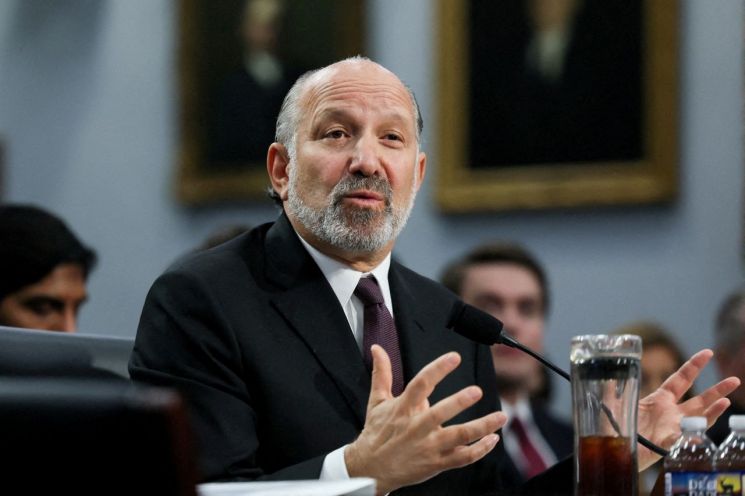
He continued, "I think they are now looking at Japan. There is no flexibility. Japan signed the contract," emphasizing, "South Korea must accept the agreement or lower tariffs. It is clear." He also said, "Let’s see if South Korea will produce results through the paperwork."
South Korea and the United States reached a broad trade agreement on July 30, but have not finalized the deal due to disagreements over specific details, such as the $35 billion investment fund for the U.S. Some observers suggest that the negotiations are at a stalemate.
On September 8, the South Korean working-level negotiation team met with officials from the U.S. Department of Commerce and the U.S. Trade Representative (USTR) but failed to reach a conclusion. On the same day, Minister Kim Jeonggwan of the Ministry of Trade, Industry and Energy arrived in the United States to consult with Secretary Lutnick and others.
In this context, Secretary Lutnick’s comments are interpreted as pressure to accept U.S. demands regarding the details of Korean investment in the United States. Otherwise, he is threatening that country-specific tariffs (reciprocal tariffs) on South Korea will rise to the originally set rate of 25%. By mentioning that Japan reached a final agreement first, he also made it clear that South Korea cannot expect to secure more favorable terms than Japan.
Secretary Lutnick projected that with trade agreements with various countries, more than $10 trillion worth of factories are being built in the United States, and that construction jobs will reach an all-time high in the first quarter of next year, leading to a U.S. GDP growth rate exceeding 4% in 2026.
However, when asked whether the incident involving the detention and arrest of Korean workers at the Hyundai Motor Company and LG Energy Solution joint venture (HL-GA) battery plant construction site in Georgia would affect the supply of labor needed for such construction, he sidestepped the question, saying that American workers should be trained through vocational schools.
Regarding the professional worker visa issues and heightened tensions with allied countries resulting from the U.S. Immigration and Customs Enforcement (ICE) crackdown on Korean workers, he said, "President Donald Trump will step in to resolve this," adding, "He knows that to build great factories quickly, you need the leadership of people who have actually built factories." He went on, "When they try to build large-scale factories in the United States, President Trump will make agreements with several countries so that workers can obtain appropriate short-term work visas and then return home after training Americans." He described this as President Trump’s "ABC principle": "A, come in; B, train Americans; C, return home."
Secretary Lutnick also gave an interview with the U.S. online media outlet Axios that day. He said that the Korean employees detained by immigration authorities had the wrong visas and that Korean companies should have requested the correct visas from U.S. authorities.
He stated, "They must obtain the appropriate visas for their workers. They need to get working visas," pointing out, "What they did was enter on tourist visas and simply work in the factories." He continued, "ICE has to do its job. If there are many people in this country with the wrong visas, the visas must be changed," defending the recent crackdown.
He added, "I called South Korea and said, 'Get the right visa. If you have trouble getting a visa, call me. I will call Kristi Noem (Secretary of Homeland Security).'" He emphasized, "I will help you get the right visa, but not by using the wrong methods." He further stated, "You cannot do things the old way. President Trump wants you to do things properly. Do you want to immigrate? Do you want to bring in workers? Follow the proper procedures. You cannot break the rules anymore."
Axios reported that Secretary Lutnick claimed the responsibility for the recent detentions lies entirely with Korean companies. Immigration authorities took issue with workers engaging in employment inconsistent with their stated purpose of stay, but it is known that among the detained Koreans, some held B-1 visas, which are short-term business visas used for business trips and similar purposes.
Axios also pointed out that for the H-1B visa, which is for professional foreign workers, demand far exceeds supply. It added that it is unclear how companies could secure the necessary visas simply by calling the Secretary of Commerce.
© The Asia Business Daily(www.asiae.co.kr). All rights reserved.
![Clutching a Stolen Dior Bag, Saying "I Hate Being Poor but Real"... The Grotesque Con of a "Human Knockoff" [Slate]](https://cwcontent.asiae.co.kr/asiaresize/183/2026021902243444107_1771435474.jpg)















