Lotte Hotel Launches Kimchi Stew HMR on the 28th of Last Month
"Plans for Overseas Exports by 2026... Sales in Six Countries Including Japan and Vietnam"
Rising Kimchi Exports Spur Luxury Hotels to Join the Market
"Next year, we are planning to expand beyond the domestic market and enter overseas markets. Focusing on the six countries where Lotte Hotel has a presence, we will promote the value of traditional Korean kimchi to the world."
Beomseok Kim, Head of Marketing at Lotte Hotel, made this statement at the press conference for the launch of Lotte Hotel Kimchi Stew Home Meal Replacement (HMR) held on the 11th. Last year, 4,000 sets of Lotte Hotel Kimchi were sold within just 15 minutes of its first broadcast on Lotte Home Shopping. Now, the brand is entering the kimchi stew market and venturing abroad. The competition among luxury hotels to discover new revenue streams based on kimchi is intensifying.
 Beomseok Kim, Head of Marketing at Lotte Hotel, is speaking at the press conference for the launch of Lotte Hotel Kimchi Stew Home Meal Replacement (HMR) on the 11th. Photo by Lotte Hotel
Currently, Lotte Hotel Kimchi is sold through its own online mall, LotteON, Market Kurly, and other online platforms, as well as offline locations such as Lotte Department Store and Lotte Mart. Moving forward, the company plans to expand its offline distribution channels and diversify its product lineup to include items like stir-fried kimchi and braised kimchi. Next year, overseas expansion is also planned. Kim stated, "We are reviewing potential entry into six countries, including Japan, Vietnam, and the United States, where Lotte Hotel operates. While the most common form is based on white kimchi, kimchi stew uses meat, so we will consider each country's regulations and tailor our approach accordingly."
This is Lotte Hotel's third attempt at the kimchi business. The company previously tried to launch hotel kimchi in 2013 and 2016, but around 2022, after hygiene issues arose with a supplier that provided kimchi to hotel restaurants, Lotte Hotel began making and selling its own kimchi. The Commerce Business Team, which is responsible for planning, product development, manufacturing, distribution, and sales of the kimchi business, consists of 10 members, and more than 50 people, including chefs such as Master Chef Songki Kim, participated in the development phase. The product was developed over three years of tasting and feedback, based on chef recipes.
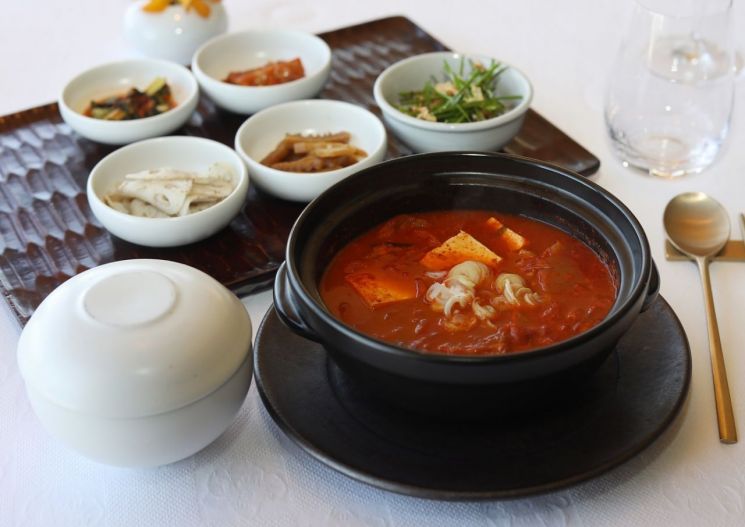
Lotte Hotel emphasizes its use of natural ingredients as a key strength. The kimchi is fermented with domestic natural ingredients such as salted shrimp, yellow croaker sauce, and fresh shrimp, creating a clean yet rich broth flavor. The stew uses 100% domestically sourced pork shoulder for added texture. The kimchi's acidity is set at 3 to 4, the point at which it tastes best after fermentation. The product is offered in a generous 600g portion, which is 100g more than competitor products (500g), allowing for a more satisfying serving.
Executive Chef Songki Kim (Master Chef) explained, "Through our previous two failed attempts, we became directly involved in everything from market analysis and planning to production. We carefully select the best seasonal ingredients to make our kimchi," adding, "To create a unique taste not found in the market, we insist on using only 100% domestically sourced and natural ingredients."
Hotel Industry Races to Enter the 'Kimchi Market'... Overseas Expansion in Sight
Recently, the hotel industry has collectively entered the kimchi market. In 1989, Walkerhill Hotel established the first 'Kimchi Research Institute' within a hotel and introduced hotel kimchi. Subsequently, it developed 'Walkerhill Suprex Kimchi' and launched products like 'Walkerhill Hotel Kimchi,' which are currently being sold. Josun Hotels & Resorts began selling packaged kimchi from its hotel restaurants in 2004, established a kimchi factory in 2011, and now produces more than 20 types of products. Lotte Hotel launched its kimchi brand through its first broadcast on Lotte Home Shopping in August 2023, and Paradise Hotel entered the market with the launch of pogi kimchi in October last year.
The reason the hotel industry is focusing on kimchi is the growing number of "Gimpojok" (people who give up making kimchi at home). As the cost of ingredients like cabbage rises each year and the number of single- and two-person households increases, the tradition of making kimchi at home is rapidly disappearing. Instead, demand for ready-to-eat packaged kimchi is rising. From January to August this year, Lotte Hotel Kimchi sales grew by 20% compared to the same period last year. Josun Hotel Kimchi sales also increased by 14.5% year-on-year during the same period. Walkerhill Hotel's sales rose by 3.4% in the first half of this year compared to the previous year.
Luxury hotels have an advantage in expanding into this business because they already have their own food and beverage (F&B) staff and kitchen facilities. With a solid infrastructure in place, they can enter the kimchi business without significant additional costs. The hotel brand image also carries a 'premium' perception, allowing them to gain high consumer trust even without aggressive marketing.
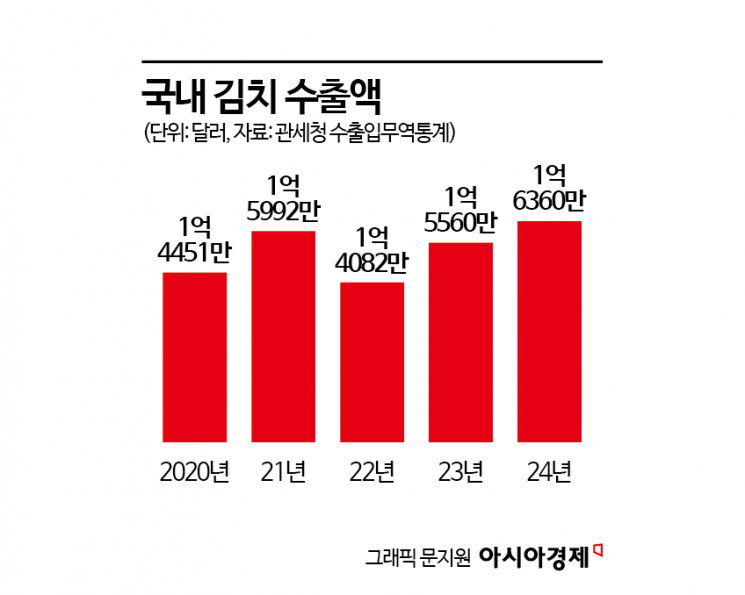
Hotels are also seeking growth opportunities in overseas markets. On the 8th, Walkerhill Hotel announced that it would export its second kimchi brand, 'Walkerhill Hotel Kimchi,' to the United States. Lotte Hotel also plans to expand exports using its global chain in six countries as a base. This is due to the increasing value of kimchi exports. According to Korea Customs Service trade statistics, Korea's kimchi exports reached a record high of 163.6 million dollars last year.
© The Asia Business Daily(www.asiae.co.kr). All rights reserved.
![Clutching a Stolen Dior Bag, Saying "I Hate Being Poor but Real"... The Grotesque Con of a "Human Knockoff" [Slate]](https://cwcontent.asiae.co.kr/asiaresize/183/2026021902243444107_1771435474.jpg)

















