The Gyeongnam Branch of the Korean Metal Workers' Union has called on the new government to abolish union accounting disclosure and the time off system.
On September 10, the Gyeongnam Branch of the Metalworkers' Union held simultaneous press conferences at the Changwon, Jinju, Tongyeong, and Yangsan branches of the Ministry of Employment and Labor.
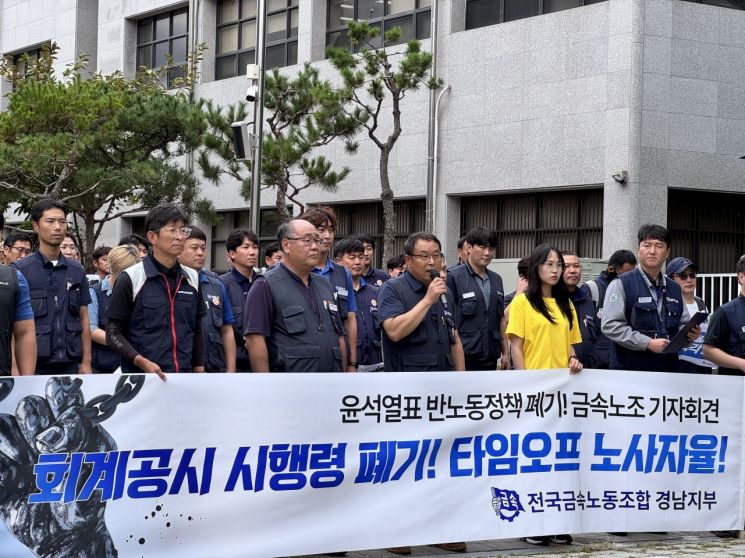 Kim Ilsik, head of the Metalworkers' Union Gyeongnam Branch, is making a statement urging the abolition of union accounting disclosure and time off. Photo by Lee Seryung
The union argued, "Union accounting disclosure is a tool devised by the Yoon Suk-yeol administration to suppress democratic unions, and the time off system serves only to shackle unions."
They also stated, "The first public statement by Minister Kim Younghoon was to expand labor-management autonomy," adding, "That should begin with the abolition of the time off system and allowing labor and management to make their own decisions."
The union further pointed out, "Over a decade ago, it was the Democratic Party that opened the door in the National Assembly for the single bargaining channel for multiple unions and the passage of the time off system," and insisted, "Now that the Democratic Party is the ruling party, it must resolve these issues."
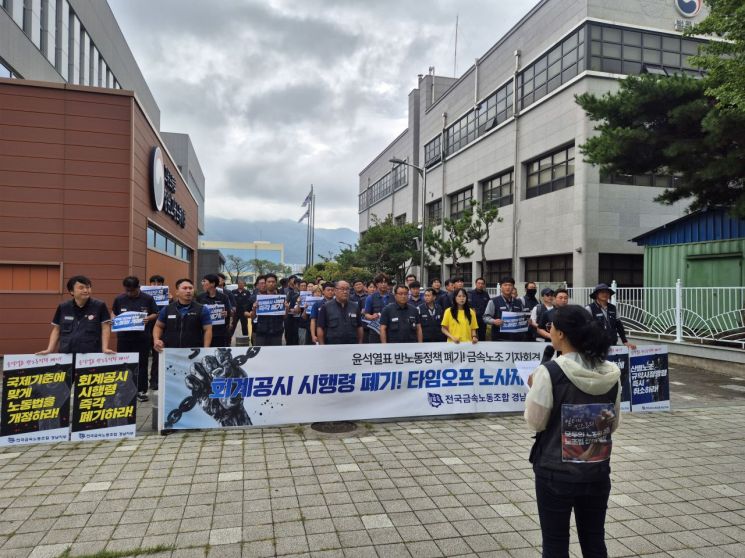 The Metalworkers' Union Gyeongnam Branch is urging the abolition of union accounting disclosure and time off. Photo by Lee Seryung
The union accounting disclosure system requires unions to disclose the results of their previous fiscal year's financial statements through the government's accounting disclosure system. This system was introduced in September 2023, when the Yoon Suk-yeol administration amended the Enforcement Decree of the Trade Union and Labor Relations Adjustment Act.
Union members who do not comply with the accounting disclosure system are not eligible for the 15% tax deduction on union dues during year-end tax settlement, according to the policy.
The time off system allows the hours spent on union activities to be recognized as working hours, enabling union members to receive wages from their workplace. It was introduced in 2010 with the intention of guaranteeing union activity time while setting an upper limit.
Accordingly, union members may engage in union activities instead of work within the maximum annual hours permitted by law, depending on the size of the workplace. This is why it is also referred to as the "work hours exemption system."
© The Asia Business Daily(www.asiae.co.kr). All rights reserved.
![Clutching a Stolen Dior Bag, Saying "I Hate Being Poor but Real"... The Grotesque Con of a "Human Knockoff" [Slate]](https://cwcontent.asiae.co.kr/asiaresize/183/2026021902243444107_1771435474.jpg)
















