"Financial Services Commission Nominee Hearing"
On Dissolution of the FSC: "Inappropriate to Comment"
On September 2, Lee Eokwon, nominee for Chairman of the Financial Services Commission, commented on the active public engagement of Lee Chanjin, Governor of the Financial Supervisory Service, who is considered a close aide to President Lee Jaemyung, stating, "Financial supervisory policy and financial policy fall strictly under the jurisdiction of the Chairman of the Financial Services Commission." Regarding the so-called "Homeplus incident," he confirmed, "After taking office, I will conduct a thorough investigation into MBK Partners and take strict action if any serious legal violations are found." However, he withheld comments on questions regarding government reorganization, such as the dissolution of the Financial Services Commission.
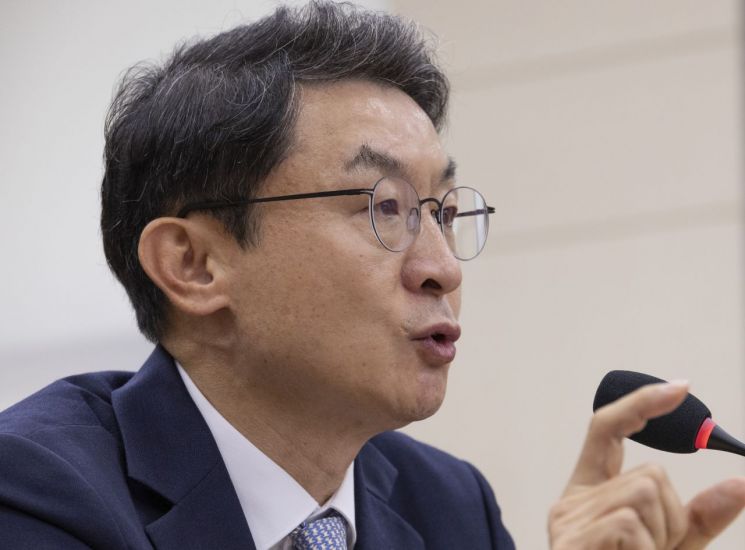
Appearing at the personnel hearing held by the National Assembly’s Political Affairs Committee that day, Lee responded to a question from Yangsoo Lee, a lawmaker from the People Power Party, who asked, "Governor Lee, who is said to wield real power, is taking bold actions-summoning big tech companies and criticizing banks for excessive interest profits. Isn’t this the role of the Chairman of the Financial Services Commission?" Lee said, "The Governor of the Financial Supervisory Service is responsible for the execution of financial supervision," clarifying his position.
Governor Lee Chanjin, who took office last month, has been holding a series of relay meetings with representatives from the banking, insurance, and secondary financial sectors. As concerns have been raised about the 'powerful FSS Governor,' nominee Lee drew a clear line. The Financial Supervisory Service is an institution supervised by the Financial Services Commission. When asked, "Is the current FSS Governor doing anything wrong?" Lee replied, "I think it needs to be observed further," but emphasized, "There are areas where we must work together, so we should act with a one-team spirit." He also added that he would prevent the FSS Governor from unilaterally influencing consumers or financial companies.
On the issue of reorganizing the Financial Services Commission, he stated, "It is not appropriate to comment (for or against) when there is no clear plan yet." When asked by Yangsoo Lee if he thought the dissolution of the Financial Services Commission would be handled at the National Assembly’s plenary session on the 25th, he replied, "I do not think it is appropriate to answer or discuss the matter based on assumptions."
When Yangsoo Lee remarked that "as a nominee for Chairman, you do not seem to have a strong conviction to defend the Financial Services Commission," Lee added, "If the details are made public and there is an opportunity to express my opinion, I will speak up when necessary." He also dismissed speculation that, as a former Vice Minister of Economy and Finance, he was seeking to become the head of a unified Ministry of Economy and Finance after the dissolution of the commission, saying, "That is absolutely not the case."
Previously, as reports emerged that the ruling party and government would process a government organization act, centered on the dissolution of the Financial Services Commission, at the plenary session on the 25th, opposition lawmakers questioned whether it was appropriate to hold a confirmation hearing for a Chairman who might serve only ten days.
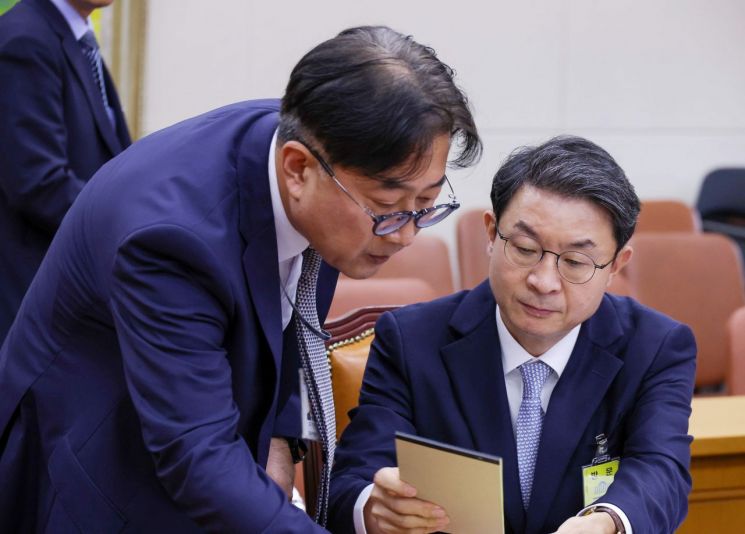
"Thorough Investigation of MBK Partners"...Push for Private Equity Fund System Reform
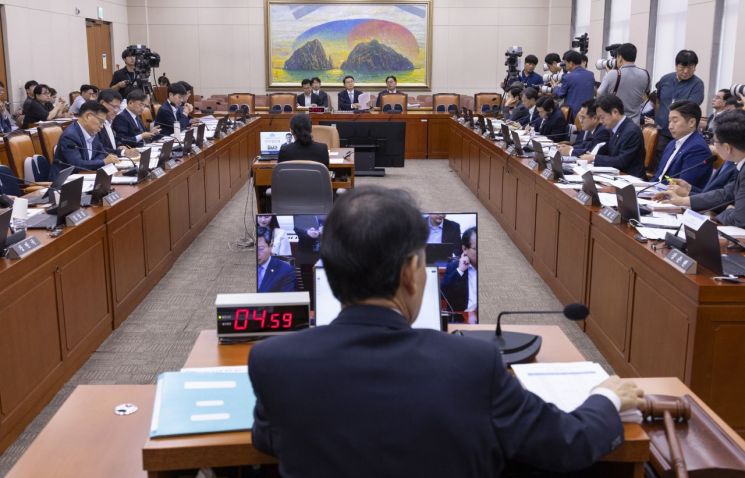
Due to clashes between ruling and opposition parties over the reorganization of financial authorities, the hearing, which was temporarily adjourned after about ten minutes in the morning, resumed later. The first question raised was from Namgeun Kim, a lawmaker from the Democratic Party, who criticized, "The former Chairman of the Financial Services Commission used the prosecution’s investigation as an excuse not to sanction MBK Partners, which ultimately led to the feared wave of Homeplus closures."
Lee responded, "I understand that the prosecution is investigating the issue of short-term bonds and fraudulent transactions," and said he would "promptly monitor both the financial authorities’ investigation and the prosecution’s investigation" after taking office. Since Governor Lee Chanjin took office, the FSS has also begun formal administrative sanctions procedures against MBK Partners. The final decision after the FSS Sanctions Review Committee rests with the Financial Services Commission. The levels of sanctions are: institutional caution, institutional warning, business suspension, and registration cancellation.
When Hyunjung Kim, a lawmaker from the Democratic Party, asked whether sanctions above an institutional warning were being considered, Lee said, "It is difficult to answer as the process is ongoing at the FSS," but added, "Depending on the seriousness of the legal violations, the FSS will determine the level of sanctions, and ultimately, the Securities and Futures Commission will impose corresponding measures."
In response to a follow-up question about whether, as a nominee, he was not ruling out sanctions above an institutional warning, Lee replied, "I have not seen the results yet," but said he would monitor the situation seriously. If MBK Partners receives a heavy sanction such as an institutional warning or higher, it could lead to the suspension or cancellation of the selection process for delegated asset managers (PGs) by limited partners such as the National Pension Service. The financial authorities have been examining whether the interests of LPs, including the National Pension Service, which invested 582.6 billion won, were harmed when the redemption rights of redeemable convertible preferred shares (RCPS) were changed in favor of Homeplus at the time of its credit rating downgrade.
In response to additional questions on the same topic in the afternoon, Lee reaffirmed, "I will thoroughly investigate MBK Partners and, if serious legal violations are found, take strict action in accordance with the law and principles." He further stated, "The private equity fund (PEF) system is approaching its twentieth year. Based on the results of research studies, we will assess its merits and shortcomings and determine whether improvements are needed in line with global standards."
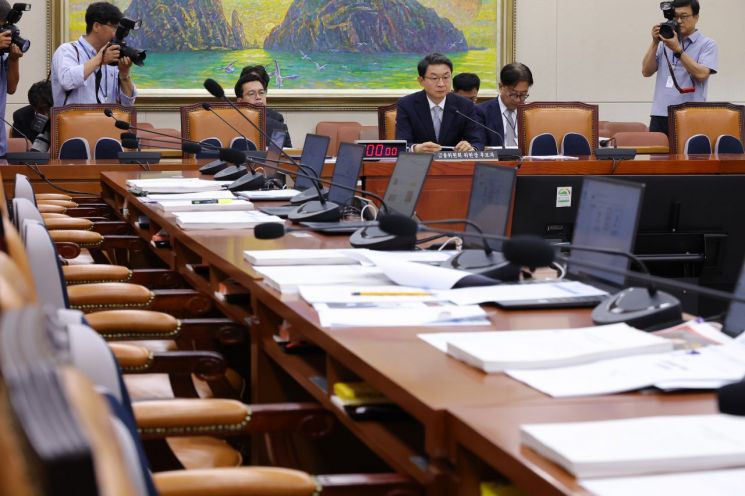
On Criticism of Major Shareholder Transfer Tax Standards: "Will Discuss with Finance Minister"
Lee was also asked by Han Hong Yoon, Chairman of the Political Affairs Committee (People Power Party), whether the tax reform plan to strengthen the criteria for major shareholders subject to capital gains tax had been finalized. Lee replied, "The Minister of Economy and Finance is listening to various opinions and deliberating carefully," and added, "I will discuss it with the Finance Minister."
At the end of July, immediately after the Ministry of Economy and Finance announced a tax reform plan to lower the stockholding threshold for major shareholders subject to capital gains tax from 5 billion won to 1 billion won per stock, the domestic stock market capitalization shrank by approximately 116 trillion won in a single day. The plan also drew criticism for contradicting the Lee Jaemyung administration’s policy of boosting the stock market to reach KOSPI 5000, sparking controversy.
Regarding the institutionalization of stablecoins, Lee confirmed that safeguards are being prepared. In response to a question from Junhyun Kang, a lawmaker from the Democratic Party, about whether the Financial Services Commission is prepared to exercise powers such as suspending issuance or ordering redemption if the increased use of stablecoins destabilizes financial markets, Lee replied, "We are preparing sufficient and reliable safeguards."
On whether stablecoin issuance should be limited to banks or expanded to non-bank institutions, he said, "We need to assess the situation." He added, "Along with institutionalizing won-denominated stablecoins, we are also preparing a regulatory framework for dollar-denominated stablecoins distributed domestically."
Regarding the accounting controversy at Samsung Life Insurance, Lee stated, "Amending supervisory regulations on asset management standards for insurers requires balancing various interests, so it is desirable for the National Assembly to decide through legislation."
On Criticism of Focusing on U.S. Stocks Instead of Korean Stocks: "For Market Experience"
During the hearing, Lee also faced criticism regarding his overseas stock investments and holding multiple outside director positions. Responding to a question from Sanghoon Kim, a lawmaker from the People Power Party, who asked, "As the head of the financial authorities, you are heavily investing in high-quality overseas stocks like Tesla, Strategy, and Nvidia. You are focusing on the U.S. market rather than the Korean market; who would invest in KOSPI then?" Lee explained, "It was to gain market experience."
He said, "During my public service, I could not invest in stocks. After leaving public office, I wanted to see how the market works by gaining experience." He added, "I invested to observe how the market operates and to understand investor sentiment. I invested a total of 70 million won in stocks-11 million won in the U.S. market and the rest in domestic stocks. I also invested in exchange-traded funds (ETFs)."
According to Lee’s written answers submitted to the Political Affairs Committee, his total stock holdings amount to 71.26 million won, with direct investment in only one domestic stock, Doosan Enerbility. The rest are investments in U.S. companies: 5.42 million won in Strategy, 4.71 million won in Tesla, and 2.52 million won in Nvidia.
Lee also rebutted criticism that, after leaving public office, he held multiple outside director positions at several companies such as LF, CJ Logistics, and Sampro Asset Management E-Broadcasting, earning high income, by stating, "I underwent review by the Public Official Ethics Committee," and "I did not serve in these positions simultaneously." He emphasized, "I was no longer a public official and had entered the market, and I did not receive higher compensation than others for outside director roles."
However, in response to criticism from Byungdeok Min, a lawmaker from the Democratic Party, that Lee earned a total of 620 million won-about 200 million won per year-over three years as an outside director at various companies, Lee replied, "In terms of the amount, I must reflect on whether it is appropriate from the public’s perspective."
Lee explained, "After leaving public office, I considered what activities to pursue, but due to a three-year employment restriction, I could not work full-time anywhere. While in public service, I was told to understand the field and the business world, so I tried to take such opportunities when they arose." He also responded to Min’s point that such behavior by former high-ranking officials negatively affects public sentiment, saying, "I will make sure not to act unfairly or allow such things to happen."
© The Asia Business Daily(www.asiae.co.kr). All rights reserved.
![Clutching a Stolen Dior Bag, Saying "I Hate Being Poor but Real"... The Grotesque Con of a "Human Knockoff" [Slate]](https://cwcontent.asiae.co.kr/asiaresize/183/2026021902243444107_1771435474.jpg)

















