Record-High Net Capital Outflow in July
China Promotes Stock Investments to Boost Consumption
Hong Kong and Shanghai Stock Markets Surge
As the real estate market in China weakens and housing prices decline, Chinese capital is shifting from real estate to stocks. This trend is influenced by the Chinese authorities easing regulations to encourage both domestic and overseas stock investment. While the influx of large amounts of capital has led to a boom in the Hong Kong and Shanghai stock markets, there are also concerns that capital outflows could put downward pressure on the yuan.
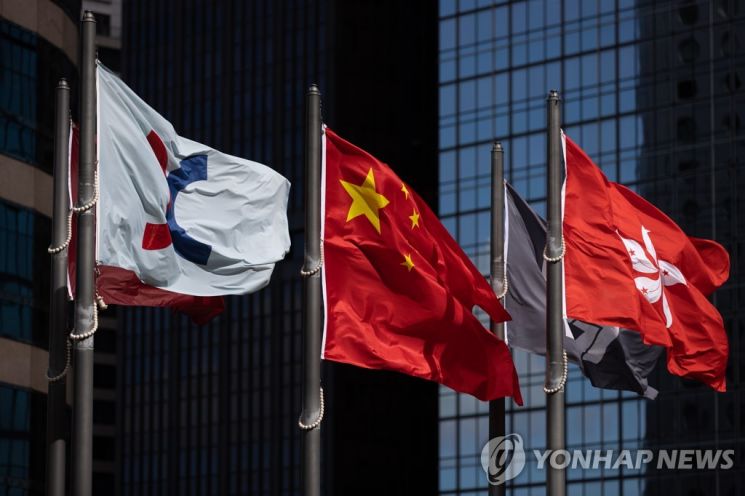
On September 1, the Nihon Keizai Shimbun (Nikkei) reported that in July alone, about 58.3 billion dollars (approximately 81.15 trillion won) flowed out of mainland China, marking the largest net capital outflow on record. According to the State Administration of Foreign Exchange of China, the net outflow-calculated by subtracting the amount of capital inflows from the funds remitted abroad by Chinese companies and households for securities investments such as stocks-reached 58.3 billion dollars in July, a tenfold increase compared to the previous month (June). This is the largest monthly figure since related statistics began in 2010.
Nikkei cited the relaxation of overseas investment regulations as the background for the outflow of Chinese capital. China has implemented strict capital controls to stabilize the yuan's exchange rate. As a result, banks and asset management companies within China were not allowed to freely invest in overseas stocks or bonds. Only Qualified Domestic Institutional Investors (QDII) that met certain requirements were permitted to invest abroad within assigned quotas. However, in June, the State Administration of Foreign Exchange increased the investment quota by 2%. With the conclusion of the US-China tariff dispute and the stabilization of yuan selling in the foreign exchange market, regulatory barriers were lowered.
The outflowing funds have flowed into the Hong Kong stock market. Since the beginning of this year, mainland Chinese capital has made net purchases of Hong Kong stocks worth about 1 trillion Hong Kong dollars (178.51 trillion won). This buying momentum has driven the Hang Seng Index up by more than 20% compared to the end of last year. The rise in stock prices was led by strong buying of large technology stocks, fueled by the emergence of artificial intelligence (AI) up-and-comer DeepSeek. Eased investment requirements for insurance companies and the resumption of taxation on government bond interest income have also led to capital inflows into the mainland stock market, pushing the Shanghai Composite Index to its highest level in a decade since August 2015.
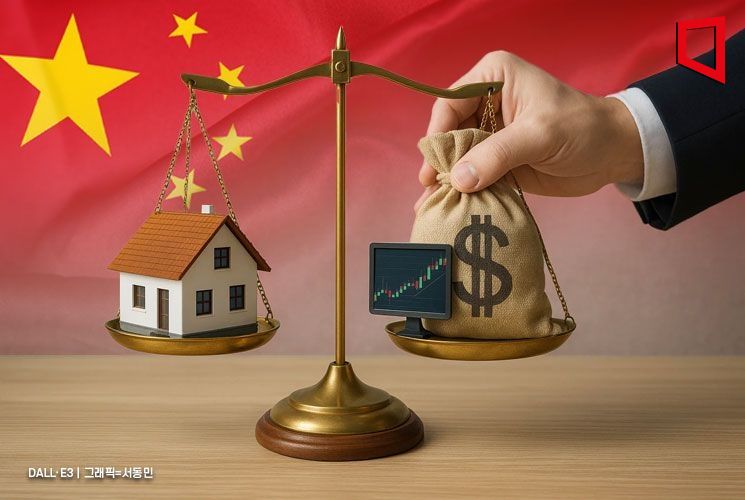
The reason the Chinese government is encouraging stock investment is to stimulate consumption. As the real estate downturn has dampened consumption, the authorities are seeking to boost spending through the wealth effect from rising stock prices. Currently, 80% of Chinese household assets are held in real estate. However, as the property bubble bursts and asset values decline, more households have reduced consumption and focused on saving. According to the People's Bank of China, the loan-to-deposit gap in banks, which represents the difference between deposits and loans, reached a record high of 52 trillion yuan at the end of July.
However, some point out that simply revitalizing stock investment may not solve the problem. To invest in overseas stocks and bonds, Chinese investors must sell yuan and buy foreign currencies. If this trend continues, the market may increasingly expect the yuan to depreciate further. This could actually lead to a weaker yuan, and the decline in currency value could trigger a vicious cycle of further capital outflows.
Another concern is the high proportion of individual investors in the mainland stock market, which increases volatility. If the stock market plunges, consumption could contract even further. Nikkei pointed out, "The mainland Chinese stock market is dominated by individual investors, so the investment base is not very deep. When stock prices rise, the market is prone to overheating, and when they fall, a vicious cycle of selling triggering more selling can easily occur."
In contrast to the recent stock market rally, China's economic indicators remain sluggish. The country's manufacturing Purchasing Managers' Index (PMI) for July declined for the fourth consecutive month, and the retail sales growth rate was only 3.7% year-on-year, falling short of the market expectation of 4.6%.
© The Asia Business Daily(www.asiae.co.kr). All rights reserved.
![Clutching a Stolen Dior Bag, Saying "I Hate Being Poor but Real"... The Grotesque Con of a "Human Knockoff" [Slate]](https://cwcontent.asiae.co.kr/asiaresize/183/2026021902243444107_1771435474.jpg)
















