Obong Reservoir Water Level at 15.3%
"Prepare Even More Thoroughly Than Emergency Measures"
Order to Declare Disaster Situation
"Mobilize Water Tankers and Large Bottled Water Nationwide"
"Include Seawater Desalination as a Long-Term Alternative"
Quantitative Comparison of Cost, Water Quality, and Acceptance
Inspection of Gangneung Commercial Districts
"We Will Do Our Best to Devise Countermeasures"
"An uncontrollable emergency could really occur, you know." (President Lee Jaemyung)
"I firmly believe it will rain in September." (Kim Hongkyu, Mayor of Gangneung)
"You shouldn't just rely on God..." (President Lee Jaemyung)
"Have you ever considered seawater desalination as a long-term measure?" (President Lee Jaemyung)
As the drought in Gangneung, Gangwon Province, reached a critical point, President Lee Jaemyung visited both the Obong Reservoir and the Gangneung City Hall Disaster and Safety Situation Room on August 30. President Lee instructed that short-, mid-, and long-term measures be separated and that those which could be implemented immediately should be executed right away. He also ordered a comprehensive plan for water supply measures to prepare for climate change, including seawater desalination as a long-term solution. Accompanying him at the drought site, Minister of the Interior and Safety Yoon Hojoong was instructed to immediately declare a disaster situation and to issue a national fire service mobilization order for the drought-affected areas in Gangneung.
Those present at the site included Minister Yoon, Kim Jintae, Governor of Gangwon Province, Kim Hongkyu, Mayor of Gangneung, Hwang Juho, CEO of Korea Hydro & Nuclear Power, and Heo Young, a lawmaker from the Democratic Party of Korea.
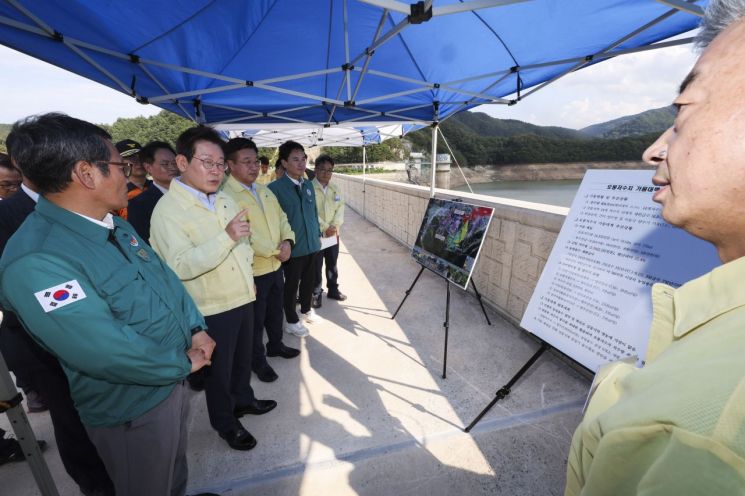
Obong Reservoir Water Level at 15.3%... "Prepare Even More Thoroughly Than Emergency Measures"
Arriving at Obong Reservoir at 3:22 p.m., President Lee personally checked the charts for water storage and supply, asking, "Is the current storage 2.18 million tons, with a water level of 15.3%, and a daily supply of 116,000 tons?" When Gangneung City reported that it was implementing "50% flow reduction through water meters" (affecting about 53,000 households), President Lee said, "The minimum required amount of water for daily life is 40,000 tons. If you have secured 18,000 tons, present a concrete plan on how to secure the remaining 22,000 tons."
Mayor Kim Hongkyu explained, "We will supplement with underground dams and treated wastewater from sewage treatment plants. In case of emergency, we will deploy more than 400 water tankers with a capacity of 10 tons each to supply water." President Lee responded, "Mobilize all those methods in the short term, but also consider 'scheduled water supply' and raising the household flow restriction from the current 50% up to a maximum of 75%." He also instructed that commercial districts be managed separately, taking into account tourism and business losses.
President Lee emphasized the need for even more thorough emergency planning. He said, "We can endure inconvenience, but an emergency could occur in a situation where there is really no countermeasure." He added, "We may need to consider scheduled water supply, but it seems there is no plan for that." When Mayor Kim replied, "I firmly believe it will rain in September," President Lee said, "You shouldn't just rely on God. On average, it may rain, but if it doesn't, we can't experiment with people's lives."
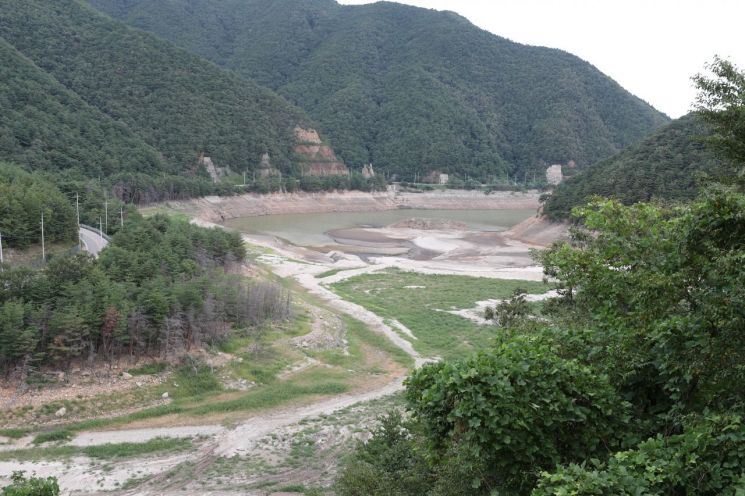
Order to Declare Disaster Situation... "Mobilize Water Tankers and Large Bottled Water Nationwide"
At the disaster countermeasure meeting held at the Gangneung City Hall Disaster and Safety Situation Room at 4:20 p.m., Governor Kim Jintae of Gangwon Province officially proposed "a government-level declaration of disaster situation." President Lee replied, "If necessary, let's do that," and instructed Minister Yoon Hojoong to immediately review and execute the declaration for Gangneung. He also ordered the phased nationwide mobilization of water tankers owned by the military, fire services, and local governments, along with requests for bottled water support.
Minister Yoon Hojoong reported, "Including 22 tankers from Gangwon Fire Services, a total of 72 water tankers can be mobilized immediately nationwide." President Lee also instructed that, in addition to this, the use of tankers usually used for road watering in summer should be considered for water supply, and that demand management measures such as scheduled water supply should be implemented under the direction of the Ministry of the Interior and Safety. The government declared a disaster situation at 7 p.m. and, under the national fire service mobilization order, plans to provide an additional 50 fire tankers to supply about 2,000 tons of water daily. President Lee further urged, "Mobilize all available government resources," and appealed, "Since nationwide support is needed, local governments with surplus resources should help out with a sense of community."
The use of the Doam Dam emerged as a key issue in securing additional water. When President Lee asked, "Isn't it necessary for securing water quantity?" Mayor Kim explained, "It was halted due to temperature differences, eutrophication, and past complaints." In contrast, Hwang Juho, CEO of Korea Hydro & Nuclear Power, said, "Recent studies show better water quality compared to Paldang Lake, and we are prepared to supply 10,000 tons per day within two weeks by adjusting intake depth and using a bypass channel." Regarding opposition from neighboring local governments, President Lee concluded, "Resolve issues that can be addressed with compensation, and verify water quality and temperature issues with objective assessments."
For mid- and long-term measures, the following were proposed: ① Expansion of Yeongok water intake and purification facilities to a capacity of 50,000 tons per day (currently 14,800 tons per day), ② Expansion of Sacheon Reservoir to 8 million tons (currently 2 million tons), and ③ Construction of a 5 million ton auxiliary dam upstream of Obong Reservoir. Regarding the estimated cost of expanding the Yeongok purification plant, President Lee instructed, "Calculate separately the costs for raw water procurement, water conveyance, and purification by category," pointing out the ambiguity regarding the existing modernization/expansion budget and the 'additional 50 billion won,' and ordered a reassessment.
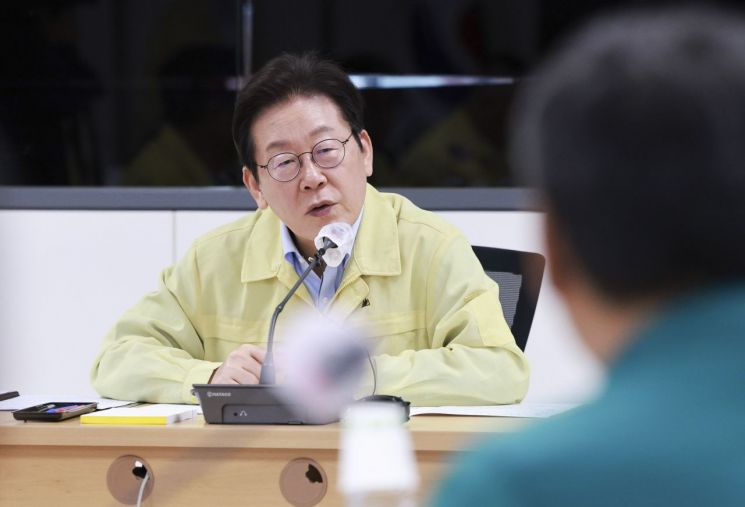
"Include Seawater Desalination as a Long-Term Alternative"... Quantitative Comparison of Cost, Water Quality, and Acceptance
President Lee stated that simply expanding reservoirs has its limits, and, noting that South Korea is classified as a "water-scarce country" amid increasing rainfall variability due to climate change, ordered that seawater desalination be included as a long-term alternative, with a quantitative comparison of cost, water quality, and public acceptance.
CEO Hwang Juho explained, "Desalination requires 5 kWh per ton of electricity, with an energy cost of about 200 won per ton." Mayor Kim Hongkyu expressed concern about the burden of facility costs. Minister Yoon Hojoong added, "Desalination is widely used in the Arab world, and combining it with power generation facilities can reduce costs. The water quality conditions are also favorable, such as with deep-sea water from the East Sea." He instructed Korea Hydro & Nuclear Power to present alternatives with numerical comparisons. President Lee ordered a scenario-based comparison of Gangneung's raw water unit cost (1,470 won per ton) and the facility and operating costs of desalination, including total cost analysis covering land, pipelines, and brine disposal.
When Mayor Kim Hongkyu requested that environmental impact assessments be excluded during reservoir dredging, President Lee instructed, "Review the matter."
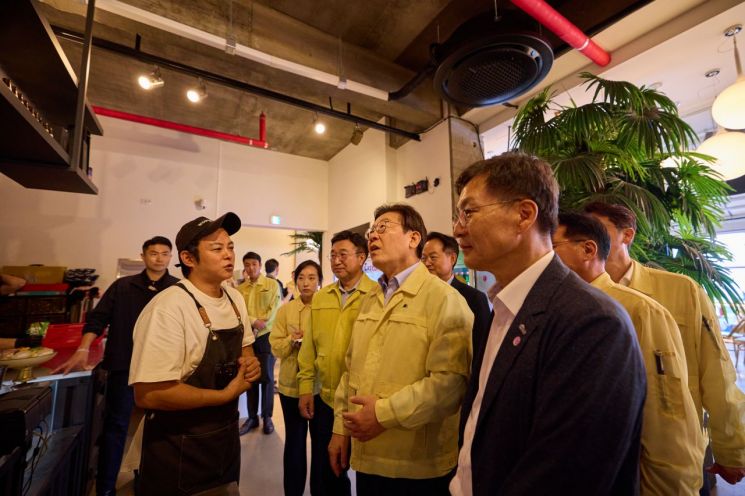
Inspection of Gangneung Commercial Districts... "We Will Do Our Best to Devise Countermeasures"
After the on-site inspection, the President visited the sashimi restaurant street at Gyeongpodae to look around the commercial area. When merchants appealed, "We have not been directly affected by water restrictions yet, but customers say they feel sorry to visit during the drought," Deputy Spokesperson Jeon Eunsu reported in a written briefing that President Lee responded, "I have ordered the declaration of a disaster situation. We will do our best to devise countermeasures."
© The Asia Business Daily(www.asiae.co.kr). All rights reserved.
![Clutching a Stolen Dior Bag, Saying "I Hate Being Poor but Real"... The Grotesque Con of a "Human Knockoff" [Slate]](https://cwcontent.asiae.co.kr/asiaresize/183/2026021902243444107_1771435474.jpg)

















