Kang Hoonshik Meets White House Chief of Staff First,
Requests Fact-Checking on Trump's Social Media Post
Summit Begins at 12:32 p.m.;
Trump Says He Is "Convinced It Was a Misunderstanding" After President Lee's Explanation
Trump States, "I Don't Believe in South Korean Election Fraud Claims";
Leaders Share Experiences with Terrorism
Summit Achieves Rapport and Builds Trust Between the Leaders
At 9:20 a.m. local time on August 25, in Washington, D.C., President Donald Trump posted on Truth Social, "What is happening in Korea? It looks like a purge or a revolution. You can't do business in such a situation." This was just a few hours before the first face-to-face meeting between the leaders of South Korea and the United States. The atmosphere became tense, and various interpretations and speculations spread rapidly. According to Presidential Chief of Staff Kang Hoonshik, while aides urgently discussed countermeasures upon hearing the news, President Lee Jaemyung remained calm.
At that time, Chief of Staff Kang was in a pre-summit review meeting. In the middle of the meeting, he headed to the White House. At 10:30 a.m., he sat down with White House Chief of Staff Susie Wiles. This meeting had been in the works for two weeks and was finalized a week prior. During the scheduled 40 minutes, the two coordinated the messages the two leaders would exchange at the summit. At the same time, they agreed to establish a real-time communication channel, a so-called "hotline," between the offices of the two chiefs of staff.
Chief Kang specifically mentioned that Wiles's father was a Korean War veteran, saying, "Korea is the country your father protected with his blood, and now we ask you to protect it." He also repeatedly requested that she report the facts to President Trump regarding the social media post. The intention was to draw a clear line so that misunderstandings surrounding the church search and military facility controversies would not disrupt the summit.
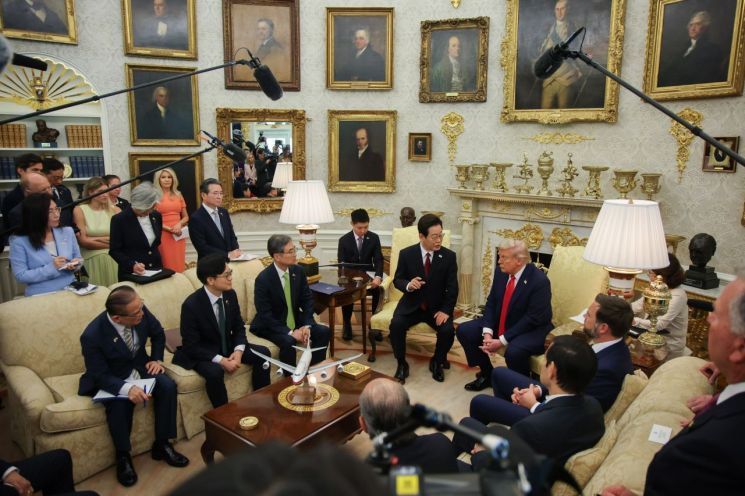
Amid heightened tensions, the two leaders finally met for the first time at 12:32 p.m., well past the scheduled noon start. They continued their Q&A with cameras open in the Oval Office, then moved to the Cabinet Room for a closed-door expanded meeting and working luncheon. The summit concluded at 3:00 p.m., lasting about two and a half hours in total.
Unlike the precarious situation in the morning, the summit proceeded smoothly from the outset. Aides present at the meeting reported that the summit, which lasted longer than expected, was consistently amicable. President Trump's tone also shifted. In a brief press conference open to all, he backed away from his earlier comments about the situation in Korea on social media, saying he was "convinced it was a misunderstanding." This was a clear departure from the harsh language used on social media. The prior coordination between the so-called "Kang-Wiles" line and President Lee's on-the-spot explanations had an impact.
After the summit, Chief Kang shared some behind-the-scenes stories from the closed luncheon during press briefings and interviews. According to Kang, President Trump stated that he "did not believe there was election fraud in Korea, at least." Trump also reportedly said, "I heard early on that you would win." This indicates that the atmosphere in the meeting room was different from the concerns just before the summit. The two leaders also discussed their experiences with terrorism. Chief Kang said President Lee first pointed out their commonalities, saying, "We both have experienced terrorism and have received the most votes."
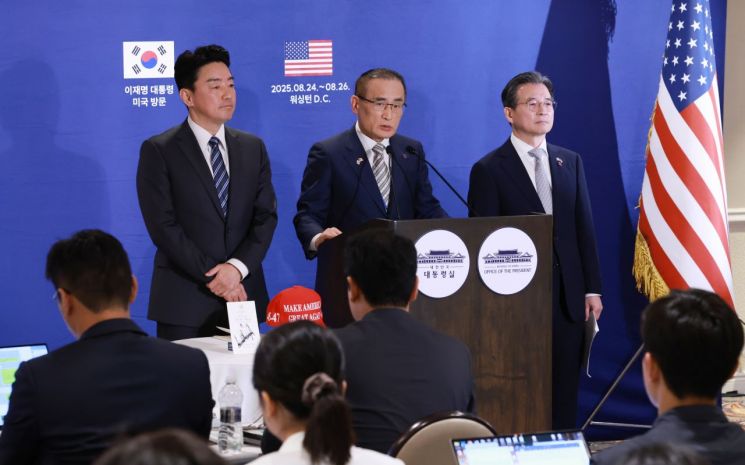
Regarding his impression of Trump, Chief Kang reflected, "He felt more like a warm American uncle than I expected." President Trump proudly showed off handwritten menus and nameplates, and signed "MAGA" hats and nameplates for each member of the accompanying staff. Kang said, "I couldn't help but feel that President Trump put a lot of sincerity and affection into personally signing 40 to 50 items." Even Chief of Staff Wiles, who had not smiled once during the 40-minute pre-summit meeting while listening to Kang's requests, finally smiled at the end of the summit when Kang said, "It was a good conversation."
This South Korea-U.S. summit achieved results in building rapport and trust between the leaders. National Security Office Director Wi Sunglak emphasized during a radio broadcast, "The greatest achievement is that personal bonds and trust were established." He added, "The president is the commander-in-chief and the top diplomat who leads foreign affairs. I believe that in their first meeting, the two top diplomats found common ground and mutual respect."
However, there are still many unresolved issues. While only broad directions were discussed regarding security and trade, the specifics will need to be addressed through further negotiations. Chief Kang also noted, "We've crossed a major mountain, but there is still a long way to go." He further analyzed that negotiations with the United States have now become the 'new normal,' in that "it's not over until it's really over."
© The Asia Business Daily(www.asiae.co.kr). All rights reserved.
![Clutching a Stolen Dior Bag, Saying "I Hate Being Poor but Real"... The Grotesque Con of a "Human Knockoff" [Slate]](https://cwcontent.asiae.co.kr/asiaresize/183/2026021902243444107_1771435474.jpg)
















