Ministry of the Interior and Safety Shifts Focus of Local Extinction Response Fund
From Infrastructure to People-Centered Population Growth
Local Leaders Propose Greater Fund Autonomy and Support Measures
The Local Extinction Response Fund, which has previously been used primarily for facilities and infrastructure, will now be utilized with a "people-centered" approach, targeting areas where there is a tangible effect on population inflow.
On August 29, the Ministry of the Interior and Safety held a policy meeting at the Sejong Convention Center with mayors, county governors, and district chiefs from population-declining areas, where this plan was announced. The meeting was attended by Minister Hojoong Yoon of the Ministry of the Interior and Safety, heads of local governments from population-declining regions, the acting president of Korea Railroad Corporation, and representatives from Socar, among others.
The Ministry of the Interior and Safety has decided to radically shift the operational paradigm of the Local Extinction Response Fund to address population decline. Whereas the fund has previously focused on facility construction, it will now be redirected toward increasing resident and short-term population, creating jobs, and building attractive communities-placing people at the center. The strategy is to attract a wide range of people, from short-term visitors to permanent residents, and to establish a virtuous cycle in which various types of resources are reinvested and spent locally, thereby creating more jobs and revitalizing the regional economy.
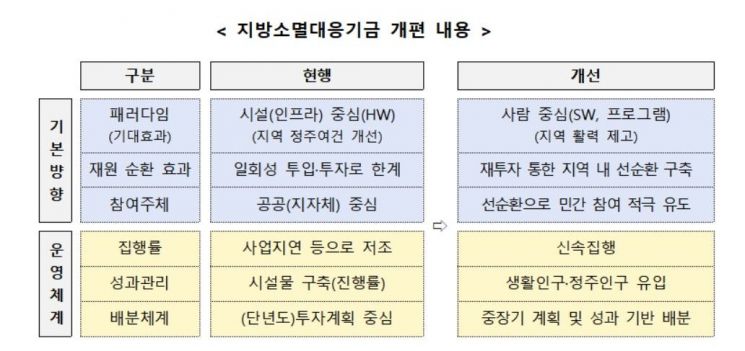
To this end, the Ministry will set specific population inflow targets for each project and strengthen performance management by reviewing results annually. In addition, by linking the redesignation of population-declining areas and the establishment of basic plans, starting with the 2027 fund, five-year mid-to-long-term plans will be developed, and confirmed project budgets will be flexibly allocated by year to ensure systematic fund execution.
Furthermore, the Ministry signed sisterhood agreements with nine local governments on this day. This is to actively pursue the sisterhood policy, which was proposed as a task for revitalizing mutual consumption in local communities during the 33rd Cabinet Meeting. The sisterhood initiative is a policy that encourages central government agencies, public institutions, and private companies to form partnerships with population-declining regions, supporting exchanges centered on hometown donation programs, workations, and the purchase of local specialties to revive stagnant local consumption.
As the ministry responsible for local administration, balanced development, and disaster safety, the Ministry of the Interior and Safety signed sisterhood agreements with all nine population-declining areas in the province, including those affected by disasters. The Ministry plans to collaborate with the Ministry of Economy and Finance and the Ministry of Trade, Industry and Energy to encourage public institutions and companies to participate, starting with central government agencies.
The Ministry of the Interior and Safety, population-declining regions, Korea Railroad Corporation, and Socar also signed a business agreement to promote the inflow of the resident population and revitalize the local economy. Korea Railroad Corporation will expand support by promoting and marketing tourism packages linked to railways and by discovering tourism resources to increase the resident population in population-declining areas. Socar will expand Socar Zones and operating vehicles in these areas and offer a 55% discount on rental fees for users in population-declining regions.
In addition, the Council of Mayors, County Governors, and District Chiefs from population-declining areas submitted a proposal to Minister Yoon on this day, outlining support measures for these regions. The proposal includes: ▲gradual expansion of the Local Extinction Response Fund, ▲increased autonomy in the use of the fund, ▲special provisions for utilizing unused military land in population-declining areas, ▲special provisions for rural revitalization districts in these regions, and ▲maintaining the status of existing population-declining areas upon redesignation.
Minister Yoon stated, "We will achieve results that lead to an increase in the resident and permanent population through comprehensive support for population-declining areas," adding, "We will continue to actively communicate and work together to ensure that these regions can unlock their potential and possibilities."
© The Asia Business Daily(www.asiae.co.kr). All rights reserved.
![Clutching a Stolen Dior Bag, Saying "I Hate Being Poor but Real"... The Grotesque Con of a "Human Knockoff" [Slate]](https://cwcontent.asiae.co.kr/asiaresize/183/2026021902243444107_1771435474.jpg)















