Opened in 2010, Current Capacity of 400 Inmates
Applicants Selected Through Interviews Due to High Demand
Asia's First Privately Operated Prison
Interest in private prisons has increased recently as news spread that Kim Hojung, who is currently serving time for drunk driving and hit-and-run charges, was transferred to Somang Private Prison. Somang Private Prison, to which Kim Hojung was transferred, opened in December 2010 in Yeoju, Gyeonggi Province. It is the only facility among 55 detention centers in South Korea that is operated by the private sector, and it is also Asia's first private prison.
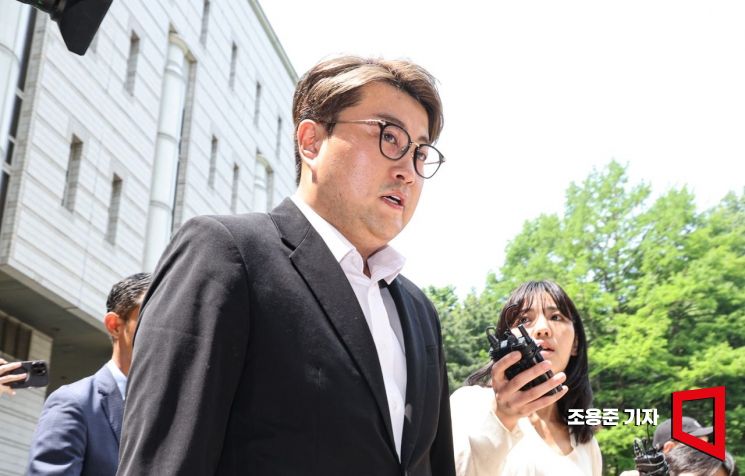 Interest in private prisons has increased recently as news spread that Kim Hojung, currently serving time for drunk driving and hit-and-run charges, was transferred to Somang Private Prison. Photo by Jo Yongjun
On August 29, Yonhap News focused on the operation, detention facilities, and daily life at Somang Private Prison, where Kim Hojung was transferred. First, in countries such as the United States, which introduced private prisons in the 1980s, as well as the United Kingdom, Australia, Japan, and Germany, there are already several private prisons run for profit. In South Korea, the enactment of the "Act on the Establishment and Operation of Private Prisons, etc." in 2000 led to the establishment of the Agape Foundation, founded by a coalition of Korean churches, which set up Somang Private Prison. In accordance with the relevant law, Somang Private Prison operates under a contract with the Ministry of Justice to carry out correctional work and is built on a site of approximately 214,000 square meters in Buknae-myeon, Yeoju, Gyeonggi Province. Initially, the prison had a capacity of 300 inmates, but after two rounds of expansion, the current capacity is 400 inmates.
'Somang Private Prison' Operated by a Christian Foundation
As a facility operated by a Christian foundation, its operational goals are also related to religion. The Somang Private Prison website states that its founding goal is "to help inmates restore their relationship with God so that they can reconcile with themselves, their families, and society, and to support them in living as devoted husbands, fathers, sons, and responsible citizens after release." In actual operation, there are several aspects that differ from ordinary prisons.
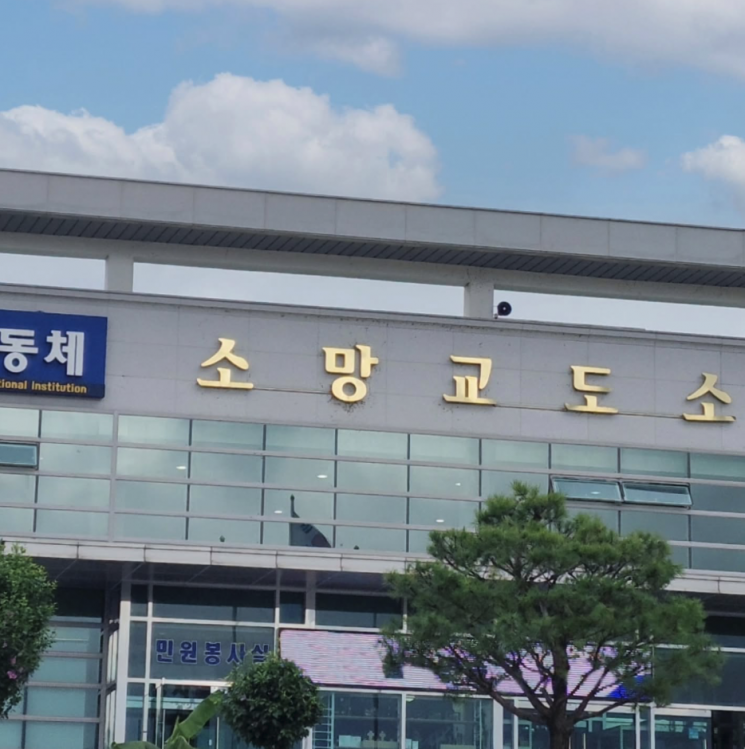 Somang Prison, to which Kim Hojung was transferred, is a private prison that opened in December 2010 in Yeoju, Gyeonggi Province. It is the only facility operated by the private sector among 55 detention facilities in South Korea and is also Asia's first private prison. Somang Prison SNS
According to Somang Private Prison, inmates are called by their names instead of numbers, and staff and inmates eat the same menu together every day, aiming for a family-like community culture. Educational and rehabilitation programs include personality type tests (MBTI), depression scale tests (BDI), as well as courses in the humanities, music, art, and spiritual training. In addition, all inmates and staff gather together for a barbecue event where they grill meat and eat together.
Somang Private Prison also highlights its unique vocational training, such as a coffee barista course that is rarely seen in other prisons, and active communication between staff and inmates through choir or instrument practice, reading, and prayer meetings. The admission requirements are also more favorable than those of ordinary prisons. According to materials released in connection with then-Minister of Justice Han Donghoon's 2022 visit to Somang Private Prison, the occupancy rate at ordinary prisons was 105.8%, while Somang Private Prison's occupancy rate was 98%. The per capita detention area is 2.58 square meters at ordinary prisons and 3.98 square meters at Somang Private Prison.
Must Meet Conditions Such as Sentence of 7 Years or Less and No More Than Two Offenses, and Pass an Interview
Inmates at Somang Private Prison are selected from among inmates in national prisons when vacancies arise due to full-term release or parole. Since the detention conditions are favorable, transferring to Somang Private Prison is considered a "hope" among inmates, but not everyone can go there. Admission is only possible under certain conditions according to a contract with the Ministry of Justice. First, admission conditions include a sentence of 7 years or less, a remaining sentence of 1 year or more, no more than two offenses, and male inmates aged between 20 and under 60. Those convicted of organized crime or drug offenses are excluded. In addition to meeting these conditions, inmates must also pass an interview at Somang Private Prison to be admitted.
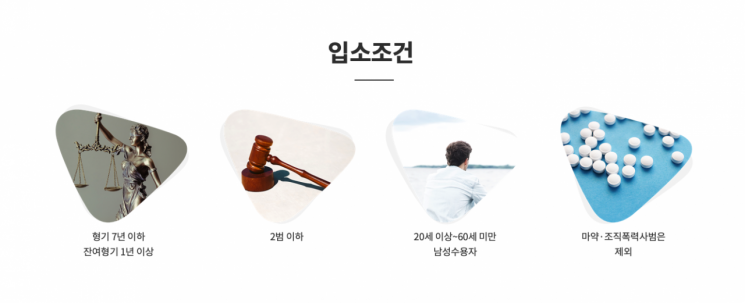 Somang Prison can only be admitted under certain conditions according to a contract with the Ministry of Justice. First, admission conditions include a sentence of 7 years or less, a remaining sentence of 1 year or more, no more than two offenses, and male inmates aged between 20 and under 60. Somang Prison website
The Ministry of Justice recruits inmates from state-run prisons who wish to be transferred, and completes the first round of selection among them. Subsequently, Somang Private Prison conducts interview procedures, including on-site visits and interviews, to select the inmates for admission. The number of first-round candidates is about twice the final number to be admitted. In an interview with Yonhap News, a current correctional officer said, "Because people think it's more comfortable than national prisons, whenever a transfer announcement is posted, even those who do not meet the requirements apply anyway."
In response to Yonhap News' inquiry about the inmate selection criteria, Somang Private Prison explained, "Voluntary willingness to participate is important, which is why we conduct interview procedures," adding, "The key factors are a minimum level of communication skills to follow the education, confirmation of voluntary willingness to participate in education, and the applicant's motivation for applying." Although it is operated by a Christian foundation, the prison added that religion is not considered during the selection process.
High Inmate Satisfaction Leads to Many Transfer Applicants
Is there a difference in the correctional effect of private prisons compared to national prisons? First, the level of life satisfaction among inmates at Somang Private Prison is found to be high. According to a report published by the Ministry of Justice in 2022, the inmate satisfaction level at three national prisons ranged from 2.83 to 3.20, while at Somang Private Prison it was 3.83. In satisfaction surveys regarding facilities and services, inmates at Somang Private Prison also reported overall higher satisfaction than those at national prisons. As inmate satisfaction is high and many apply for transfers, some critics argue that excessive services are being provided to offenders.
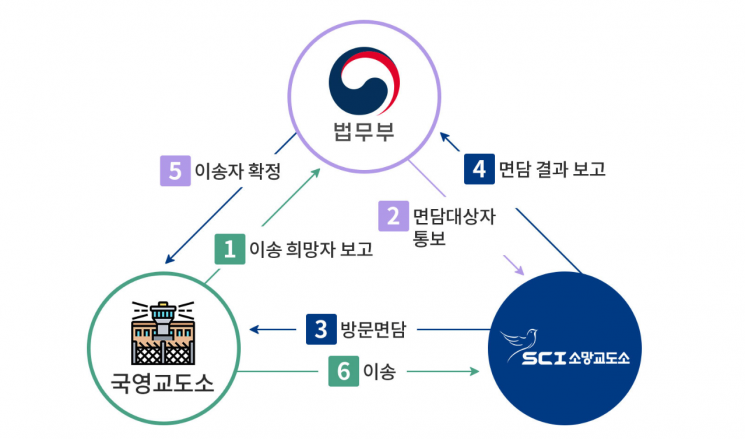 The Ministry of Justice is recruiting inmates from state-run prisons who wish to be transferred and will complete the first round of selection among them. Subsequently, Somang Prison will conduct interview procedures, including on-site visits and interviews, to select the inmates for admission. Somang Prison website
Meanwhile, although the need for private prisons continues to be raised due to issues such as overcrowding, it is not easy to establish additional private prisons. The biggest issue is the cost of establishment and operation. As of 2010, Somang Private Prison spent about 23 billion won on initial construction costs, and since then, 90% of its budget has been supported by the government. From the state's perspective, some budget can be saved, but since there is no profit, it is pointed out that it is difficult to find an operator unless it is a religious organization.
While private prisons overseas are run for profit, in South Korea they are operated purely as nonprofit foundations. In the case of Somang Private Prison, as of 2019, a total of 7,159 people participated in volunteer work annually, and several thousand volunteers help each year. The average salary per staff member is also known to be about two-thirds that of national prisons. Regarding the reason why new private prisons are not being established, Somang Private Prison stated, "The enormous construction cost may be the biggest reason," adding, "It is also a challenge to negotiate with local residents, as the facility is often perceived as undesirable in the community."
© The Asia Business Daily(www.asiae.co.kr). All rights reserved.
![Clutching a Stolen Dior Bag, Saying "I Hate Being Poor but Real"... The Grotesque Con of a "Human Knockoff" [Slate]](https://cwcontent.asiae.co.kr/asiaresize/183/2026021902243444107_1771435474.jpg)

















