At Least 60% of Assets Must Be Invested in Ventures
Will the Venture Investment Ecosystem Be Revitalized?
Six years after the initial discussion, the introduction of Business Development Companies (BDC) has finally become a reality in South Korea. A BDC is a collective investment vehicle (fund) that raises investor capital through an initial public offering (IPO) and is subsequently listed on the stock market. General investors will now be able to easily invest in promising unlisted ventures and startups, such as Toss and Dunamu, while venture and innovative companies are expected to secure greater funding. Expectations are rising that this will accelerate the activation of the venture ecosystem.
At Least 60% of Assets Must Be Invested in Ventures
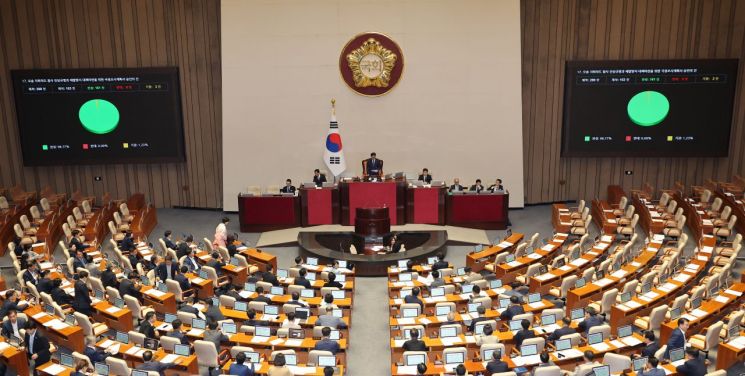
On August 27, the National Assembly passed an amendment to the Capital Markets Act that provides the legal basis for introducing BDCs. The core of this amendment is the introduction of BDCs as public offering funds that invest at least 50% of their assets in ventures and innovative companies with high growth potential. It also stipulates that these funds will be operated as closed-end funds with a maturity of at least five years, during which redemptions are not allowed. The amended Capital Markets Act is scheduled to take effect around March next year, six months after its promulgation.
According to the draft enforcement decree, the investment ratio in ventures and innovative companies must be at least 60%. Eligible investment targets include unlisted companies, KOSDAQ-listed companies, and shares in venture investment associations, new technology investment associations, and private equity funds specializing in startups. To ensure operational stability, BDCs may invest up to 10% of shares, 10% of securities, and 10% of loans in a single company, and up to 50% of the total shares issued by each target company (up to 10% for public offering funds).
Partial borrowing, which was previously not allowed, will now be permitted. Since a BDC is a closed-end public offering fund, it is difficult to inject additional capital once it is established, making it challenging for companies to raise more funds if needed. There was a previous proposal to allow borrowing from financial institutions up to 100% of the BDC's total assets, but this was not accepted due to concerns about potential investor losses. As a result, some pointed out that BDCs might not be able to fully function as investment vehicles supporting companies through their growth stages. According to the draft enforcement decree, loans to venture and innovative companies will be permitted up to 40% of the total investment amount.
Kang Kyunghoon, a professor at the Department of Business Administration at Dongguk University, commented, "Allowing 100% borrowing could lead to excessive investments and side effects such as losses for general investors. However, permitting partial borrowing is a positive step, as it will make it easier for venture companies to secure growth capital."
Investor protection measures are also included. BDC operators are required to make a 5% seeding investment as part of responsible investing. In addition, there must be at least one fair value assessment of the fund per year, external evaluations of the growth potential of venture and innovative companies, and mandatory disclosure of key management matters.
In addition to public asset management companies, venture capital firms are also being considered as potential operators. However, securities companies are currently excluded from initial approval due to potential conflicts of interest between proprietary and client asset management and sales processes.
Will the Venture Investment Ecosystem Be Revitalized?
Retail investors will gain access to new investment opportunities. Anyone with a securities account can participate, and fund shares can be freely traded on the market like stocks and exchange-traded funds (ETFs), significantly improving liquidity.
The venture investment industry is increasingly hopeful about the influx of private capital. Deep tech startups, particularly in artificial intelligence (AI) and biotech, require large-scale investments at each stage of growth. However, domestic venture capital firms typically manage funds of only several tens of billions of won, limiting individual investments to the 1 billion to 2 billion won range. Even large-scale private equity funds (PEFs) have rarely made significant investments in startups. The introduction of BDCs is expected to help bridge the "investment gap" between the early and later stages of venture and startup growth.
© The Asia Business Daily(www.asiae.co.kr). All rights reserved.
![Clutching a Stolen Dior Bag, Saying "I Hate Being Poor but Real"... The Grotesque Con of a "Human Knockoff" [Slate]](https://cwcontent.asiae.co.kr/asiaresize/183/2026021902243444107_1771435474.jpg)















