Sharp Decline in Student Numbers Led by Kindergartens and Elementary Schools
Dropout Rate Rises, Especially Among High School Students
Number of Multicultural Students Continues to Grow
Over the past five years, the number of kindergarten, elementary, and secondary students nationwide has decreased by approximately 460,000. The decline was led by kindergarteners and elementary school students. As the trend of low birth rates has intensified, the decrease in the number of students has become more pronounced at lower school ages.
On August 28, the Ministry of Education announced the results of the "2025 Basic Educational Statistics Survey." Every year, the Ministry conducts a survey as of April 1, targeting kindergartens, elementary, middle, and high schools, higher education institutions, and education administrative agencies nationwide, and releases the results in August.
According to the results, the total number of students in kindergartens, elementary, middle, and high schools nationwide this year is 5,551,250, a decrease of 2.3% (133,495 students) compared to the previous year. The number of kindergarteners fell by 17,079 (down 3.4%) to 481,525, and the number of elementary school students dropped by 149,517 (down 6.0%) to 2,345,488, representing a larger decrease than in other school levels such as middle and high schools.
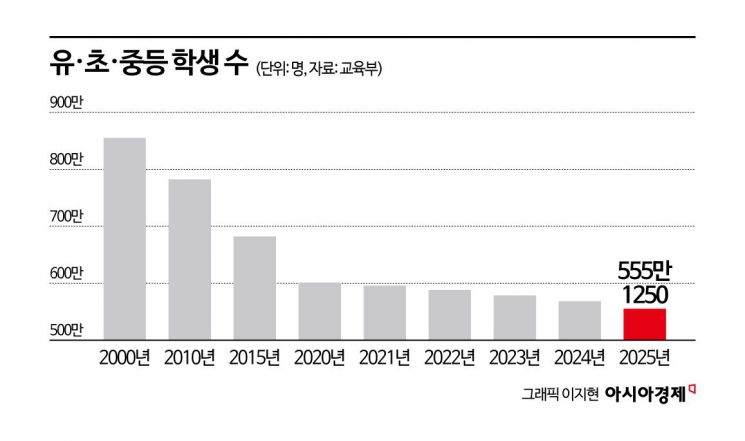
The number of middle school students increased by 37,506 (up 2.8%) to 1,370,356, while the number of high school students decreased by 4,859 (down 0.4%) to 1,299,466.
The number of students in "other schools," including special schools, civic high schools, technical high schools, various types of schools, and broadcasting and telecommunication middle and high schools, increased by 454 (up 0.8%) to 54,415.
The average number of students per class in kindergartens decreased by 0.1 to 15.6. In elementary schools, it decreased by 0.7 to 19.3. In middle schools, it increased by 0.4 to 24.9, while in high schools, it remained the same as the previous year at 23.4.
The number of students per teacher decreased by 0.4 in kindergartens and by 0.6 in elementary schools compared to the previous year. It remained the same in middle schools and increased by 0.3 in high schools.
The number of multicultural students increased by 8,394 (up 4.3%) to 202,208 compared to the previous year. The proportion of multicultural students among all students was 4.0%. This is an increase of 0.2 percentage points from 3.8% last year.
The dropout rate increased from 0.6% in 2020 to 1.1% in 2024. The increase was particularly notable in high schools. During the same period, the dropout rate among high school students rose by 1.0 percentage point, from 1.1% to 2.1%. Last year, 20,765 high school students dropped out, an increase of 1,150 compared to the previous year (2023).
The total number of kindergarten, elementary, and secondary teachers was 506,100, a decrease of 0.6% compared to the previous year. The number of kindergarten teachers decreased by 181 to 55,223, and the number of elementary school teachers decreased by 3,527 to 193,071. The number of high school teachers decreased by 1,103 to 128,333, while the number of middle school teachers increased by 1,266 to 116,046.
The Ministry of Education and the Korea Educational Development Institute plan to provide the results of the "2025 Basic Educational Statistics Survey" through various channels, including the Educational Statistics Service website and the Educational Statistics Yearbook publication.
© The Asia Business Daily(www.asiae.co.kr). All rights reserved.
![Clutching a Stolen Dior Bag, Saying "I Hate Being Poor but Real"... The Grotesque Con of a "Human Knockoff" [Slate]](https://cwcontent.asiae.co.kr/asiaresize/183/2026021902243444107_1771435474.jpg)















