A "fluorescent reporter" capable of tracking the process of cell death in real time has been developed.
Cells in the human body undergo programmed death (apoptosis) after a certain period. This is a natural process that helps maintain the body's balance.
Conversely, when old or damaged cells are not removed, it can lead to diseases such as cancer, heart disease, and dementia. Accurately observing when and how cells undergo apoptosis is therefore a crucial tool in the fields of life sciences, medicine, and pharmacology, enabling early disease diagnosis and evaluation of treatment efficacy.
The Korea Research Institute of Bioscience and Biotechnology (hereafter referred to as KRIBB) announced on August 28 that the research team led by Dr. Sunwook Kim at the Future Animal Resources Center has developed a "fluorescent reporter" technology that can visualize the process of apoptosis occurring inside cells in real time.
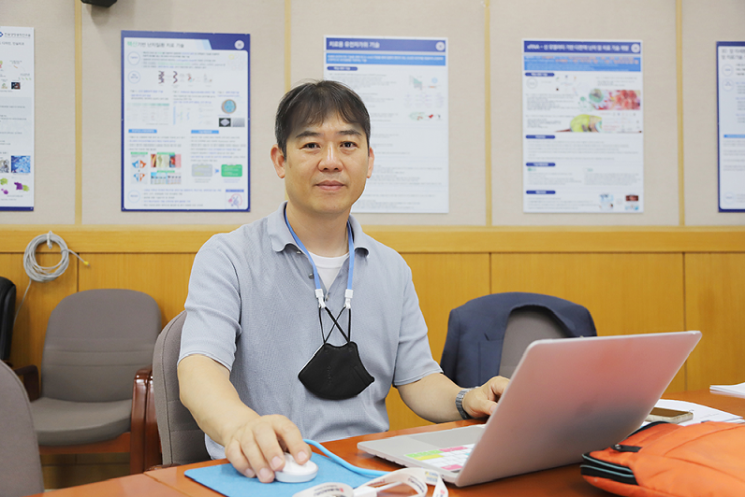
This technology utilizes a mutant fluorescent protein to directly observe apoptosis, overcoming the limitations of existing apoptosis detection methods and increasing its potential for commercialization. It is also expected to contribute to a paradigm shift in drug development and life science research.
Until now, methods such as microscopic observation, genetic analysis, and fluorescent protein technologies have mainly been used to detect apoptosis. However, these methods have shown problems in terms of complex sample processing, additional staining procedures, and accuracy.
With this in mind, the research team focused on the enzyme "caspase-3," which acts as the "final executor" in the process of apoptosis.
This enzyme selectively cleaves a specific amino acid sequence (DEVDG). By precisely inserting this sequence into GFP (green fluorescent protein), fluorescence is lost in real time when apoptosis occurs, allowing for immediate detection and measurement.
Notably, among all GFP fluorescent reporters developed to date, this technology features the simplest operating mechanism and an ultra-compact design, which dramatically increases the sensor's sensitivity and accuracy.
The research team verified that, using this technology, the process of apoptosis could be tracked in real time under a microscope under various conditions, including exposure to toxic substances and anticancer drugs.
Furthermore, this technology can be applied not only to cancer cells but also to various animal cell models, confirming its broad potential for use in evaluating the cytotoxicity of drug candidates and verifying drug efficacy. The team expects it will also contribute to research on diseases related to apoptosis, such as Alzheimer's disease, heart disease, and cancer.
Dr. Sunwook Kim stated, "The technology developed by our team allows apoptosis to be observed much more sensitively and easily than existing methods, so we expect it to contribute to rapidly verifying the efficacy of drug candidates such as anticancer agents in the future. Above all, it will be highly useful in research on degenerative brain diseases, where apoptosis plays an important role."
Meanwhile, this research was supported by the BIG (Big Issue Group) project led by the National Research Council of Science & Technology (KRIBB's main project), the Global TOP Project, the Excellent Young Researcher Program of the Ministry of Science and ICT, and the Core Technology Development Program for the Bio-Industry of the Ministry of Trade, Industry and Energy. The results were published online in the international journal 'Journal of Advanced Research'.
© The Asia Business Daily(www.asiae.co.kr). All rights reserved.
![Clutching a Stolen Dior Bag, Saying "I Hate Being Poor but Real"... The Grotesque Con of a "Human Knockoff" [Slate]](https://cwcontent.asiae.co.kr/asiaresize/183/2026021902243444107_1771435474.jpg)















