Coway’s U.S. Subsidiary Achieves 214.2 Billion Won in Sales Last Year
Up 40.6% Over Five Years
Cuckoo Homesys Also Grows 125.5% in the Same Period
Large Market Size Makes It a ‘Blue Ocean’
Recent Demand on the Rise
The home appliance rental industry is moving beyond the stagnant domestic market and expanding into the vast United States market. Industry players see significant growth potential due to the low penetration rate of rental appliances relative to the population and the recent increase in demand. However, it is expected to take some time to gain a foothold in the market, given the resistance to in-home care systems and the challenges of establishing an initial network.
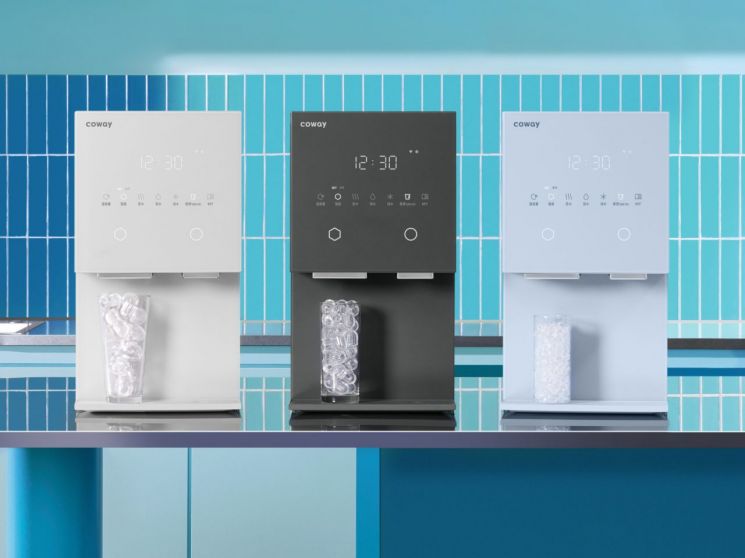
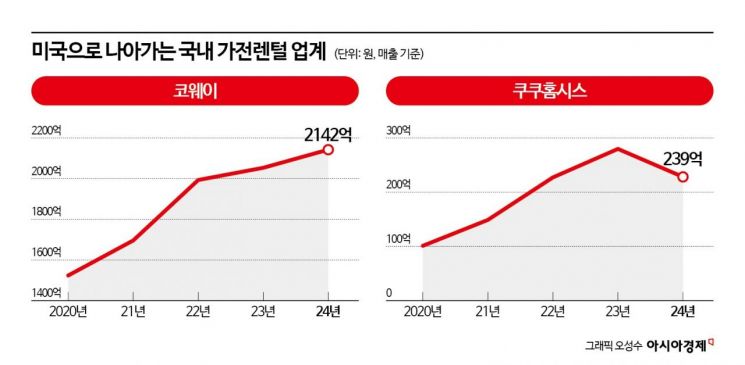
According to industry sources on August 27, Coway’s U.S. subsidiary recorded sales of 214.2 billion won last year, up 40.6% from 152.4 billion won in 2020, five years ago. This is the second-highest growth rate among Coway’s major overseas subsidiaries, following Thailand (335.0%). Sales for the first half of this year reached 118.1 billion won, and if this trend continues, the company is expected to achieve record results again this year. In June, Coway acquired a 100% stake in its U.S. local subsidiary, NecoA Holdings, to accelerate its efforts to penetrate the U.S. market.
Cuckoo Homesys has also been steadily scaling up since establishing its U.S. subsidiary in 2019. The U.S. subsidiary’s sales increased by 125.5%, from 10.6 billion won in 2020 to 23.9 billion won last year. This growth is attributed to steady increases in offline sales through Costco in the U.S. and online sales via Amazon. Meanwhile, Chungho Nice, which primarily sells filters, is also planning to gradually expand its product lineup and presence in the U.S. market. A Cuckoo Homesys representative explained, “The strong performance that was once centered in Malaysia is now shifting to the U.S.,” adding, “We are now strengthening our marketing efforts toward local Americans, moving beyond our previous focus on the Korean community.”
The U.S. market is considered a representative ‘blue ocean.’ Water purifiers, in particular, are seen as highly competitive. The growth potential is considered limitless, given the relatively low household installation rate and the large market size. In the U.S., where people mainly purchase bottled water or use tap water with attached filters, demand for water purifiers has been rising due to issues such as aging water and sewage pipes and increases in bottled water prices. According to global market research firm Fortune Business Insights, the U.S. water purifier market is expected to grow from $6.44 billion in 2023 to $9.59 billion by 2030.
However, challenges such as cultural differences and difficulties in building an initial network must be overcome. In the U.S., where there is a strong reluctance to allow outsiders into one’s home, there is significant resistance to professional care services in which a manager visits monthly to replace and clean filters. Furthermore, the rental system, where customers pay a fixed monthly fee to rent products, is not widely understood, making marketing and promotion more challenging than in other markets.
An industry insider commented, “We are focusing on introducing a filter management system based on regular deliveries instead of the coordinator system, and strengthening brand recognition among local residents. Since the rental business tends to grow rapidly once the initial network is established, the key to success in the U.S. market will be who manages to ‘plant their flag’ first.”
© The Asia Business Daily(www.asiae.co.kr). All rights reserved.
![Clutching a Stolen Dior Bag, Saying "I Hate Being Poor but Real"... The Grotesque Con of a "Human Knockoff" [Slate]](https://cwcontent.asiae.co.kr/asiaresize/183/2026021902243444107_1771435474.jpg)

















