Relative Overvaluation Is a Fact
Some Misunderstandings in Sam Altman's Remarks and the MIT Report
How much truth is there to the AI bubble theory, which has been sparked by Sam Altman's statement that "the AI bubble is real" and an MIT report claiming that "95% of companies adopting AI see no results"? While it is true that the stock prices of the Magnificent 7 (M7) are overvalued, both Altman's comments and the MIT report can be interpreted in a nuanced way.
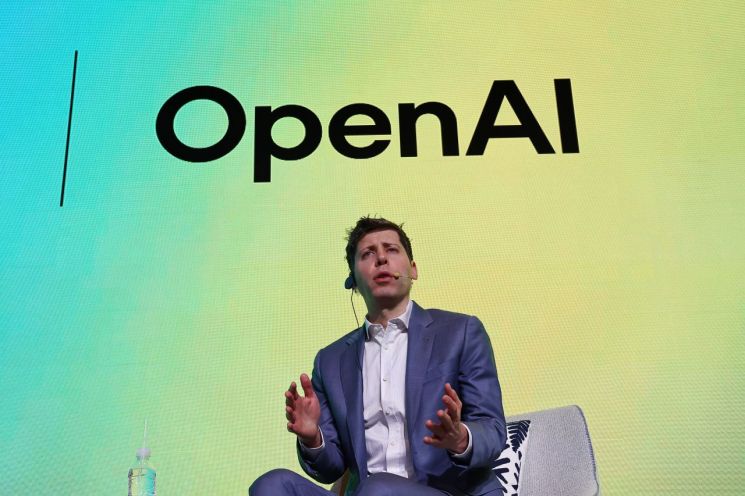
Sam Altman: "AI is the Foundation for Long-Term Innovation"
Sam Altman, CEO of OpenAI and creator of ChatGPT, remarked that the current situation is "similar to the dot-com bubble 20 years ago." Immediately after his comment, the stock prices of the Magnificent 7 (Apple, Nvidia, Microsoft, Amazon, Alphabet, Meta, Tesla) plummeted in the U.S. stock market. Right before the dot-com bubble burst, the S&P 500 price-to-earnings ratio (PER) was 25, and this figure has recently risen to 22. The PER for the M7, in particular, stands at 28, which is higher than that of the S&P 500.
However, Altman's interview not only warns against investors' excessive expectations, similar to those during the dot-com bubble, but also presents a dual perspective by emphasizing that AI will serve as the foundation for long-term innovation. Park Hyunjung, an analyst at Daishin Securities, explained, "The key point is that companies with core technologies will survive even if the bubble bursts, and in the long run, AI will be a huge net win for the economy. Ultimately, this means filtering out so-called scam companies and selecting firms with economic moats."
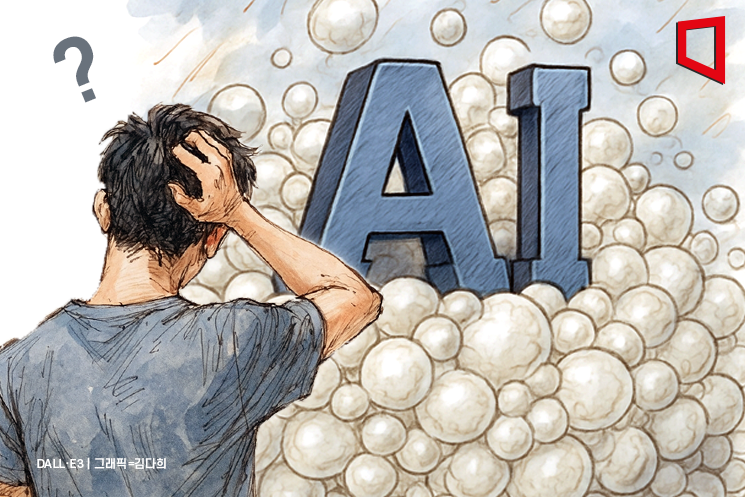
MIT Report: "Boost Productivity with Agentic AI"
Last week, MIT NANDA (Networked Agents And Decentralized Architecture) published a report on generative AI, stating that "companies have invested $3 billion to $4 billion in generative AI, but 95% have seen no results." The report points out that companies still rely on humans to handle complex and long-term work processes.
However, the report also suggests that the limitations of generative AI can be overcome by utilizing Agentic AI, which is seeing a growing number of users. Kim Ilhyuk, a strategist at KB Securities, noted, "MIT NANDA diagnosed that current generative AI systems have a 'learning gap,' which hinders their effective use. However, they also stated that these limitations can be overcome by employing Agentic AI, which incorporates permanent memory and repetitive learning into its design." Unlike generative AI, Agentic AI does not require users to provide the entire intended context every time it is used. It learns through interaction with users and, because of these characteristics, can independently coordinate complex work flows. Therefore, the report concludes that companies should utilize Agentic AI.
© The Asia Business Daily(www.asiae.co.kr). All rights reserved.
![Clutching a Stolen Dior Bag, Saying "I Hate Being Poor but Real"... The Grotesque Con of a "Human Knockoff" [Slate]](https://cwcontent.asiae.co.kr/asiaresize/183/2026021902243444107_1771435474.jpg)
















