Bid Notice for Contractor Selection Issued on the 21st
Bid Deposit Set at 100 Billion Won
Hyundai E&C and HDC Hyundai Development Company Request Review of Bidding Guidelines
The competition to win the construction contract for Seongsu 1 District, with a project cost reaching 2 trillion won, has officially begun. Amid an industry trend of construction companies selectively pursuing redevelopment projects due to the economic downturn, Hyundai Engineering & Construction, GS Engineering & Construction, and HDC Hyundai Development Company have entered a strategic standoff to secure a redevelopment site in the Hangang Belt. With the three companies already showing notable moves, restrictions in the bidding guidelines and the massive bid deposit have emerged as key variables in the early stage of the race.
According to the redevelopment industry on August 22, the Seongsu 1 District redevelopment association announced a bid for the selection of a construction company the previous day. The bid deposit is set at 100 billion won, and joint contracts are not allowed. The bidding deadline is in October, and the association plans to hold a general meeting to select the contractor as early as November or December.
Industry experts expect this bidding war to be a three-way contest among GS Engineering & Construction, HDC Hyundai Development Company, and Hyundai Engineering & Construction. In May, when the intention to participate in the bid was confirmed with ten construction companies, these three expressed their interest in the project.
GS E&C Targets Votes with Specialized Design... Hyundai E&C and HDC Hyundai Development Company Go All In as Latecomers
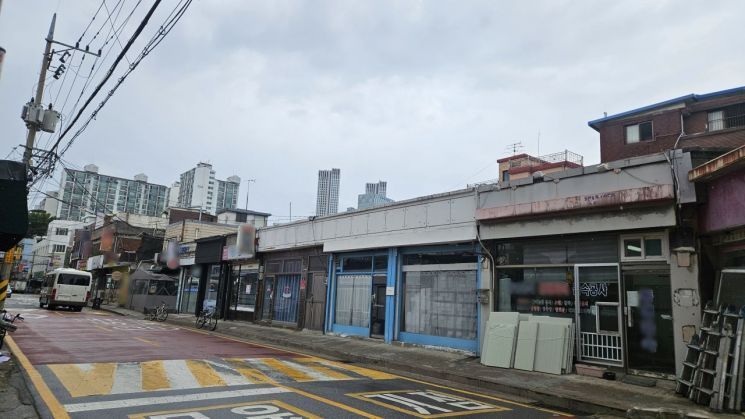
Seongsu 1 District boasts a location that offers both the Han River and Seoul Forest, and has business potential comparable to that of the Gangnam area. Winning this project would allow the contractor to secure a high-rise landmark along the Han River and expand its influence in the premium residential market of the Hangang Belt. Notably, Seongsu 1 District has the earliest bidding schedule among the four districts in the Seongsu Strategic Redevelopment Zone, so securing this contract could have a ripple effect on winning the remaining districts. Once redevelopment is completed, the area will feature 3,014 apartment units along with cultural and convenience facilities.
GS Engineering & Construction, which has recently struggled in Hangang Belt redevelopment bids, is making an all-out effort for this project. The company has been working behind the scenes to use Seongsu 1 District as a springboard for revitalizing its redevelopment business. Recently, it has differentiated itself starting from the design stage. It is collaborating with David Chipperfield Architects, founded by Pritzker Prize-winning architect David Chipperfield, for the design. The company is also working with the global engineering firm ARUP for high-rise construction technology.
The latecomers have also jumped into the competition early. HDC Hyundai Development Company is putting forward its "developing strategy," which was used in the Yongsan Maintenance Depot Zone 1 project. This approach goes beyond simple construction, encompassing product planning and operation to enhance future value. Hyundai Engineering & Construction is leveraging its high-rise construction capabilities as a differentiator. It has selected global architectural firm SMDP and global engineering company LERA as partners. LERA has experience designing high-rise landmark structures such as Lotte World Tower in Jamsil and the World Trade Center in New York.
Bidding Restrictions and 100 Billion Won Deposit... Possibility of Changing the Competitive Landscape
Key variables include the restrictive bidding conditions and the enormous bid deposit. Hyundai Engineering & Construction and HDC Hyundai Development Company have pushed back against the bidding guidelines set by the association, calling them "excessively restrictive." The guidelines prohibit priority pre-sales proposals for association members, restrict financial terms, require a completion guarantee except in cases of natural disasters or war, prohibit offering discounts on pre-sale prices for members, and ban alternative designs or additional idea proposals.
Both companies sent an official letter on August 18 requesting a review of these restrictions, arguing that the conditions could serve as toxic clauses that hinder participation in the bid. They claim that the excessive restrictions prevent competitors from differentiating themselves and appear to favor a particular contractor. Hyundai Engineering & Construction stated, "We are unable to present business proposals that showcase each company's strengths, which undermines the purpose of competitive bidding." HDC Hyundai Development Company also requested revisions and a review, saying, "There are many aspects of the guidelines that do not align with the best designs and business conditions we are preparing."
For the latecomers, excessively restrictive bidding conditions inevitably put them at a disadvantage. Since Seongsu 1 District is a project that GS Engineering & Construction has been cultivating for a long time, competitors must present highly differentiated business terms to overturn the current dynamics. An industry insider commented, "These two companies are challenging a site that is essentially GS E&C's stronghold, so they need to offer exceptional terms to change the game. If bidding conditions are too restrictive, companies cannot demonstrate their competitiveness, which narrows their options."
Whether the companies can secure the massive bid deposit is also a critical factor in this competition. The 100 billion won deposit required by the Seongsu 1 District association is considered a heavy burden even within the redevelopment industry. This is the same condition as that for Apgujeong District 2, whose contractor bidding closed on August 11. In contrast, the bid deposit for Gaepo Woosung 7th, which is set to select a contractor on August 23, is only 30 billion won (15 billion won in cash and 15 billion won in a performance guarantee bond).
In particular, to participate in the Seongsu 1 District bidding, the entire deposit must be paid in cash. In the case of Yongsan Maintenance Depot Zone 1, which had the same total deposit requirement, 50 billion won could be paid in cash and the remainder in a performance guarantee insurance bond, but the burden is even greater here.
Some observers predict that construction companies may drop out of the competition. The combination of excessive bidding restrictions, which prevent companies from demonstrating their competitiveness, and the need to bear financing costs for the bid deposit, is a major deterrent. An industry insider said, "If construction companies determine that the restrictions prevent fair competition, they may ultimately conclude that the chances of winning are low, and there is a possibility that they may choose not to participate in the bid."
© The Asia Business Daily(www.asiae.co.kr). All rights reserved.
![Clutching a Stolen Dior Bag, Saying "I Hate Being Poor but Real"... The Grotesque Con of a "Human Knockoff" [Slate]](https://cwcontent.asiae.co.kr/asiaresize/183/2026021902243444107_1771435474.jpg)
















