World Economists Conference, Day Four
Findings from the Global Inequality Database (GRID) Study
"Improvement Over 20 Years... In Contrast to Widening Inequality in Advanced Economies"
Research Team: Jang Yongseong, Han Jongseok, Lee Jeongmin
An analysis has found that income inequality in Korea has generally improved over the past 20 years, except during periods of economic downturn such as the global financial crisis and the COVID-19 pandemic. The rapid increase in income among the bottom 10% has driven this improvement in inequality, with the rise in the minimum wage having a particularly positive impact on the income of low-income groups.
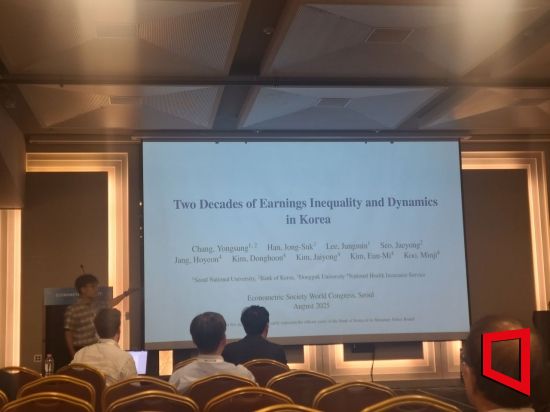 Professor Han Jongseok of Dongguk University’s Department of Economics is presenting the analysis results of "Income Inequality in Korea over the Past 20 Years" at the World Economists Conference (ESWC) on the 21st. Photo by Kim Hyemin
Professor Han Jongseok of Dongguk University's Department of Economics presented these research findings at the "Comparative Study of Cross-Country Income Dynamics Based on Administrative Data: GRID Phase 2" session during the "World Economists Conference (ESWC) 2025," held at COEX in Gangnam-gu, Seoul, on August 21.
The research team, which included Professor Han, Jang Yongseong, member of the Monetary Policy Board at the Bank of Korea, and Professor Lee Jeongmin of Seoul National University's Department of Economics, analyzed the income of workers aged 25 to 54 using data from the National Health Insurance Service from 2002 to 2022 to examine trends in income inequality in Korea over the past 20 years.
The results showed that inequality indicators, such as the income decile ratio (the ratio of the top 10% to the bottom 10% in income), have clearly declined since 2002. Professor Han explained, "Inequality among the bottom 10% has decreased significantly, while inequality among the top 90-99% has increased only slightly. Overall, inequality is gradually decreasing." This contrasts with major advanced countries like the United States and the United Kingdom, where income inequality has widened over recent decades.
A detailed time-series analysis of income distribution revealed that the decline in income inequality was largely due to a sharp increase in the income of lower-income groups. The degree of inequality worsened during economic downturns, such as the 2009 global financial crisis and the 2020 COVID-19 pandemic, as the income of the lower-income group dropped sharply, leading to an overall increase in inequality.
The improvement in income among lower-income groups was found to be closely related to the minimum wage. The research team examined how the minimum wage and real gross domestic product (GDP) growth rate affected changes in inequality and found that increases in the minimum wage or real GDP per capita led to a reduction in the overall standard deviation of income.
However, the effects differed between income groups. The rise in the minimum wage had a significant effect in reducing inequality among lower-income groups but did not affect higher-income groups. In contrast, the effect of real GDP was to reduce inequality among higher-income groups, but it did not improve inequality among lower-income groups.
By age group, inequality among younger people (aged 25-34) has steadily decreased over the past 20 years. However, those aged 35-44 and 45-54 showed an "inverted U-shaped" trend, with inequality increasing until 2010 and then decreasing thereafter. The income gap between men and women appeared to narrow until 2010 but has recently shown a tendency to widen again.
This study was conducted as part of the GRID project, which aims to build a database on inequality by collecting administrative data from nearly complete censuses spanning at least 20 years under globally standardized criteria. Korea has been participating since Phase 2.
© The Asia Business Daily(www.asiae.co.kr). All rights reserved.
![Clutching a Stolen Dior Bag, Saying "I Hate Being Poor but Real"... The Grotesque Con of a "Human Knockoff" [Slate]](https://cwcontent.asiae.co.kr/asiaresize/183/2026021902243444107_1771435474.jpg)















