Victor Cha Raises Possibility of North Korean Missile Launch and Nuclear Test
"U.S. Defense Department Seeks Clear Commitment on China-Related Contingencies"
There are predictions that North Korea may carry out a significant provocation next week, when President Lee Jaemyung and U.S. President Donald Trump are scheduled to hold a South Korea-U.S. summit.
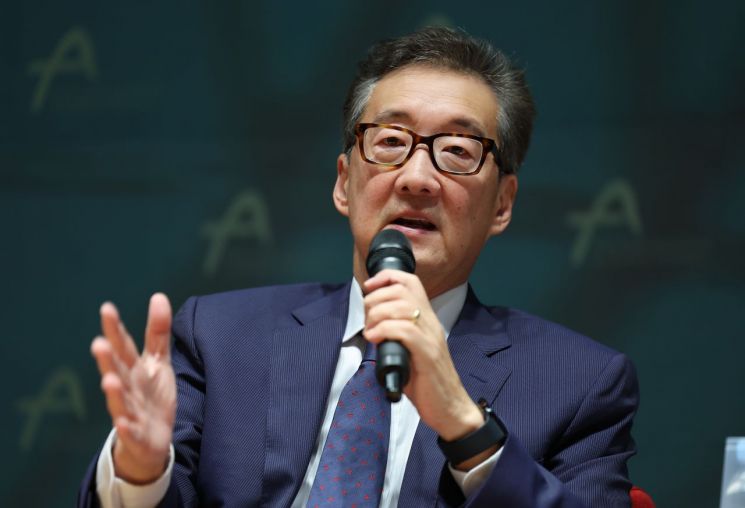 Victor Cha, Korea Chair at the Center for Strategic and International Studies (CSIS). Yonhap News Agency
Victor Cha, Korea Chair at the Center for Strategic and International Studies (CSIS), said during a media briefing on the South Korea-U.S. summit held on the 20th (local time), "We cannot rule out the possibility that North Korea may take some action next week." He explained, "This is because three things will coincide next week. First, the summit meeting; second, the ongoing South Korea-U.S. joint military exercise (UFS, Ulchi Freedom Shield); and third, the absence of any contact or diplomacy between the United States and North Korea." He added, "Empirical research shows that the combination of these factors is not a good sign," and predicted, "While we cannot know for sure, there could be a missile test or a nuclear test."
Sid Seiler, Senior Advisor at CSIS, also pointed out, "It's important to remember that this is the summer training period for North Korea," and noted, "This period is typically marked by additional displays of military force, missile launches, and artillery firing demonstrations." However, Seiler predicted, "North Korea's provocation is unlikely to be fatal or take a physical form."
Cha identified the reduction of the U.S. trade deficit with South Korea as a priority agenda item that President Trump may emphasize at the upcoming summit. He said, "President Trump is focusing on the trade deficit issue with allies like a laser beam," and added, "He will likely want to see South Korea make more commitments to reduce its trade surplus." He also noted, "The fact that the U.S.-Russia summit in Alaska did not go as well as expected may make President Trump even more eager for the summit with South Korea to proceed smoothly."
Cha further stated, "If there are discussions about changes to the deployment of U.S. forces in Korea, this would likely be linked to a broader realignment aimed at prioritizing deterrence and defense in the Taiwan Strait." He added, "Defense Department officials around President Trump will want clearer commitments from South Korea regarding its stance on relations with China." This implies that the U.S. may seek assurances on how South Korea would respond in the event of a Chinese invasion of Taiwan.
Additionally, regarding the 'modernization of the South Korea-U.S. alliance,' Cha explained, "This could mean potential changes to the U.S. military posture in Korea, including a reduction of ground forces." He elaborated, "This may also include enhancing air and naval capabilities, increasing South Korea's defense spending, revising the Special Measures Agreement on the cost-sharing of U.S. forces in Korea, returning wartime operational control, and strengthening defense industry cooperation."
Meanwhile, Katrin Katz, Visiting Fellow at CSIS, commented on President Lee's decision to visit Japan and hold a summit with Japanese Prime Minister Shigeru Ishiba before his trip to the U.S., saying, "What might be sensitive for President Trump is the possibility that the South Korean and Japanese leaders could use the occasion to publicly present a joint stance on ongoing sensitive trade and security negotiations in opposition to the U.S." She added, "While Japan and South Korea are in similar positions in many respects and could exchange views in private meetings, appearing to jointly pressure President Trump would not be beneficial for either country."
© The Asia Business Daily(www.asiae.co.kr). All rights reserved.
![Clutching a Stolen Dior Bag, Saying "I Hate Being Poor but Real"... The Grotesque Con of a "Human Knockoff" [Slate]](https://cwcontent.asiae.co.kr/asiaresize/183/2026021902243444107_1771435474.jpg)















