Justice de Moraes, Presiding Over Bolsonaro Trial,
Added to U.S. Sanctions List for "Human Rights Violations"
Says, "Sanctions Will Be Resolved Diplomatically or Overturned in Court"
The Brazilian Supreme Court justice at the center of tensions between the United States and Brazil has expressed confidence that the U.S. sanctions against him will be lifted. According to Yonhap News, on the 20th (local time), Alexandre de Moraes, Justice of the Federal Supreme Court of Brazil, told Reuters, "The sanctions against me will either be resolved through diplomatic channels or ultimately overturned in a U.S. court," adding, "A legal challenge (through litigation) is also possible, but for now, I have chosen to wait for the sanctions to be lifted."
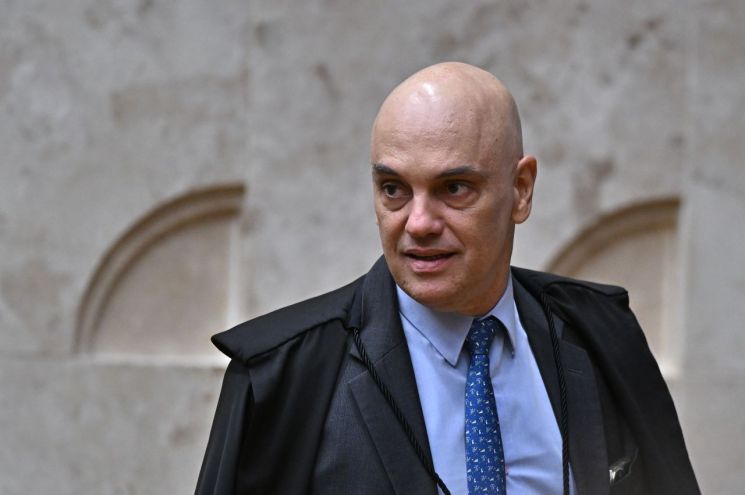
Justice de Moraes has been at odds with U.S. President Donald Trump. He is the presiding judge in the case involving former President Jair Bolsonaro, who, after losing the 2022 Brazilian presidential election to President Luiz Inacio Lula da Silva, is accused of conspiring with cabinet members to stage a coup or inciting his supporters to riot in protest of the election results.
However, President Trump, who has close ties to former President Bolsonaro, announced a 50% super-high tariff on Brazilian imports last month and strongly criticized the trial, calling it a witch hunt. The Trump administration also placed Justice de Moraes on the sanctions list under the Global Magnitsky Act. This law allows for sanctions such as asset freezes and entry bans against foreigners involved in human rights violations or corruption. The fact that a Brazilian Supreme Court justice is presiding over the former president's coup case has been interpreted as a human rights violation. In response, President Lula pointed out, "President Trump seems unaware that the judiciary is independent in Brazil."
Nevertheless, in this interview, Justice de Moraes claimed, "There was hesitation within the U.S. State Department and Treasury Department regarding the decision to sanction me." A U.S. State Department official familiar with the matter told Reuters that the sanctions proposal "faced significant internal opposition." Reuters, citing anonymous sources, added that several officials within the Treasury Department's Office of Foreign Assets Control also expressed their objection.
According to Yonhap News, the State Department did not issue an official comment, while the Treasury Department, through a spokesperson, stated, "The entire Trump administration is united in its position that de Moraes committed serious human rights violations."
Due to the Trump administration's sanctions, Brazilian financial institutions operating in the United States now find themselves in a difficult position. Justice de Moraes argued, "If Brazilian financial institutions decide to implement U.S. measures within Brazil, they could be prosecuted for illegal conduct," emphasizing that "the seizure of Brazilian citizens' assets, freezing of funds, or blocking of property is impossible without following domestic legal procedures."
Previously, Brazilian Supreme Court Justice Flavio Dino also interpreted that "foreign regulations cannot be automatically applied in Brazil." In response, the U.S. State Department countered, "Foreign courts cannot nullify U.S. sanctions or exempt violators from severe penalties." Reuters noted, "Given the global influence of the U.S. financial system, some foreign banks may restrict transactions more broadly to avoid secondary sanctions."
© The Asia Business Daily(www.asiae.co.kr). All rights reserved.
![Clutching a Stolen Dior Bag, Saying "I Hate Being Poor but Real"... The Grotesque Con of a "Human Knockoff" [Slate]](https://cwcontent.asiae.co.kr/asiaresize/183/2026021902243444107_1771435474.jpg)















