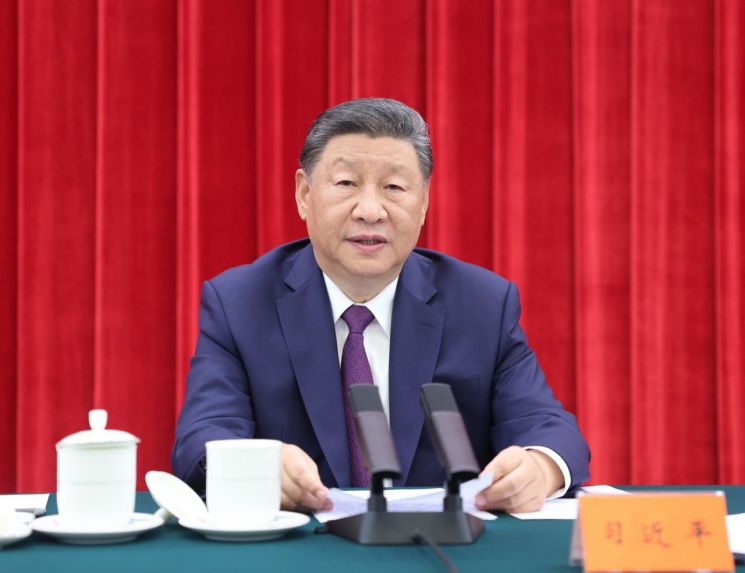
Chinese President Xi Jinping visited Lhasa, the capital of the Tibet Autonomous Region, on August 20 (local time) to attend the 60th anniversary celebration of the region. This marks Xi's second visit to Tibet since taking office, after his first public inspection in July 2021. Tibet shares a border with India, making the visit particularly significant.
China's state-run Xinhua News Agency reported that President Xi arrived in Lhasa by private plane during the day and, for the first time in the history of the Chinese Communist Party, is attending the anniversary event for the founding of the Tibet Autonomous Region as the head of state.
Xinhua explained that this demonstrates the Party's high regard for Tibet and its careful attention to Tibetan officials and residents. Accompanying Xi on this trip are Wang Huning, Chairman of the Chinese People's Political Consultative Conference and the fourth-ranking official in the Communist Party, and Cai Qi, Secretary of the Secretariat of the Communist Party and the fifth-ranking official. The 60th anniversary celebration of the founding of the Tibet Autonomous Region will be held at 10 a.m. local time on August 21.
The Tibet Autonomous Region was established in 1965, six years after the Dalai Lama, the spiritual leader of Tibet, led a failed uprising for Tibetan independence in 1959 and subsequently fled to India. It was the fifth and last autonomous region to be established in China, following Inner Mongolia, Xinjiang Uygur, Guangxi, and Ningxia.
This visit comes as China and India, which previously experienced armed clashes along their border, are seeking to improve relations for the first time in five years. Since the bloody confrontation between troops from both countries in the disputed Himalayan region in 2020, China and India have been attempting to mend their previously hostile relationship.
Recently, China has been at odds over the issue of succession for the Dalai Lama, who turned 90 this year. The Dalai Lama has stated that he intends to continue the tradition of succession through reincarnation, and that the sole authority to recognize his reincarnation lies with a nonprofit foundation he established. However, China maintains that the succession of the Dalai Lama requires government approval.
© The Asia Business Daily(www.asiae.co.kr). All rights reserved.
![Clutching a Stolen Dior Bag, Saying "I Hate Being Poor but Real"... The Grotesque Con of a "Human Knockoff" [Slate]](https://cwcontent.asiae.co.kr/asiaresize/183/2026021902243444107_1771435474.jpg)















