Number of Short-Term Workers Up 48%
Driven by MZ Generation Preferences and Job Market Slump
Kim Dokyung (29), who is preparing for the firefighter civil service exam, makes a living by working part-time at a Coupang logistics center whenever he has spare time. He said, "Whenever I need money, I can start working right away just by applying, without a separate interview," adding, "I can also set my own hours, so it's easy to balance with my exam studies."
Recently, the 'Gig Economy'-an ultra-short-term contract labor market where people work only as much as they need and get paid accordingly, based on the needs of both companies and workers-has been spreading. Its biggest feature is that people can choose to work at their preferred times through various platforms.
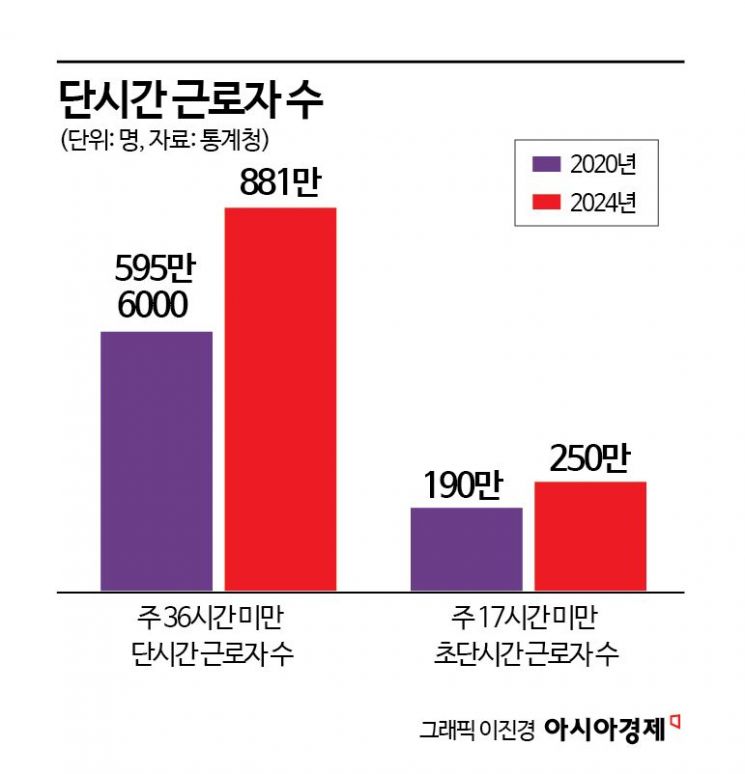
According to Statistics Korea on August 23, the number of part-time workers working less than 36 hours per week increased by 48%, from 5,956,000 in 2020 to 8,810,000 last year. Among them, ultra-short-term workers working less than 17 hours per week rose from 1,900,000 to 2,500,000 over the same period.
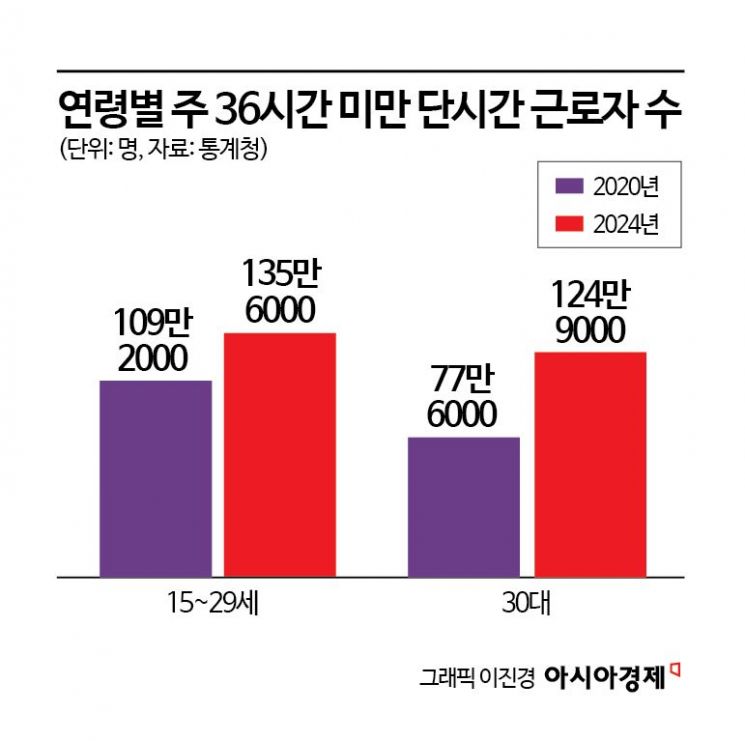
By age group, the increase was particularly notable among younger people in their 30s and below. As the job market remains sluggish and the job search period grows longer, more people are turning to short-term jobs to cover living expenses. The number of part-time workers aged 15 to 29 rose by 24% year-on-year to 1,356,000 last year, while those in their 30s surged by 61%, from 776,000 to 1,249,000.
Ms. Cho (28), who tutors elementary and middle school students in English in Dobong-gu, Seoul, also works 16 hours a week at a restaurant to save up for opening her own academy. She said, "During school vacations, I only teach in the mornings and increase my part-time hours, but when the semester starts, I cut back," adding, "The advantage is being able to freely adjust my schedule."
Seo Yonggu, a professor of business administration at Sookmyung Women's University, explained, "The main reason for the increase in gig workers is the difficulty in finding full-time jobs, but now there is an alternative where people can make a living through short-term jobs even if they are not regular employees." He added, "For example, in delivery work, you don't have to deal with stress from a boss and can work as much as you want, which seems to be a key advantage."
Gig Economy
© The Asia Business Daily(www.asiae.co.kr). All rights reserved.
![Clutching a Stolen Dior Bag, Saying "I Hate Being Poor but Real"... The Grotesque Con of a "Human Knockoff" [Slate]](https://cwcontent.asiae.co.kr/asiaresize/183/2026021902243444107_1771435474.jpg)
















