Transfer Connections Lead to Increased Village Bus Usage
Practical Support for Operators, Including Charging Station Sites
Jung Wono, District Mayor: "A Policy Model for Transportation Welfare and Public Transit Coexistence"
Jeon Youngsook, a 68-year-old resident of Seongdong District in Seoul, rides the Seonggong Bus three to four times a week. Having been born and raised in Seongdong, she says it has become much more convenient to visit the district library, swimming pool, and hospitals near public facilities. Jeon commented, "The buses run on a precise schedule, and the drivers are friendly, so residents really like it," adding with a laugh, "We jokingly call it the bus for successful people."
The Seonggong Bus, a public shuttle introduced by Seongdong District in October last year, is drawing attention as a "transportation welfare model." Initially, it faced strong opposition from the village bus industry, but it has since become a huge success, operating three routes with an average of 2,000 passengers per day and a cumulative total exceeding 160,000 riders. Cho Hyonyong, head of Seongdong District's Transportation Administration Division, said, "There were concerns that free buses would hurt village bus businesses, but it actually resulted in mutual growth."
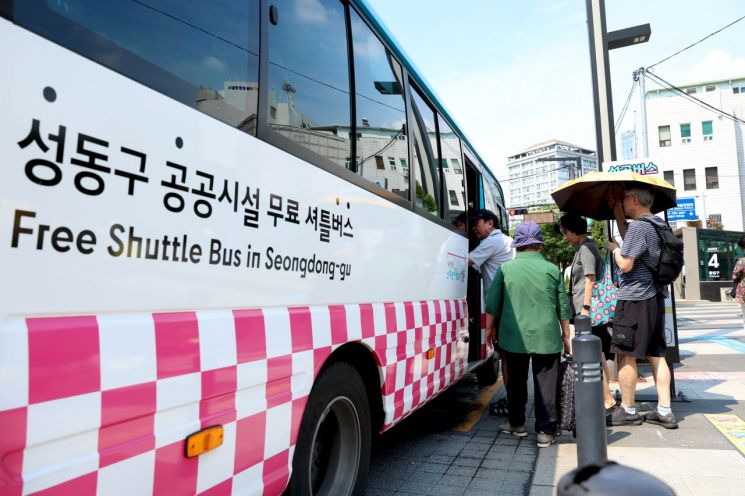 Jung Wono, Mayor of Seongdong District, said, "The Seonggong Bus is a policy model that leads both transportation welfare and coexistence in public transportation." The photo shows residents using the Seonggong Bus at Wangsimni Station. Provided by Seongdong District.
Dozens of Meetings... Convincing Skeptical Company Owners
The process of launching the Seonggong Bus was not smooth. When Seongdong District began drafting an ordinance in January last year to introduce the Seonggong Bus, representatives from seven village bus companies unanimously opposed the plan. One company owner argued, "Even if you say it's to fill transportation blind spots, in the end, it will just take away our customers."
Cho explained, "At first, the atmosphere was, 'We don't trust this,'" adding, "But through frequent meetings and persuasion, we finally reached an agreement to try it as a pilot project by June last year."
There were two key points. The first was to minimize overlap with existing village bus routes. During the planning phase, most Seonggong Bus routes were designed to avoid duplicating village bus lines. When the first route was piloted in October last year, the response was that "the impact was less than expected."
The second was support measures for coexistence. Seongdong District offered practical support, such as providing land for charging stations needed for the transition to electric buses. Cho said, "The district office leased land that private companies found difficult to secure, establishing charging infrastructure," and added, "Only then did the operators begin to feel that the district truly cared about them."
Prior to this, starting last year, Seongdong District became the first among Seoul's 25 districts to introduce a mandatory labor allowance for village bus drivers (300,000 won per month). After COVID-19, driver shortages had caused severe delays, but with the introduction of the allowance, the driver recruitment rate increased and drivers from other districts began inquiring about job opportunities.
When Put to the Test... Residents Say "Transportation Welfare," Industry Sees "Revenue Growth"
The turnaround was confirmed in the data. According to the Seoul Open Data Plaza, in the first half of this year, after the Seonggong Bus began operating, the number of village bus boardings in Seongdong District increased by 7.18% compared to the same period last year. This is three times the average increase for Seoul as a whole (2.36%) during the same period.
Notably, the number of boardings on village bus routes that partially overlap with Seonggong Bus lines rose by an average of 7.96%, higher than the 4.78% increase on non-overlapping routes. The concern about "losing customers" actually turned into a "transfer effect" that benefited the industry.
The popularity of the Seonggong Bus itself is also surging. In its first month of operation in October last year, it had only about 300 daily users, but by July this year, that number had increased to around 2,000-a 6.8-fold jump. Cho said, "Whereas seniors used to only go as far as the local senior center, now they are participating in programs at the community sports center, library, and art hall," adding, "Many residents say their daily routines have changed."
Currently, three Seonggong Bus routes are in operation. Another route is scheduled to be added this November, and during this process, the district office and village bus company representatives signed an agreement to limit the number of routes to four. Any future additions of routes or stops must have the companies' consent.
Jung Wono, Mayor of Seongdong District, said, "The Seonggong Bus is not just a free shuttle but a policy model that leads both transportation welfare and coexistence in public transportation," adding, "We will continue to coordinate so that more residents can enjoy their right to mobility."
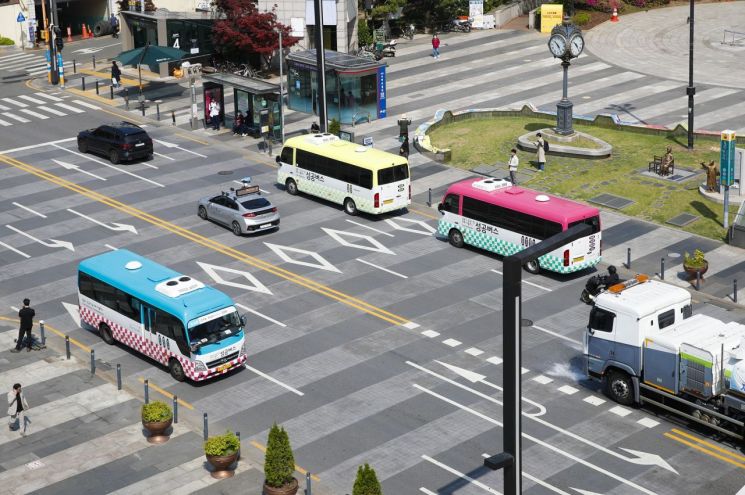 Three Seonggong bus routes pass through Wangsimni Station, a transfer stop. Provided by Seongdong-gu.
◆What is the 'Seonggong Bus'?
The Seonggong Bus is a free public facility shuttle bus introduced by Seongdong District in October last year. It is based on the "Seongdong District Public Facility Shuttle Bus Operation Ordinance" and connects essential facilities for residents-such as the district office, library, public health center, sports, and cultural facilities-where village buses do not run frequently. All routes pass through Seongdong District Office (Wangsimni Station), and anyone can ride for free using the app (QR code) or an ID card (for those aged 65 and over).
© The Asia Business Daily(www.asiae.co.kr). All rights reserved.
![Clutching a Stolen Dior Bag, Saying "I Hate Being Poor but Real"... The Grotesque Con of a "Human Knockoff" [Slate]](https://cwcontent.asiae.co.kr/asiaresize/183/2026021902243444107_1771435474.jpg)
















