The "Gyeonggi Climate Insurance," introduced by Gyeonggi Province for the first time in the nation, has proven to be a significant support for climate-vulnerable groups within the province.
On August 20, Gyeonggi Province announced that the Gyeonggi Climate Insurance, launched this past April, has recorded a total of 2,358 payouts in just four months, firmly establishing itself as a health safety net for residents. Notably, 1,945 cases, accounting for 82% of the total, were paid out to climate-vulnerable groups, helping to mitigate health inequalities caused by climate conditions, according to the province.
Gyeonggi Climate Insurance is fully funded by the province for all 14.2 million Gyeonggi residents. The coverage includes: ▲diagnosis fees for heat-related and cold-related illnesses, ▲diagnosis fees for infectious diseases, and ▲accident consolation payments for injuries lasting four weeks or more due to weather advisories.
Monthly payout statistics show that the numbers were minimal in the initial phase, with 8 cases in May and 13 in June. However, payouts have increased exponentially, with 187 cases in July and 2,150 cases as of August 19. Gyeonggi Province attributes this surge to heightened public interest in the insurance following recent heatwaves and heavy rains.
In one case, a resident of Gapyeong County, identified as Mr. A, suffered a fracture requiring more than four weeks of treatment after being struck by debris while participating in flood recovery work following heavy rains. Mr. A received 300,000 won as a climate disaster accident consolation payment.
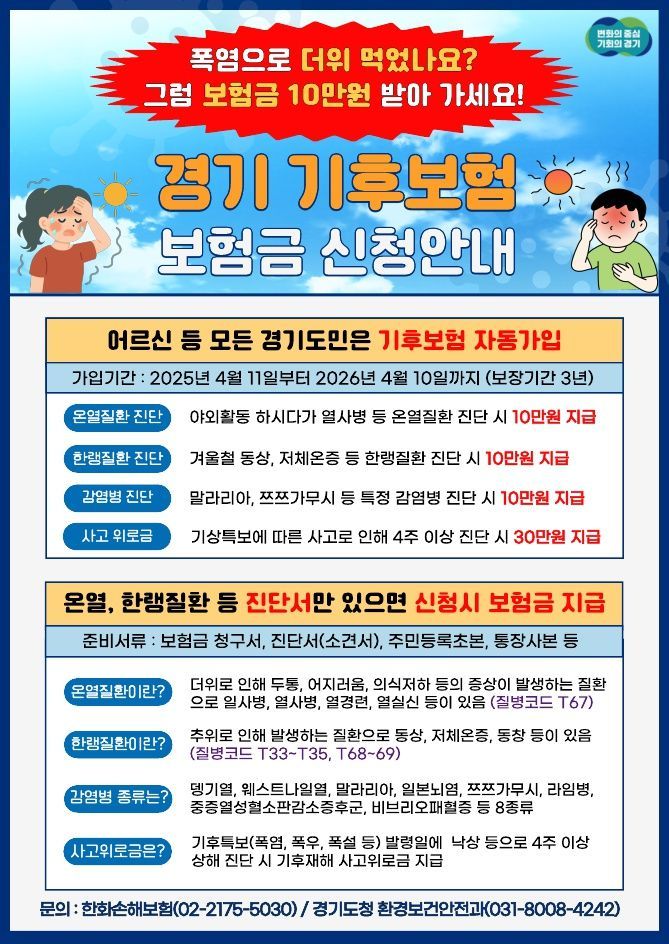
Ms. B, while working outdoors in a region outside Gyeonggi Province, was diagnosed with heat exhaustion after experiencing dizziness and was hospitalized. She received a 100,000 won diagnosis fee for a heat-related illness from Gyeonggi Province.
Mr. C, a member of a climate-vulnerable group, was diagnosed with heat syncope and received a 100,000 won diagnosis fee for a heat-related illness, along with an additional 500,000 won for hospitalization (100,000 won per day for five days). Another climate-vulnerable individual, Mr. D, applied for transportation expenses to medical facilities for 10 visits (20,000 won per visit), receiving a total of 200,000 won.
By payout category, transportation expenses to medical facilities accounted for the largest number of cases at 1,931. This was followed by diagnosis fees for heat-related illnesses (335 cases), diagnosis fees for infectious diseases (66 cases), climate disaster accident consolation payments (13 cases), and hospitalization fees for heat-related illnesses (13 cases).
In particular, the climate insurance program designates individuals with chronic illnesses, those aged 65 and older, and basic livelihood security recipients-who are already part of public health center outreach programs-as climate-vulnerable groups, providing them with additional support such as transportation expenses to medical facilities, hospitalization fees for heat-related illnesses, and climate disaster accident consolation payments for injuries lasting two weeks or more.
Park Daekeun, Director of Environmental Health and Safety at Gyeonggi Province, stated, "The results over the past four months signal that climate insurance is becoming established in residents' daily lives," adding, "Going forward, we will proactively respond to seasonal climate crises such as typhoons and heavy rains, as well as heatwaves, to provide even stronger support for our residents."
© The Asia Business Daily(www.asiae.co.kr). All rights reserved.
![Clutching a Stolen Dior Bag, Saying "I Hate Being Poor but Real"... The Grotesque Con of a "Human Knockoff" [Slate]](https://cwcontent.asiae.co.kr/asiaresize/183/2026021902243444107_1771435474.jpg)















