First Case of Both Albinism and Xanthochromism Observed
in a Caribbean Cartilaginous Fish
A rare orange shark was caught off the coast of Costa Rica, drawing the attention of marine biologists and netizens worldwide. On August 18, British media outlets such as the Daily Mail and other foreign news sources reported that Costa Rican fishermen recently captured a "nurse shark" with a body tinged orange and white eyes. The nurse shark discovered this time had a deep orange hue all over its body, and its eyes had turned a milky white due to a lack of melanin, giving it a ghostly, pale appearance.
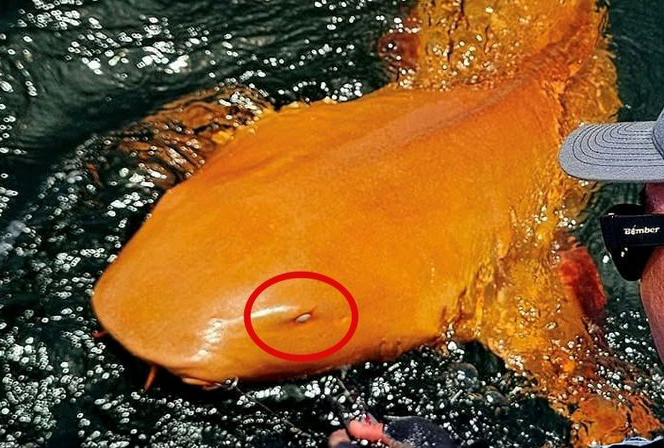 A rare orange shark was caught off the coast of Costa Rica, drawing the attention of marine biologists and netizens worldwide. Photo by Parisminadomusdei Facebook
The media reported that this shark is the first cartilaginous fish in the Caribbean to exhibit both xanthochromism and albinism. Notably, xanthochromism is generally rare and typically observed in freshwater fish, birds, or reptiles; this is virtually the first reported case in cartilaginous fish such as sharks or rays. Normally, nurse sharks have brown skin, which provides camouflage among rocks and reefs on the ocean floor. However, the shark found this time was caught in a highly conspicuous color, making its very survival remarkable.
Marine biologists from the Federal University of Rio Grande in Brazil commented on the discovery, stating, "Xanthochromism makes it difficult for animals to blend into their surroundings and makes them more visible to predators," and added, "Albinism also brings various survival disadvantages, such as increased sensitivity to sunlight and difficulties in mating." Local experts explained that the fact this shark, which has both conditions, survived to adulthood provides important insights into genetic diversity and adaptability within the marine ecosystem.
This shark is estimated to be an adult, measuring about 1.8 meters in length. Typically, animals with albinism or xanthochromism are more visible to other animals, resulting in lower survival rates and increased sensitivity to sunlight. Therefore, experts plan to continue research on how this shark managed to survive and how such pigment abnormalities have affected natural selection.
© The Asia Business Daily(www.asiae.co.kr). All rights reserved.
![Clutching a Stolen Dior Bag, Saying "I Hate Being Poor but Real"... The Grotesque Con of a "Human Knockoff" [Slate]](https://cwcontent.asiae.co.kr/asiaresize/183/2026021902243444107_1771435474.jpg)















