Is Issuing a Won Stablecoin Necessary? "It Is Necessary"
Who Should Issue Stablecoins? "Banks With Strong Regulations Should Lead, Gradually Expanding"
How to Address Conflicts With Existing Regulations? "Start With Measures to Prevent Circumvention
"As dollar stablecoins are becoming more widespread, particularly in the United States, there are three main issues surrounding the introduction of a won-based stablecoin: whether it is necessary, who should be responsible for issuance, and how to address potential conflicts with existing regulations." On August 19, Lee Changyong, Governor of the Bank of Korea, responded to an additional report request regarding won-based stablecoins at the full meeting of the Planning and Finance Committee held at the National Assembly in Yeouido, Seoul.
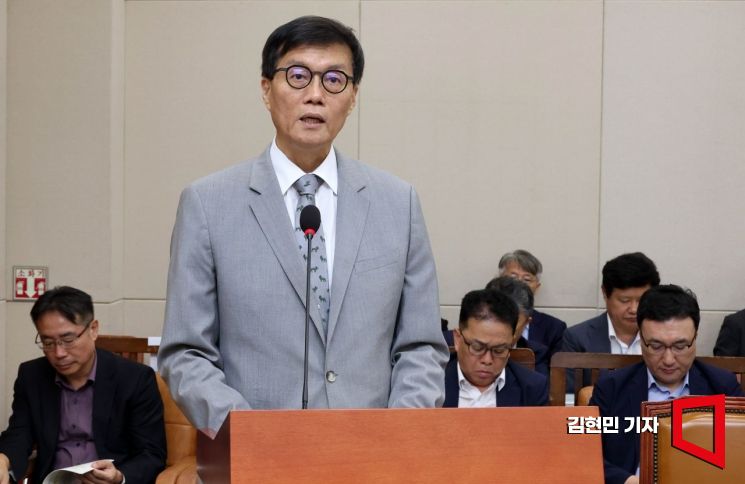 Lee Changyong, Governor of the Bank of Korea, is reporting on operations at the full meeting of the Planning and Finance Committee held at the National Assembly on the 19th.
Is it necessary to issue a won-based stablecoin? "It is necessary"
Regarding the first issue, whether the introduction of a won-based stablecoin is necessary, Governor Lee stated that it is indeed necessary. This is not only for the convenience of payments and settlements but also because it could contribute to digital financial innovation by enabling services such as "conditional payments" through the use of smart contracts. Governor Lee especially pointed out that in the future, as the digitalization of currency becomes commonplace, there will be a need for programmable functions that can incorporate specific details such as detailed contracts.
For example, when an exporter ships goods to Los Angeles, USA, the current process requires the importer to notify the bank to make payment to the exporter after customs clearance is completed upon arrival. However, with programmable currency, it would be possible to execute specific contract terms, such as "transfer half of the payment the moment the ship departs and crosses the Pacific Ocean."
He explained that such contract conditions could be applied to various transactions, including real estate deals. Governor Lee said, "As the ability to program contract details into currency will become increasingly important in the future, I believe the digitalization of currency through the introduction of stablecoins is essential to prepare for what lies ahead."
Who should issue it? "Banks with proper regulation should take the lead, gradually expanding"
Regarding the second issue, the entity responsible for issuance, Governor Lee argued that it would be desirable to first allow issuance by highly regulated banks and then gradually expand. The idea is to start with banks, observe how to regulate and control any side effects, and then, if necessary, allow non-bank institutions to participate through a gradual approach.
Governor Lee said, "Some advocate that the issuance of won-based stablecoins should be left to non-bank private institutions to foster innovation, arguing that with distributed ledger technology (DLT), all information is recorded, making regulation more transparent even without oversight by the Bank of Korea or other supervisory authorities." He continued, "However, I see two main problems with this."
First, while DLT can be used to manage information, if even very small companies are allowed to issue stablecoins, there is an incentive not to use the technology, even if it is available. Governor Lee said, "if companies with very low capital requirements are allowed to participate, there is a risk they could be tempted to engage in money laundering if someone offers them money," adding, "if the number of stablecoin issuers increases significantly, various side effects and uncertainties could arise." Therefore, he explained, it is necessary to focus on companies above a certain size.
He also pointed out that even if a company meets the size requirement, there are still issues to consider when it comes to non-banks. Allowing non-banks to issue stablecoins is essentially equivalent to permitting payment-specialized banks (narrow banking), which would require a policy review on whether to relax the existing separation between banking and commerce. Governor Lee said, "If non-banks are allowed to issue won-based stablecoins, given that Korea still maintains the principle of separation between banking and commerce, it would effectively mean allowing non-banks to establish narrow banks," adding, "The reason we have not allowed narrow banking in the past is because of its significant impact on the structure of the banking industry, and this issue also needs to be considered comprehensively." He emphasized that if bank deposits decrease and bank profitability declines, careful consideration is needed regarding how the industry structure, which has been centered around banks, might change.
How to address conflicts with existing regulations? "Start with measures to prevent circumvention of foreign exchange regulations"
Governor Lee also stressed the need for preemptive solutions to the potential issue of circumventing foreign exchange regulations when introducing a won-based stablecoin. There are concerns that cross-border fund transfers could increase by bypassing the foreign exchange regulatory system, which is centered around foreign exchange banks and includes requirements such as reporting obligations for foreign exchange transactions. There is also the possibility that compliance with regulations related to customer identification, tax evasion prevention, and anti-money laundering could be weakened.
Governor Lee said, "Some argue that issuing won-based stablecoins could attract overseas direct investment in K-pop goods or non-fungible tokens (NFTs).This could help internationalize Korea's financial markets and prevent dollar stablecoins from penetrating our market,and that may indeed be the case," he said. "However, we must also consider the issue of what happens if not only foreigners purchase won-based stablecoins, but also if Korean nationals use them to buy goods in overseas markets." He expressed concern about the possibility of purchasing won-based stablecoins and depositing them into overseas networks or institutions. Governor Lee said, "In other words, this would be equivalent to holding Korean won deposits overseas," adding, "This is the very issue we have been most concerned about in scenarios of capital liberalization over the past several decades."
So far, when Korean nationals wished to transfer part of their assets abroad, they have been allowed to do so up to an annual limit of $100,000. This also required converting the won to dollars, so there were several safeguards in place. However, if a won-based stablecoin is createdand can be directly transferred overseas, regulation would become significantly more difficult.
He also explained that there are obstacles in terms of the effectiveness of monetary policy. Governor Lee said, "Depending on economic conditions, if the central bank wants to reduce the money supply, it is easy to do so because banks are subject to reserve requirements. However, if non-bank financial institutions issue stablecoins and the central bank suddenly demands that all government bonds held as collateral be sold to reduce the money supply, the resulting shock to the market could be significant."
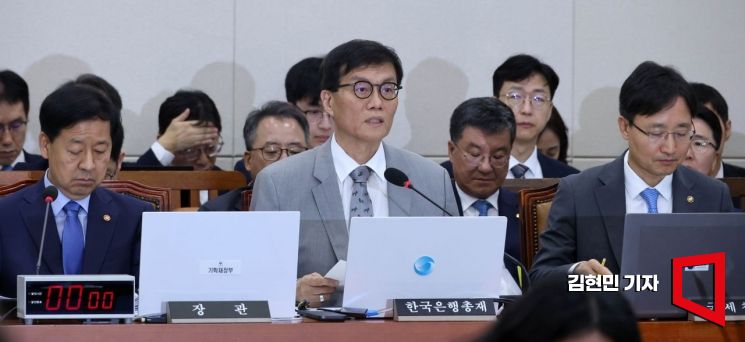 Lee Changyong, Governor of the Bank of Korea, is speaking at the full meeting of the Planning and Finance Committee held at the National Assembly on the 19th.
Is urgent introduction needed? "Take time and introduce gradually"
Governor Lee disagreed with some claims that the introduction of a won-based stablecoin is extremely urgent. While stablecoins are mostly used in virtual asset transactions, Korea does not currently allow virtual assets under its Virtual Asset Act. Governor Lee said, "The Bank of Korea's official position is that it would be best to gradually introduce stablecoins as a means of payment, while monitoring the development of the domestic virtual asset market."
Currently, over 90% of stablecoins worldwide are dollar-denominated. Demand for stablecoins tends to follow demand for the dollar, so Governor Lee is skeptical that creating a won-based stablecoin urgently would increase demand for it or reduce demand for dollar stablecoins.
He explained that the Bank of Korea has been leading the establishment of a digital payment ecosystem through "Project Hangang" because it recognizes the necessity of digital currency and the purpose of digital financial innovation. Project Hangang is a program in which banks issue stablecoins (tokenized deposits) within a network managed by the Bank of Korea.
He said, "Those who advocate for allowing non-banks emphasize technological innovation," adding, "While debate is possible, the advantage of stability when banks issue stablecoins is clear, whereas the various innovations that non-bank issuance might bring have not yet been sufficiently verified. Therefore, I believe it is desirable to expand gradually."
© The Asia Business Daily(www.asiae.co.kr). All rights reserved.
![Clutching a Stolen Dior Bag, Saying "I Hate Being Poor but Real"... The Grotesque Con of a "Human Knockoff" [Slate]](https://cwcontent.asiae.co.kr/asiaresize/183/2026021902243444107_1771435474.jpg)
















