Ministry of Land and Accident Investigation Committee
Announce Findings and Measures to Prevent Recurrence
The Sejong-Anseong Expressway collapse accident in February was found to have occurred because the anti-overturning devices were arbitrarily removed. The girders were supposed to be fixed with screw jacks to prevent them from toppling, but they were dismantled for work convenience, leading to the collapse.
It was also revealed that the launcher used to install the girders was moved backward, contrary to its original certification. The government has decided to revise the relevant regulations. Based on the investigation results, specific legal violations will be reviewed, and measures such as business suspension are expected to be imposed.
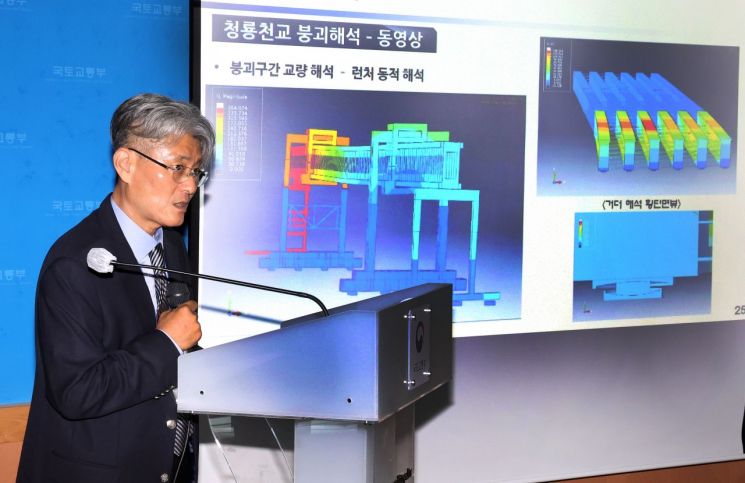 On the 19th, Oh Hongseop, Chairman of the Construction Accident Investigation Committee for the Sejong-Anseong Expressway Collapse Accident, explained the investigation results and recurrence prevention measures related to the Cheongyongcheon Bridge collapse accident during the Sejong-Anseong Expressway construction at the Ministry of Land, Infrastructure and Transport press room in the Government Complex Sejong. Photo by Yonhap News
Oh Hongseop, a professor at Gyeongsang National University and chairman of the Construction Accident Investigation Committee, announced these findings on the 19th. Chairman Oh stated, "According to structural analysis for each collapse scenario, even under the same conditions such as the rearward movement of the launcher, the girders would not have collapsed if the screw jacks had not been removed," adding, "The removal of the screw jacks was the decisive cause of the collapse."
The responsibility for inspecting temporary facilities such as the launcher lies with the contractor, but it was found that the subcontractor's removal of the screw jacks was not detected. For the launcher used to install the girders, safety certification was only obtained for forward movement operations under the Occupational Safety and Health Act. Nevertheless, backward movement operations were carried out. Despite preparing a safety management plan in violation of the law, both the contractor and the ordering agency approved the plan. It was also stated that the intention to perform backward movement operations was specified during the contractor's bidding process.
Additionally, it was found that the launcher operator listed in the construction plan was different from the operator recorded in the work log on the day of the accident. The operator in the work log left the site during the operation to control another crane, revealing overall poor site management and supervision.
The committee determined that the remaining structures at the site after the accident were damaged and require repair or reconstruction. The connection between the pier columns and foundations was damaged, and the concrete compressive strength of the abutment was only 84.5% of the design standard, falling short of the specification requirement (85%). The girders that did not collapse were bent beyond the standard value (55mm).
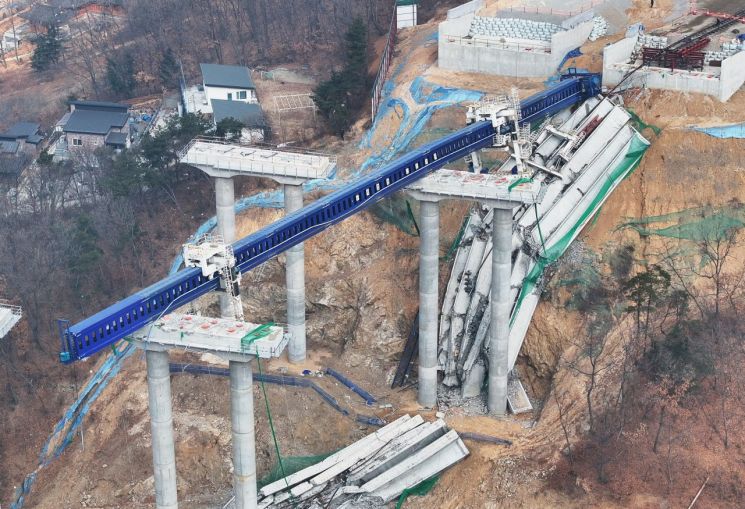 On February 25th, 10 workers fell from above and were killed or injured when the bridge deck structure being installed on a pier at the Seoul Sejong Expressway construction site collapsed. Photo by Yonhap News
To prevent similar accidents in the future, the committee proposed establishing clear criteria for the timing of dismantling anti-overturning devices. It also emphasized the need to make the management and supervision duties of the ordering agency and construction project managers more practical. From a design and construction perspective, the committee pointed out the need to strengthen control over girder deflection due to increased length and camber, and to enhance expert review of equipment selection, including launchers.
Chairman Oh stated, "We will compile the investigation results and submit the final report to the Ministry of Land, Infrastructure and Transport within this month," adding, "I hope the relevant agencies will promptly improve the system to prevent such tragic accidents from happening again."
The Ministry of Land, Infrastructure and Transport has decided to revise the standard bridge construction specifications so that anti-overturning devices are dismantled only after beam placement and curing, and with the approval of a certified construction project manager. For special construction methods using equipment such as launchers, the operating regulations will be amended to require the participation of equipment experts during technical consultations by the ordering agency.
Separate from the accident investigation, a special inspection of this construction section uncovered four cases of inadequate safety management, nine cases of illegal subcontracting, and one case of poor quality control. Kim Taebyeong, Director of Technical Safety Policy at the Ministry of Land, Infrastructure and Transport, stated, "We will notify relevant ministries, local governments, and regional offices of the investigation results, review legal violations, and pursue administrative actions by each authority," adding, "For this accident, the Ministry plans to take direct administrative action, and after objection and hearing procedures, the actual measures are expected to take about four to five months."
This accident occurred on the morning of February 25 at the Cheongyongcheon Bridge construction site in Section 9 of National Expressway Route 29 between Sejong and Anseong. Korea Expressway Corporation was the client, with Hyundai Engineering and others as contractors. The subcontractor was Jangheon Industry. Four people, including two foreigners, were killed and six were injured.
© The Asia Business Daily(www.asiae.co.kr). All rights reserved.
![Clutching a Stolen Dior Bag, Saying "I Hate Being Poor but Real"... The Grotesque Con of a "Human Knockoff" [Slate]](https://cwcontent.asiae.co.kr/asiaresize/183/2026021902243444107_1771435474.jpg)
















