With just six days remaining until the first summit between President Lee Jaemyung and U.S. President Donald Trump, North Korean leader Kim Jong Un has asserted his presence by emphasizing his commitment to strengthening North Korea's nuclear capabilities. Analysts suggest this move is politically motivated to preemptively block any possibility of dialogue based on denuclearization. At the same time, there are growing concerns that North Korea may carry out additional provocations in response to the South Korea-U.S. summit.
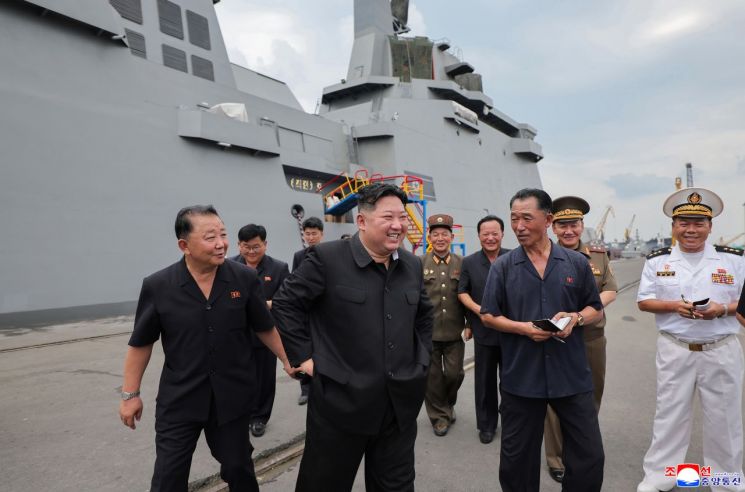 North Korean State Affairs Commission Chairman Kim Jong Un visited the Nampo Shipyard in South Pyongan Province on the 18th to inspect the integrated operation test process of the armament system of North Korea's first new 5,000-ton class destroyer "Choe Hyun Ho," according to Korean Central News Agency on the 19th. Yonhap News Agency
On the 19th, the Korean Central News Agency reported that Kim visited the Nampo Shipyard in South Pyongan Province the previous day to inspect the integrated operation test process of the armament system of North Korea's new 5,000-ton class destroyer, "Choe Hyun Ho." Kim directly mentioned the South Korea-U.S. joint exercise, Ulchi Freedom Shield (UFS), criticizing it as "a clear expression of their intention to be the most hostile and confrontational toward the Democratic People's Republic of Korea (North Korea), without concealing their motives." He added, "The security environment facing our country is becoming increasingly serious," and stated, "The current situation requires us to make groundbreaking and rapid changes in existing military theory and practice, as well as a radical expansion of nuclear armament."
Experts are paying close attention to the timing of Kim's message ahead of the South Korea-U.S. summit. Lim Eulchul, a professor at Kyungnam University's Institute for Far Eastern Studies, analyzed, "It is intended to neutralize the policy and intention of resuming dialogue based on North Korea's denuclearization, pushing the situation so that denuclearization cannot even be mentioned. This reaffirms that the focus remains firmly on nuclear deterrence rather than dialogue or cooperation." He added, "Citing the protection of sovereign security as justification, North Korea has hinted at the operational deployment of maritime nuclear forces such as submarine-launched ballistic missiles (SLBMs), indicating the possibility of further provocations."
In this context, North Korea has not only advanced its nuclear and missile capabilities but has also recently been pursuing the nuclear armament of its navy. The construction of the 5,000-ton class destroyer "Choe Hyun Ho" and similar vessels is based on this plan. Kim has shown significant interest by visiting the construction site of the Choe Hyun class destroyer more than ten times so far. Experts explain that Kim's latest visit was intended to demonstrate, both domestically and internationally, that the integration of the combat system and the operational deployment of the destroyer are progressing smoothly. Choi Il, head of the Submarine Research Institute, noted, "For the first time, photos of the combat information center have been released, and with the combat system monitors turned on, it appears that system integration is underway. System integration is a core technology that organically links various detection sensors and armaments to support rapid decision-making, thereby maximizing combat power and operational efficiency."
Meanwhile, during the UFS exercise period, which runs until the 28th, about 20 out of 40 field training exercises (FTX) have been postponed to next month. While the military cited the heat wave as a reason, many interpret this as a measure aimed at easing tensions with North Korea under the new administration. Defense Minister Ahn Kyubaek, presiding over the first day of the UFS defense strategy meeting, stated, "We must work together with the international community under a strong combined defense posture to de-escalate the crisis and return to the pre-crisis situation, preventing it from escalating into a full-scale war." Nevertheless, Kim's direct criticism of the UFS exercise is seen as reaffirming North Korea's unchanged stance on the adversarial relationship between the two Koreas.
© The Asia Business Daily(www.asiae.co.kr). All rights reserved.
![Clutching a Stolen Dior Bag, Saying "I Hate Being Poor but Real"... The Grotesque Con of a "Human Knockoff" [Slate]](https://cwcontent.asiae.co.kr/asiaresize/183/2026021902243444107_1771435474.jpg)















