U.S. Treasury Secretary Scott Besant has pressured the Bank of Japan to raise interest rates, criticizing the central bank for lagging behind in its response to inflation.
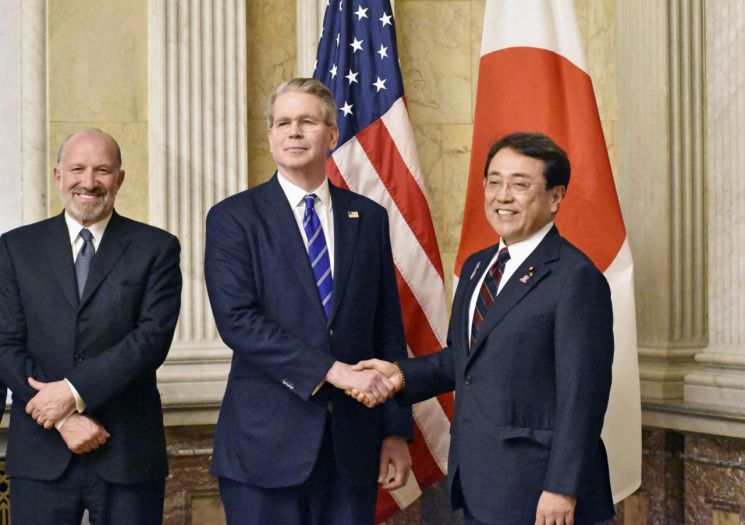 Scott Besant, U.S. Secretary of the Treasury (center), and Ryosei Akazawa, Japan's Minister for Economic Revitalization (right), are shaking hands during their meeting for the second tariff negotiations in Washington DC last May. Photo by Yonhap News
In an interview with Bloomberg TV on August 13 (local time), Secretary Besant stated, "Japan is facing an inflation problem," and emphasized, "They need to raise interest rates to control this inflation issue." He also mentioned that he had discussed this matter with Kazuo Ueda, Governor of the Bank of Japan.
Secretary Besant's perspective stands in contrast to Governor Ueda's position. At the end of last month, the Bank of Japan kept its benchmark interest rate at "around 0.5%" for the fourth consecutive time. In a press conference immediately afterward, Governor Ueda stated that he did not believe the central bank's rate policy was falling behind.
The United States has previously urged the Bank of Japan to adopt a tighter monetary policy. In a report to Congress in June, the U.S. Treasury Department argued that the Bank of Japan should pursue policies tailored to domestic fundamentals such as growth and inflation, thereby supporting the normalization of the yen's weakness against the dollar and structural rebalancing essential for bilateral trade.
The market responded immediately to Besant's remarks. Expectations have grown that an interest rate hike could occur in either October or January, and Japan's government bond yields also rose slightly. On this day, the yield on Japan's 10-year government bonds increased by 0.04 percentage points to 1.55%, while the yen weakened to 146.4 yen per dollar.
On the same day, Besant also pressured the Federal Reserve (Fed) to cut interest rates. Additionally, he warned that the United States could raise secondary tariffs on India for importing Russian crude oil. He stated, "We have imposed secondary tariffs on India for purchasing Russian oil, and if things do not go well, we may either impose sanctions or raise the secondary tariffs."
Previously, U.S. President Donald Trump announced that the United States would impose an additional 25% tariff on India due to its purchases of Russian crude oil.
© The Asia Business Daily(www.asiae.co.kr). All rights reserved.
![Clutching a Stolen Dior Bag, Saying "I Hate Being Poor but Real"... The Grotesque Con of a "Human Knockoff" [Slate]](https://cwcontent.asiae.co.kr/asiaresize/183/2026021902243444107_1771435474.jpg)
















