'National Fiscal Savings Meeting' Presided Over by President Lee on the 13th
Budget Cuts for 4,400 Projects, 1,300 to Be Abolished
Lee: "Disclose All Finalized Restructuring Details"
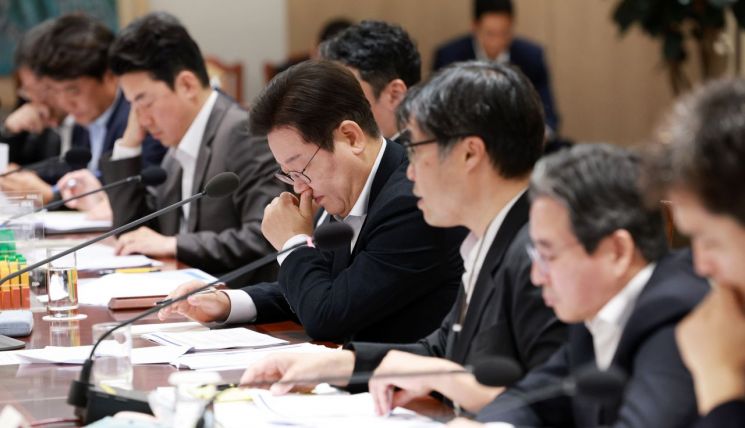 President Lee Jae Myung is holding a meeting on national fiscal savings on the 13th at the Yongsan Presidential Office Building in Seoul. Photo by Yonhap News
President Lee Jae Myung received a report from the Ministry of Economy and Finance outlining a spending restructuring plan totaling 27 trillion won. This restructuring amount is the highest ever, exceeding that of the Yoon Suk Yeol administration, which had emphasized "sound fiscal management." The decision is interpreted as a response to President Lee's directive to reduce wasteful spending.
On the 13th, President Lee presided over a "National Fiscal Savings Meeting" at the Yongsan Presidential Office and was briefed by the Ministry of Economy and Finance on the "progress of expenditure restructuring for next year's budget." Yoo Byung Seo, Director General for Budget at the Ministry, personally presented the plan, explaining, "Departing from the previous incremental budgeting approach, this time we reviewed all budget items from a zero base and allocated resources to reinvest in the new administration's core tasks to enhance public satisfaction."
According to the plan reported to President Lee, the Ministry of Economy and Finance will cut a record 27 trillion won when formulating next year's budget. A total of 17,000 policies are subject to restructuring, with 4,400 budget projects actually facing reductions. The number of abolished projects will be significantly increased from about 200 this year to about 1,300 next year. Projects subject to reductions or abolishment will undergo efficiency improvements and restructuring.
Notably, the restructuring targets not only 25 trillion won in discretionary spending but also 2 trillion won in mandatory spending, which has traditionally been difficult to adjust. The structure for distributing education taxes has been reformed to reduce educational grants, and the eligibility criteria for unemployment benefits have been tightened to minimize moral hazard.
Additionally, spending restructuring, which had previously focused on project costs, has been expanded to include operating expenses. Accordingly, the Ministry of Economy and Finance set separate reduction targets and efficiency measures for annual event expenses, promotional costs, and administrative expenses. Travel expenses will be minimized by reducing business trips or shifting to remote alternatives, and 47.9 billion won will be saved in 182 projects related to events and promotional activities.
Furthermore, support for zombie and high-performing small and medium-sized enterprises was reduced by 700 billion won, and official development assistance (ODA), which had surged under the previous administration, was cut by more than 1 trillion won. Other measures included reducing offline support for agricultural products, cutting fossil fuel subsidies, and halting the introduction of outdated conventional weapons.
Meanwhile, after the announcement by the Ministry of Economy and Finance, a discussion took place regarding whether to disclose the details of the spending restructuring. Jung Chang Soo, head of the Korea Institute of Public Finance, who attended the meeting, pointed out, "Every year, press releases on spending restructuring only present a few cases and large figures." In response, President Lee instructed, "Let's disclose everything that has been finalized," adding, "That should resolve any issues."
© The Asia Business Daily(www.asiae.co.kr). All rights reserved.