July Nationwide Index Down 20.1 Points from Previous Month
Seoul Plunges by 44.9 Points, Marking a Sharp Decline
Liquidity Crunch for Buyers Worsens Occupancy Conditions
As a result of the impact of stringent lending regulations, the market has contracted, leading to a sharp decline in the apartment occupancy outlook index for July. Analysts attribute the deterioration in the occupancy market to reductions in mortgage loan limits and the inability to use jeonse deposits to pay the remaining balance on home purchases.
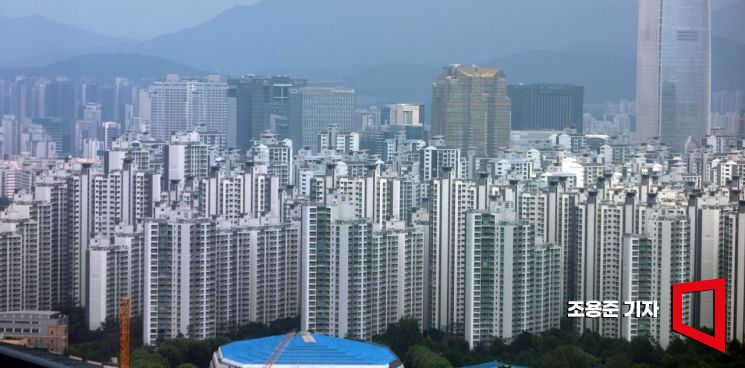
According to data released on the 13th by the Housing Industry Research Institute (HIRI), this month's nationwide apartment occupancy outlook index fell to 75.7, a steep drop of 20.1 points from the previous month’s 95.8. This index predicts whether buyers of newly built apartments will be able to pay the full balance and move in as scheduled. A reading below 100 indicates that more respondents have a negative outlook on the occupancy market.
By region, the Seoul metropolitan area saw a 41-point decrease to 76.1. Seoul dropped by 44.9 points to 76.3, Incheon fell by 41.2 points to 70.3, and Gyeonggi Province declined by 36.9 points to 81.8. Notably, Seoul’s occupancy outlook index, which exceeded 120 last month, plunged below 80 this month, reflecting a significant downward trend.
Among the five major metropolitan cities, Daejeon was the only one to record an increase, rising by 4.1 points to 91.6. Ulsan declined by 21.5 points to 78.5, Daegu by 15.0 points, and Busan by 6.5 points. Sejong also dropped by 17.8 points to 75.0. The increase in Daejeon is attributed to delayed implementation of regional pledges, which caused a downturn in the Sejong housing market and redirected some investment demand toward newly built apartments around the planned Daejeon National Industrial Complex.
This month, the nationwide apartment occupancy rate reached 63.9%, up 3 percentage points from the previous month. By region, the rate in the Seoul metropolitan area rose from 80.8% to 83.4%, in the metropolitan cities from 53.8% to 60.8%, and in other regions, there was a slight increase of 0.1 percentage points from 58.7%.
The most common reason for non-occupancy was failure to secure balance loans (38.5%). This was followed by delays in selling existing homes (32.7%), failure to secure tenants (17.3%), and sales of pre-sale rights in certain regions (1.9%). The proportion of respondents citing failure to secure balance loans surged by 11.4 percentage points compared to June.
It is analyzed that tighter lending regulations have raised the threshold for balance loans, worsening the occupancy market. HIRI stated, "The sharp increase in the proportion of those unable to secure balance loans indicates that tighter lending regulations are causing a liquidity crunch, which is restricting buyers from moving in." The institute warned, "If the lending environment does not improve, this could lead to a rise in occupancy cancellations, prolonged unsold inventory, and worsening liquidity for developers."
HIRI further emphasized, "The June 27 measures have made it more difficult to secure apartment occupancy funds, which could result in a decrease in private sector supply," adding, "Additional financial and policy responses are needed to stabilize the housing market."
© The Asia Business Daily(www.asiae.co.kr). All rights reserved.
![Clutching a Stolen Dior Bag, Saying "I Hate Being Poor but Real"... The Grotesque Con of a "Human Knockoff" [Slate]](https://cwcontent.asiae.co.kr/asiaresize/183/2026021902243444107_1771435474.jpg)
















