Experts Call for Voluntary Prevention Over Harsher Penalties
Criticism Grows Over High Costs and Limited Effectiveness of SAPA
Urgent Need to Revise Laws and Support SMEs for Workplace Safety
More than three years have passed since the Serious Accidents Punishment Act (SAPA) was implemented, yet industrial accidents continue to occur frequently, raising concerns about the law's limited effectiveness in prevention. Experts have suggested that, rather than focusing on harsher penalties, efforts should be made to encourage companies to voluntarily prevent industrial accidents.
Jinwoo Jung, Professor in the Department of Safety Engineering at Seoul National University of Science and Technology, criticized the current approach at the "Industrial Accident Prevention Policy Improvement Forum" hosted by the Korea Employers Federation on the 13th. He stated, "Although Korea is investing significant manpower and resources into industrial accident prevention, the current industrial safety and health legal system, which is heavily focused on sanctions and severe punishment, continues to result in a 'high cost, low effectiveness' structure."
For example, the number of industrial safety inspectors at the Ministry of Employment and Labor has increased significantly even before the SAPA was enacted, and the government plans to add 1,300 more inspectors by next year. The budget for industrial accident prevention has also risen from 513.4 billion won in 2020 to 1.2878 trillion won in 2024.
However, the number of fatal industrial accidents at companies with 50 or more employees-the primary targets of the SAPA-rose from 248 in 2021, before the law was implemented, to 250 in 2024, indicating that fatal accidents have not decreased.
Professor Jung emphasized, "The high level of industrial safety and health in advanced countries was not achieved by intensifying sanctions, but by establishing robust prevention systems. Considering the diversity of workplace environments and rapid technological changes, it is urgent to revise the law to promote employers' voluntary industrial accident prevention activities."
He proposed the following directions for reform: revising overlapping and inconsistent employer obligations under the Occupational Safety and Health Act and the SAPA; improving the rationality of legal interpretation and enforcement by innovating subcontracting regulations that excessively assign responsibility to primary contractors; clarifying the roles and responsibilities of construction project owners; enhancing the substance of risk assessments; refining detailed safety and health standards; and shifting supervisory administration toward guidance and support.
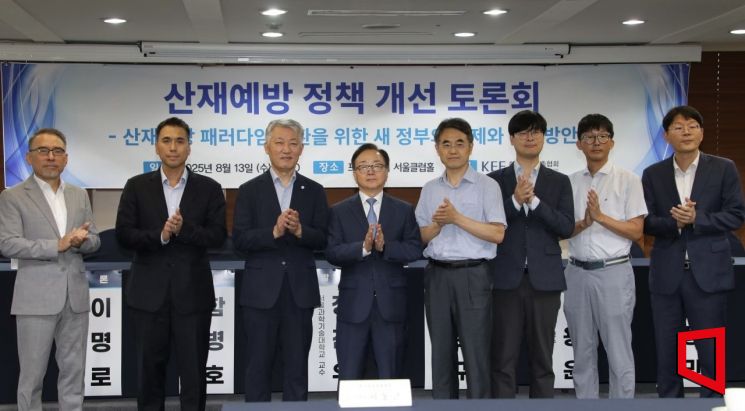 At the 'Industrial Accident Prevention Policy Improvement Forum' hosted by the Korea Employers Federation on the 13th, participants are taking a commemorative photo. From the left: Byungho Ham, Professor at Korea National University of Transportation; Sangmin Kim, Lawyer at Bae, Kim & Lee LLC; Seonggyu Kang, Professor at Gachon University Gil Medical Center; Donggeun Lee, Executive Vice President of the Korea Employers Federation; Jinwoo Jeong, Professor in the Department of Safety Engineering at Seoul National University of Science and Technology; Yongyun Seo, Professor in the Department of Industrial Systems Engineering at Dongguk University; Sooyoung Choi, Research Fellow at Korea Construction Industry Research Institute; Wootak Lim, Director of Safety and Health Headquarters at the Korea Employers Federation. Photo by Korea Employers Federation
Yongyun Seo, Professor in the Department of Industrial Systems Engineering at Dongguk University, also pointed out, "Given the reality that small and medium-sized enterprises are struggling to survive, there are structural limitations to relying solely on government regulation for effective industrial accident prevention. Instead of focusing on sanctions or punishment, it is necessary to reignite the spark of safety management by providing greater rewards and incentives."
Professor Seo suggested, "It is urgent to establish an inter-ministerial control tower to enhance the effectiveness of support for occupational safety and health activities in small and medium-sized enterprises and to provide meaningful compensation. In addition, the enactment of a new 'Industrial Accident Prevention Support and Market Promotion Act' should be considered to ensure the stable development of professional personnel training, safety technology research and development, and the activation of private specialized institutions."
Donggeun Lee, Executive Vice President of the Korea Employers Federation, stated, "Advanced countries in safety have recognized that a policy of severe punishment and uniform regulation alone has limitations in reducing serious accidents. Accordingly, labor, management, and government have worked together to improve safety systems so that safety can be effectively implemented at worksites," and added, "It is crucial to revise the current safety standards, which are not functioning as effective tools for accident prevention, to better reflect real-world conditions. In addition, it is an urgent priority to strengthen support for small and micro enterprises that are struggling to comply with the SAPA due to limited resources."
© The Asia Business Daily(www.asiae.co.kr). All rights reserved.
![Clutching a Stolen Dior Bag, Saying "I Hate Being Poor but Real"... The Grotesque Con of a "Human Knockoff" [Slate]](https://cwcontent.asiae.co.kr/asiaresize/183/2026021902243444107_1771435474.jpg)
















