City and SH to Initiate Bidding for Sinnae 4 and Jangji Bus Depot Projects
Leveraging Existing Structures for Both Infrastructure and Housing
Enormous Project Cost a Key Issue... Thorough Feasibility Review Needed
Seoul City is accelerating three-dimensional development projects that utilize spaces above roads and bus depots. Facing a shortage of available land, the city has identified complex construction projects that simultaneously plan and promote both infrastructure and residential complexes. However, as each project is expected to require several hundred billion won solely for construction, experts emphasize the need for a thorough review of business feasibility.
According to the maintenance industry on August 12, Seoul City and Seoul Housing & Communities Corporation (SH) are preparing to soon issue tenders for foundational construction work for the Sinnae 4 District and Jangji bus depot development projects.
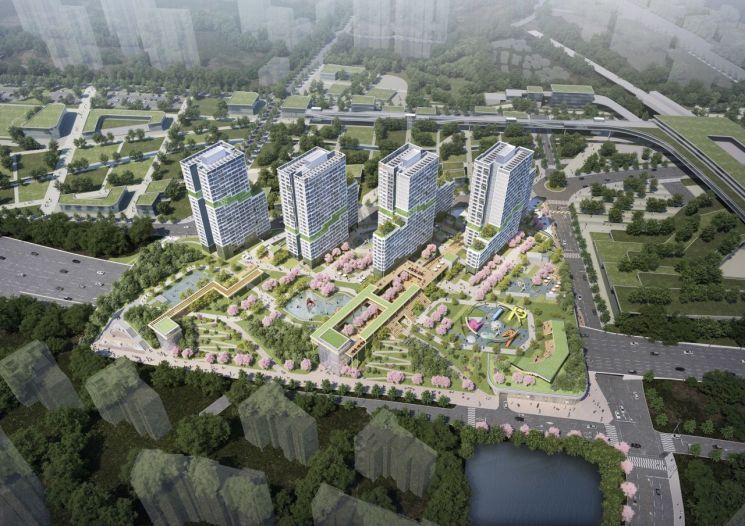 Perspective view of the three-dimensional complex development project in Sinnae 4 District, Jungnang-gu, Seoul, promoted by Seoul City and SH. Seoul City
The three-dimensional complex development project in Sinnae 4 District, Jungnang-gu, has drawn significant attention as the nation’s first “city above a road” initiative. The core of the project is to build an artificial platform of 26,000 square meters above a 300-meter stretch between Sinnae IC and Jungnang IC on the Bukbu Expressway, where a three-dimensional park and residential complexes will be constructed. The residential complex will consist of approximately 800 units. Seoul City expects that transforming the area above the Bukbu Expressway into an artificial park will help connect previously divided neighborhoods that were separated by the road.
The Jangji-dong bus depot development in Songpa-gu is a three-dimensional complex project based on modernizing the existing public bus depot. The plan is to reconstruct the current depot into a two-story, 52,102-square-meter facility and to build green spaces and community facilities such as a swimming pool in the space above. The site, currently classified as a natural green area, will be rezoned as a Type 3 general residential area, with some land allocated for rental housing. Around 660 units are planned for university students, young professionals, newlyweds, and housing-vulnerable groups.
Given that both projects require coordination between infrastructure and residential construction, Seoul City is considering introducing an integrated project management (PM) system for construction management.
The main issue is the enormous project cost. According to the confirmed implementation plans, construction costs are set at 406.3 billion won for Sinnae 4 District and 322.8 billion won for the Jangji bus depot. If compensation costs are included, the total project cost for Sinnae 4 District is expected to reach 600 billion won. Since the development will retain existing functions, the project period is likely to be extended, which could further increase costs. In particular, for the residential complexes, the key question is whether there will be actual demand, given that they will be built above depots and roads.
For Sinnae 4 District, the plan is to begin construction as early as within this year, following the issuance of construction tenders. For the Jangji bus depot, work will start with the construction of a temporary depot, followed by the main depot construction next year. The target completion dates are December 2029 for Sinnae 4 District and June 2029 for the Jangji bus depot.
The maintenance industry believes that the success or failure of the Sinnae 4 District and Jangji bus depot projects will influence other three-dimensional complex developments. Currently, Seoul City is pursuing similar projects for the Dong Seoul Bus Terminal, Suseo Train Depot, and Yeonhui Rainwater Pumping Station. Additional plans include covering the Gyeongbu Expressway and Dongbu Expressway or undergrounding railways to develop the surface areas. An industry official commented, “Since there are few precedents for three-dimensional complex construction in Korea, even slight delays could lead to increased construction costs, reduced business viability, and loss of demand. Active support from administrative agencies is essential for these projects to become successful development cases.”
© The Asia Business Daily(www.asiae.co.kr). All rights reserved.
![Clutching a Stolen Dior Bag, Saying "I Hate Being Poor but Real"... The Grotesque Con of a "Human Knockoff" [Slate]](https://cwcontent.asiae.co.kr/asiaresize/183/2026021902243444107_1771435474.jpg)















