Kang Hwansuk Attends Korea-U.S. Defense Technology Security Cooperation Meeting
Government Proposes Shipbuilding Cooperation to Revitalize U.S. Industry
Discussions Held on Easing Regulations and Expanding MRO Collaboration
Korean Shipbuilders Secure Multiple U.S. Navy Maintenance Contracts
Both Sides Agree to Establish Working Group for Detailed Consultations
The South Korean government has proposed a plan to support the revitalization of the U.S. shipbuilding industry and the enhancement of U.S. naval power by producing and supplying blocks for naval vessels domestically. The government also envisions promoting the construction of U.S. naval ships at Korean shipyards through future amendments to relevant laws.
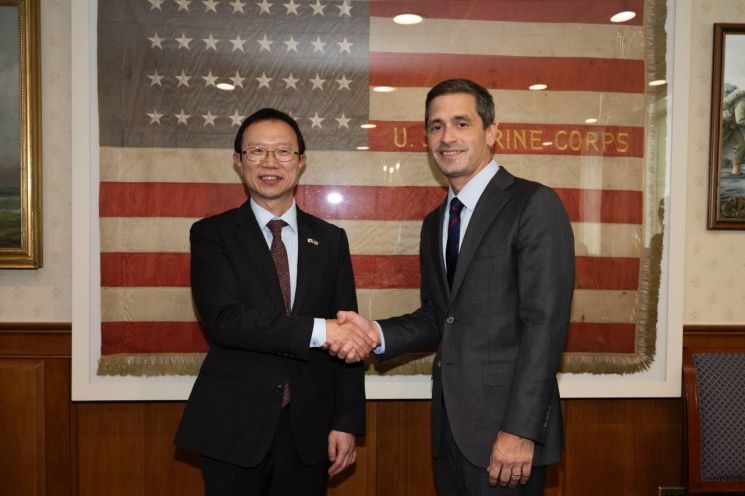 Kang Hwansuk, Deputy Administrator of the Defense Acquisition Program Administration, and Jason Porter, Deputy Assistant Secretary of the U.S. Navy for Research, Development, and Acquisition, are taking a commemorative photo after a meeting at the U.S. Navy Department in Washington D.C. Photo by Defense Acquisition Program Administration
The South Korean government has pledged support for the revival of the U.S. shipbuilding industry?specifically, the "Make American Shipbuilding Great Again (MASGA)" project?as a bargaining chip in tariff negotiations with the United States. As a result, the importance of shipbuilding cooperation between South Korea and the U.S. is coming to the fore.
According to the Defense Acquisition Program Administration (DAPA) on August 8, Kang Hwansuk, Deputy Administrator of DAPA, visited the U.S. Navy Department and met with Jason Porter, Deputy Assistant Secretary of the U.S. Navy for Research, Development, and Acquisition. During the 10th Korea-U.S. Defense Technology Security Cooperation Meeting (DTSCM), the two sides discussed practical cooperation measures in the construction, maintenance, repair, and overhaul (MRO) of naval vessels. At this meeting, DAPA explained cooperation models in which the Korean shipbuilding industry would contribute to the maintenance and development of U.S. naval power by producing and supplying block modules for naval vessels, with final assembly taking place at local U.S. shipyards.
In addition, both sides agreed on the need to ease regulations, such as amending the Byrnes-Tollefson Act?which restricts the construction of U.S. Navy vessels to U.S. shipyards only?in order to expand cooperation in shipbuilding and MRO. They also decided to establish a working group for detailed consultations between the two countries.
So far, Korean shipbuilders have won a total of four U.S. Navy MRO contracts. Hanwha Ocean secured MRO projects for the U.S. Navy’s logistics support ship "USNS Wally Schirra" in August 2024, the oiler "USNS Yukon" in November 2024, and the supply ship "USNS Charles Drew" in July 2025. On August 5, after the conclusion of the Korea-U.S. tariff negotiations, HD Hyundai Heavy Industries won its first contract to maintain the U.S. Navy’s cargo supply ship "USNS Alan Shepard."
DAPA also hosted the DTSCM to promote mutual understanding of each country's technology protection and export control policies in line with expanded defense industry cooperation, and discussed future directions. In particular, the DTSCM Terms of Reference (TOR) were updated to reflect the latest defense technology, security, and information policies. Kang Hwansuk and Michael Laychak, Director of the Defense Technology Security Administration (DTSA) at the U.S. Department of Defense, served as co-chairs of the DTSCM.
During the meeting, Kang Hwansuk emphasized that "Korea, as a steadfast ally of the United States, is the optimal partner for shipbuilding cooperation," and proposed, "Let us work closely together with Korean shipyards, which possess world-class naval vessel construction technology and are capable of building all types of ships under any cooperation model."
© The Asia Business Daily(www.asiae.co.kr). All rights reserved.
![Clutching a Stolen Dior Bag, Saying "I Hate Being Poor but Real"... The Grotesque Con of a "Human Knockoff" [Slate]](https://cwcontent.asiae.co.kr/asiaresize/183/2026021902243444107_1771435474.jpg)















