Mobile Carriers and Government Agencies Hold Voice Phishing Response Meeting
Damage in First Half Reaches 640 Billion Won, Up 98%
"Urgent Need for Prevention and Data Utilization"
Sharing AI-Based Detection and Blocking Technologies for Entire Call Process
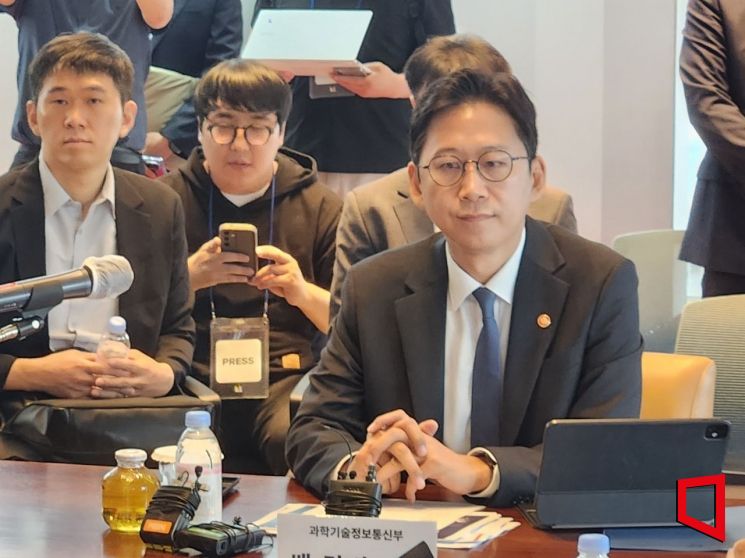
"I also received a text message saying 'You have illegally dumped trash' and asking me to click a link, and I was really confused. Such a small beginning can lead to major damage." (Baek Kyunghoon, Minister of Science and ICT)
On August 8, Baek Kyunghoon, Minister of Science and ICT, made these remarks at the "AI-based Voice Phishing Response On-site Meeting" held at the KT headquarters in Gwanghwamun, Seoul, highlighting that anyone in the country could become a victim. He said, "In this era of AI transformation, voice phishing is also evolving with AI," and stressed, "We must not stop at short-term countermeasures but establish fundamental prevention strategies."
Minister Baek presented statistics showing a sharp increase in voice phishing damage in the first half of this year. He stated, "In the first half of 2025, there were about 12,000 cases, up 23% from the same period last year, and the amount of damage reached approximately 640 billion won, a staggering 98% increase." He emphasized, "We must be even more alert and prepared for this issue. In particular, it is urgent to focus on prevention in advance."
This meeting was organized to advance countermeasures against voice phishing in the telecommunications sector and to strengthen public-private cooperation. Attendees included representatives from the Ministry of Science and ICT, the three major mobile carriers?KT, SK Telecom, and LG Uplus?as well as the Personal Information Protection Commission, the National Forensic Service, the Institute of Information & Communications Technology Planning & Evaluation, and the Korea Internet & Security Agency.
KT has commercialized a real-time call-based voice phishing detection service with triple blocking functions?context detection, speaker recognition, and deep voice detection?since July 30. By utilizing actual voice phishing call data held by the National Forensic Service, KT has improved detection accuracy and aims for a detection rate of over 95% and prevention of 200 billion won in damages this year.
SK Telecom operates a call blocking system based on police report history and plans to introduce a deep voice detection service to identify AI-manipulated voices. LG Uplus provides real-time call warnings and deepfake voice detection through its on-device service app "ixi-O," and has converted around 1,800 stores nationwide into security specialist hubs.
Minister Baek also emphasized the importance of data sharing and utilization. He said, "To maximize the effectiveness of AI-based voice phishing prevention, it is most important to establish a data foundation," and added, "We will work with relevant ministries to remove barriers to data usage." He continued, "Today's discussion should not end with responding to current issues; next year, we will hold a session to review how much the number of cases and amount of damages have actually decreased."
© The Asia Business Daily(www.asiae.co.kr). All rights reserved.
![Clutching a Stolen Dior Bag, Saying "I Hate Being Poor but Real"... The Grotesque Con of a "Human Knockoff" [Slate]](https://cwcontent.asiae.co.kr/asiaresize/183/2026021902243444107_1771435474.jpg)















